The Big Picture
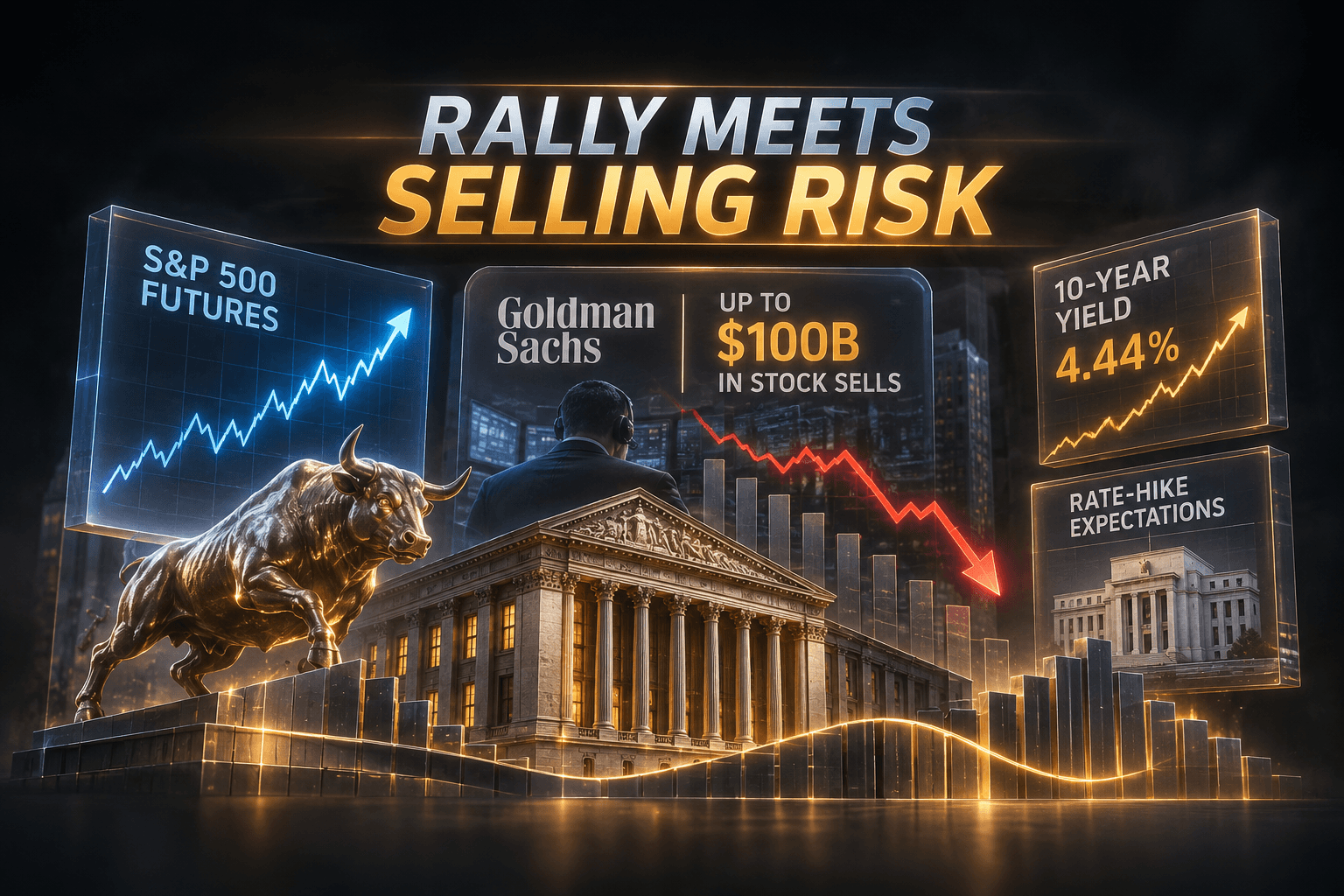
A premarket rally is colliding with a warning that as much as $100 billion in automated stock selling may still be ahead, leaving finance investors to weigh improving near-term sentiment against a potentially large technical headwind. Goldman Sachs traders say trend-following funds have one more significant bout of selling left this year, while Friday’s market snapshot shows major U.S. index futures sharply higher.
For banks and advisory firms, the backdrop matters: market direction, interest-rate expectations and investor risk appetite can all influence activity and valuations. But the reports offer mixed signals, not a clear sector-wide catalyst. How should you read a rally when systematic selling and rate concerns remain in view? With selectivity and attention to the data, especially because U.S. markets close early at 1 p.m. ET today.
Market Highlights
The premarket numbers point to a strong bounce after a mixed Wednesday session. The snapshot cited by Benzinga showed Dow futures up 1.30%, S&P 500 futures up 2.00%, Nasdaq 100 futures up 2.84% and Russell 2000 futures up 1.50%. SPY was up 1.98% at $730.97, while QQQ rose 2.83% to $651.90.
- Goldman Sachs traders flagged a possible $100 billion wave of selling by trend-following funds, a technical risk that could complicate the rally.
- The 10-year Treasury yield was reported at 4.922%, and the two-year yield at 4.695%. Markets were pricing a 98.8% likelihood of a Federal Reserve rate hike at its December meeting, according to CME FedWatch figures cited in the report.
- Friday’s U.S. session is shortened, with the market scheduled to close at 1 p.m. ET. October trade-balance and inventory data were due at 8:30 a.m. ET.
Rates are central to the finance-sector read-through. Higher yields can support some lending economics, but rapid rate increases can also raise funding and credit concerns. The available reports don’t provide bank-specific yield sensitivity or updated credit figures, so the yield moves are context rather than a direct forecast for financial-company results.
Key Developments
Moelis draws dividend-focused attention as selling risk builds
A Seeking Alpha article titled “Moelis & Company: Attractively Priced Advisory For The Dividend” puts $MC in focus, but the supplied story summary contains no valuation figures, dividend details or new company announcement. The title frames the stock as an advisory business with dividend appeal; it isn’t enough on its own to establish the size of any discount or assess the sustainability of a payout.
That distinction is useful when you’re comparing a company-level thesis with a volatile market backdrop. The Goldman selling warning concerns trend-following funds across stocks, not a stated view on Moelis specifically. Investors following $MC can look for the article’s supporting numbers and company disclosures rather than treating its headline as a confirmed change in fundamentals.
Rates and positioning keep the market bounce in perspective
The index gains offer a near-term contrast to strategist Darius Dale’s defensive stance. MarketWatch reported that both of his model portfolios turned bearish earlier in the fall and that he is 100% in cash, citing concerns about an overheating economy, hot inflation and upward pressure on interest rates. His view is one strategist’s positioning, not a consensus forecast or a reported move by banks.
The same report says he sees a point when markets may begin to price an easing cycle and better conditions for risk-taking, but not yet. Meanwhile, the cited FedWatch reading points in the opposite policy direction, with markets assigning a high probability to a December hike. Those are market expectations, not a Federal Reserve decision. For your read of financial shares, the key question is whether yields and policy expectations remain elevated, or whether incoming data shifts that pricing.
Cross-sector headlines add to an uneven risk picture
The wider market report included a revised estimate of U.S. third-quarter growth at an annualized 4.3%, up from a prior estimate of 3.4%. It also highlighted inflation, rising business input costs and tariff uncertainty as concerns for margins and risk assets. The same report said SAP was reportedly planning to cut 10,000 jobs, or about 9% to 10% of its workforce, in a shift toward artificial intelligence. That is a technology-sector development, not a banking announcement, but it adds to the broader conversation about cost pressures and corporate adaptation.
Other company items included HP’s $0.83 earnings per share on $16 billion in revenue and a quarterly dividend of $0.31 per share, as well as Deere revenue of $12.12 billion and earnings of $3.89 per share. Those results may help frame wider corporate conditions, but they don’t establish a trend for banks or advisory firms. Two additional headlines, a Janus Henderson global life-sciences account commentary and a report titled “French Economy Sinks Deeper Into Gloom,” came without substantive summaries in the supplied material, so their specific market implications can’t be assessed here.
What to Watch
Today’s first check is how the market trades after the opening, given the gap between the strong futures snapshot and Goldman’s warning about possible systematic selling. The early close may also mean less time for investors to respond to fresh headlines. Watch whether trading strength holds across the major indexes and whether financial shares participate, rather than assuming a broad futures gain automatically signals improving bank fundamentals.
Next, monitor the October trade balance and inventory releases, along with Treasury yields and market-implied Fed expectations. These indicators can shape views about economic demand, inflation and the policy path, but one report alone won’t settle those questions. You’ll also want to distinguish data from forecasts: the 98.8% hike probability is a pricing measure, not a promise of what the Fed will do.
For finance-specific follow-through, look for verifiable Moelis disclosures or detailed dividend and valuation figures, as the headline alone leaves key questions open. Across markets, the reported French economic gloom and technology layoffs are reminders to watch for signs of weaker demand or cost pressure, while recognizing that the supplied stories don’t quantify direct effects on U.S. banks.
Bottom Line
- Premarket gains are substantial, but Goldman’s reported $100 billion trend-fund selling risk could make the session volatile.
- Treasury yields near 4.9% and strong market pricing for a December rate hike keep policy uncertainty in focus.
- The Moelis dividend article presents a positive framing, but the available summary includes no figures to test that thesis.
- Use today’s economic releases and the market’s response as context, not as a standalone signal about bank earnings or valuations.
- This summary is for informational purposes only and is not personalized investment advice.
FAQ
Q: Why are finance stocks facing mixed signals today? A: Premarket indexes are higher, while potential automated selling, elevated yields and rate-hike expectations remain risks.
Q: What does the $100 billion selling warning mean? A: Goldman Sachs traders reportedly see a possible large sale by trend-following funds, which could add pressure to stocks; it is a market-flow warning, not a prediction for a specific company.
Q: Did Moelis announce a new dividend or financial results? A: No such announcement appears in the supplied summary. The Seeking Alpha headline discusses the stock’s dividend appeal, but the details weren’t provided.