The Big Picture
Friday’s market rout has left finance and banking investors with a risk-management question for the week ahead: how much more stress can markets absorb if technology shares keep sliding and interest-rate uncertainty builds? U.S. markets were closed Saturday, November 21, so the sharp price moves in the reports occurred on Friday, November 20, the last trading day.
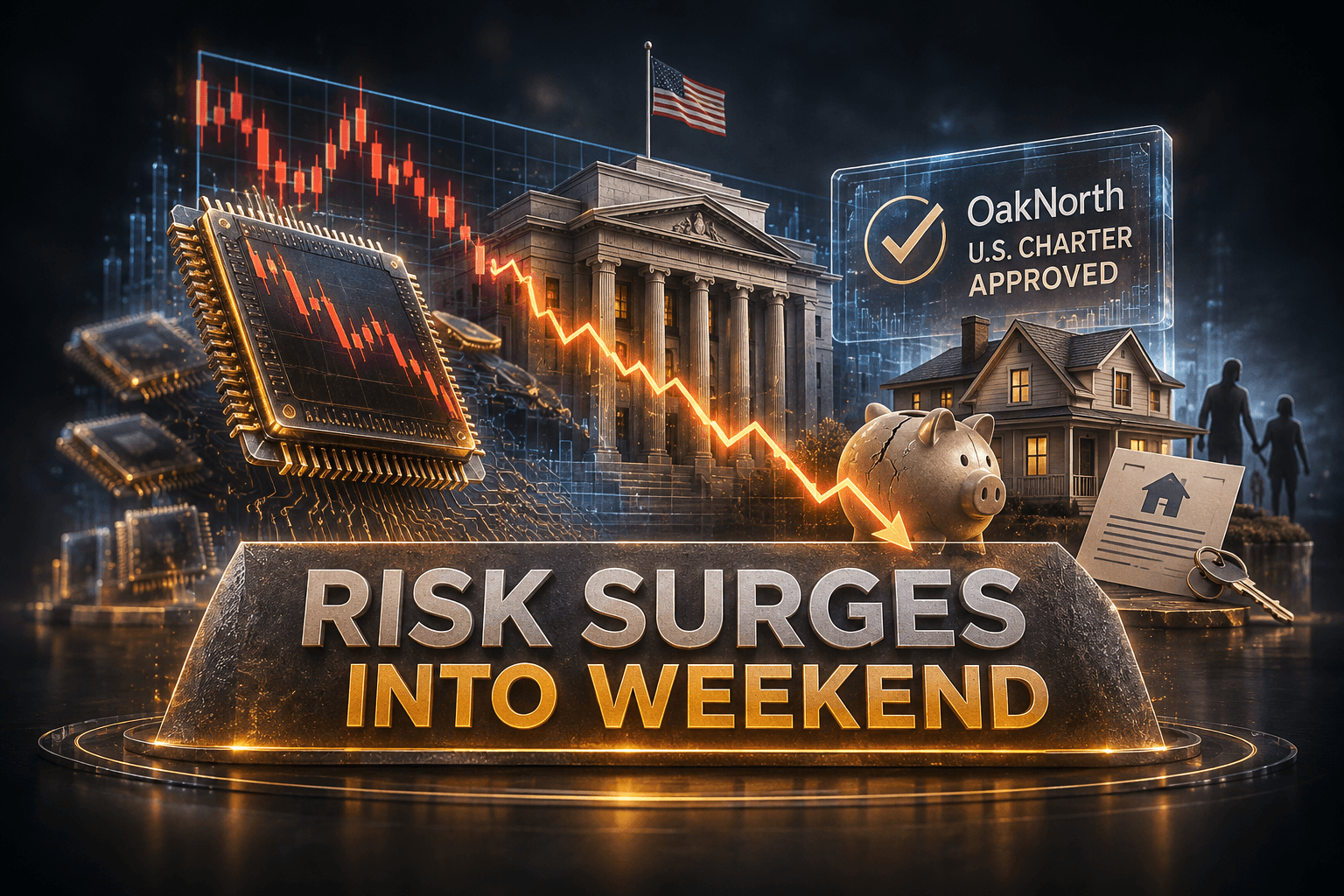
The S&P 500 entered correction territory, semiconductor stocks neared their worst two-month stretch since 2001, and the VIX climbed. There was a notable positive for the banking sector: regulators approved OakNorth’s U.S. national banking charter after a 20-month wait. Still, the wider picture is cautious, and you’ll want to separate that company-specific opening from broad market risk.
Market Highlights
Friday’s selling was concentrated in AI and chip-related stocks, but the weakness spread across major indexes and other assets. The reports also point to a difficult environment for growth companies, as investors weigh trade restrictions and the possibility of tighter monetary policy.
- The S&P 500 fell 3.2% Friday to 6,949, leaving it 11% below its October 6 record. Its seven-session slide totaled 8.7%.
- The Nasdaq 100 dropped 4.7% Friday and 9.5% for the week, turning negative for 2026. The Dow lost 1.5% Friday.
- The iShares Semiconductor ETF (SOXX) fell 10% Friday and was down 34.5% since September 30. Nvidia (NVDA) dropped 13% to $127, while SanDisk (SNDK), Micron Technology (MU), Advanced Micro Devices (AMD), $AVGO and $TSM also posted steep Friday declines.
- The VIX rose 20% to 34. Bitcoin was reported at $58,400 Friday after a 5.6% decline. A separate 21Shares outlook forecasts a possible new Bitcoin high in 2027, but that is a firm’s prediction, not a market certainty.
- Anthropic ($ANT) slid sharply after its IPO pop, falling from a $115.10 high to an $83.15 low in two sessions, according to Benzinga. Its $83 IPO price is a reference level, not a guaranteed floor.
For your Monday market view, the key context is that Friday’s declines came alongside new concerns about chip exports to China and a possible Federal Reserve rate increase. Those pressures can matter well beyond semiconductor companies, particularly if investors reduce exposure to growth assets more broadly.
Key Developments
Chip selloff combines market stress with policy risk
The semiconductor decline was the clearest corporate-market story in the weekend reports. $NVDA lost 22% for the week, according to Benzinga, after a seven-week losing streak began to take shape across the AI trade. The broader $SOXX decline of 34.5% since September 30 is close to the 35.1% two-month fall that ended in September 2001, the only worse period cited in the report.
The pressure is not only about valuations or demand. New U.S. rules restrict Chinese chip designers from buying chips at 16 nanometers or more advanced without a license. Taiwan Semiconductor reportedly suspended orders from some Chinese customers, while Nvidia halted H200 shipments to China and removed the country from its forecast. Regulatory scrutiny and export limits add uncertainty to revenue expectations, even after Nvidia reported an earnings beat and strong guidance.
Anthropic faces a test of IPO support and AI confidence
Anthropic’s fast reversal offers a second example of how quickly sentiment has changed. The company’s shares fell from their first-day high toward the $83 offering price as the wider market weakened. The report says underwriters exercised their 147 million-share overallotment option, closing the short position that can otherwise create an incentive to buy shares below the offer price. That makes the IPO price a psychological marker rather than a confirmed support level.
Supply is another issue for the coming weeks. Up to 303 million shares are scheduled to become eligible for sale on December 15, while the report estimates Nasdaq-100 tracker buying at $4.6 billion. Those figures don’t establish that shareholders will sell or that index-related demand will be insufficient, but they do make the share-flow calendar important. Investors will also be watching the company’s growth against rising infrastructure costs and its reported swing from operating profit in Q2 to an operating loss in Q3.
OakNorth approval contrasts with household and housing strain
The Federal Reserve and Office of the Comptroller of the Currency approved OakNorth’s U.S. license, making the British lender the first foreign digital bank to receive a U.S. national banking charter, according to Banking Dive. The approval gives OakNorth a path to operate under a national charter after its 20-month wait. It’s a meaningful regulatory milestone, although the supplied report doesn’t provide financial projections or details that would quantify the business impact.
Consumer-facing reports point to pressures outside bank earnings. MarketWatch described a housing market with record-low sales, record-high home prices and mortgage rates around 7%, where the limited pool of buyers is gaining negotiating leverage. Separate personal-finance stories raise concerns about possible financial exploitation of an ailing parent and whether a household facing job loss and chronic illness should draw on a 401(k). They underline the importance of fraud safeguards and careful financial planning, but the headlines alone don’t provide enough information to assess individual circumstances.
Other weekend commentary included Seeking Alpha pieces on crisis dynamics, Lithium Americas’ capital spending and Nvidia. Their supplied summaries contain no supporting detail, so no specific conclusions about those companies can be drawn here.
What to Watch
U.S. markets reopen Monday, November 23. Watch whether Friday’s volatility carries into the new week, especially across chipmakers and other AI-linked companies. Anthropic’s listed options are scheduled to begin trading Monday, which could add hedging activity around a newly listed stock, although the direction and scale of that effect are uncertain.
The Federal Reserve’s December 8-9 meeting is another key catalyst. One Fed governor has discussed the possibility of a half-point hike, while another official has expressed concern about inflation’s path. That is not a policy decision, but it raises the stakes for incoming inflation data and interest-rate expectations. Dell reports earnings Tuesday after the close, with investors focused on AI-server demand and the effects of export restrictions.
For financial companies, monitor whether market stress affects funding conditions, loan demand or credit quality, while keeping OakNorth’s charter approval in perspective as a company-specific development. In housing, mortgage rates and sales activity will help show whether buyers’ stronger negotiating position persists. What would change the outlook? A sustained easing in volatility, clearer trade rules or evidence that rate pressures are cooling would offer a different set of signals, but none is assured.
Bottom Line
- Friday’s correction and semiconductor losses set a cautious backdrop for the next U.S. session on Monday, November 23.
- Trade restrictions and rate uncertainty are adding risks to the AI and chip investment story, even where company results have been strong.
- Anthropic’s IPO price is not a guaranteed floor; upcoming share unlocks and market conditions are important factors to monitor.
- OakNorth’s U.S. charter approval is a positive regulatory development, but its financial impact is not quantified in the report.
- Housing and household-finance headlines point to consumer strain. Treat forecasts and individual finance scenarios as informational, not personalized advice.
FAQ
Q: Were U.S. stock markets open on November 21? A: No. Saturday markets were closed; the price moves discussed here refer to Friday, November 20.
Q: What was the main banking-sector development? A: OakNorth received Fed and OCC approval for a U.S. national banking charter after a 20-month wait.
Q: What should investors watch when markets reopen? A: Monitor volatility, chip-sector reaction to export rules, Anthropic’s trading and the week’s economic and company news.