The Big Picture
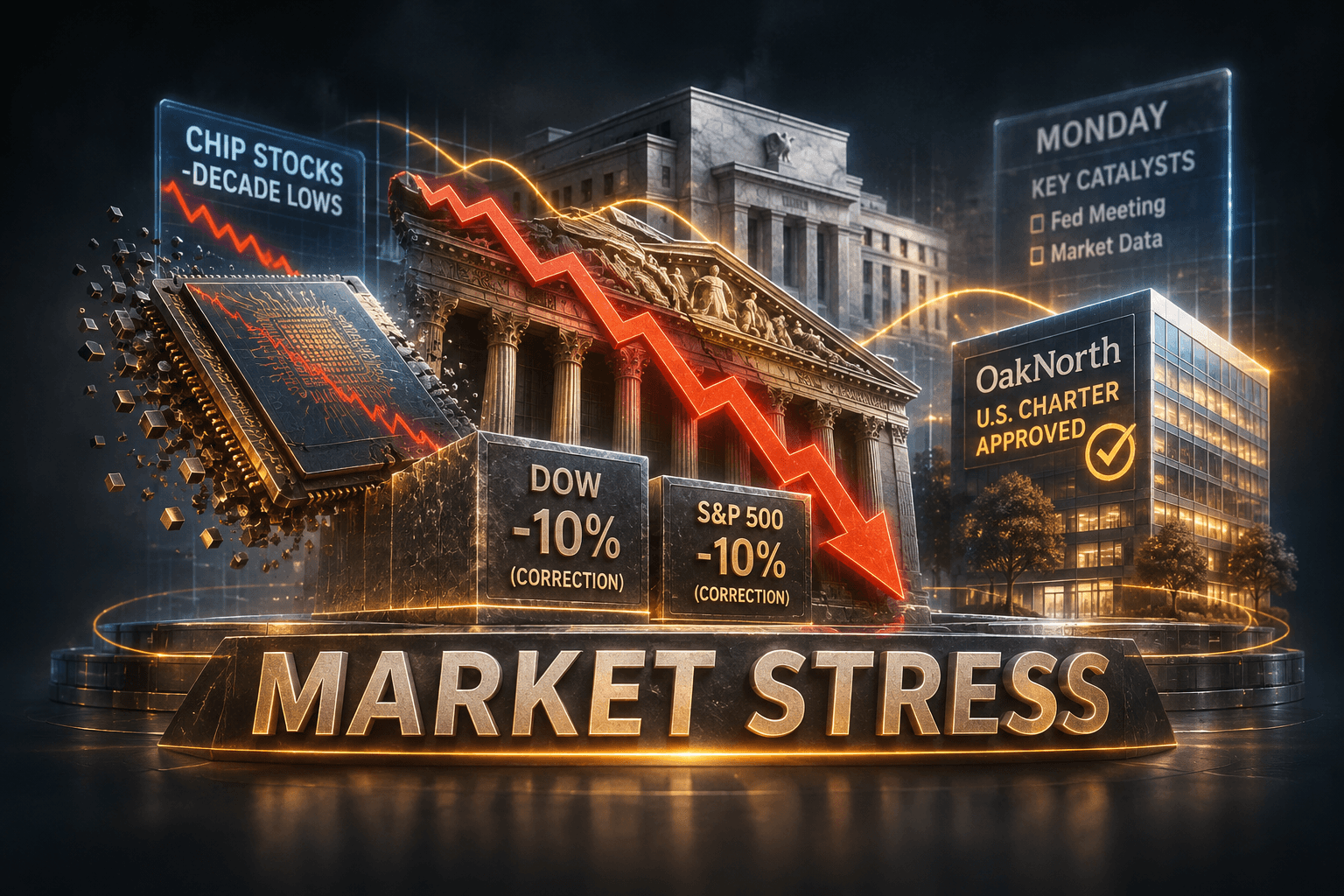
Investors head into the weekend facing a sharp reversal in risk appetite: the Dow and S&P 500 entered correction territory Friday, while semiconductor shares posted one of their worst stretches in decades. U.S. markets are closed Saturday, November 21, and will next trade Monday, November 23, so Friday’s closing levels are the reference point for the opening week ahead.
The selloff reaches beyond technology, with all 11 S&P 500 sectors down more than 1% for the week, according to MarketWatch. Against that backdrop, OakNorth’s approval for a U.S. national banking charter is a notable positive, but it doesn’t offset the broader risk signals. What should you watch first when trading resumes?
Market Highlights
Friday’s declines were especially severe in the AI and semiconductor trade. MarketWatch reported that the Nasdaq Composite had its worst week since 2020, while the S&P 500 and Dow entered correction territory. The Nasdaq 100 fell 9.5% for the week and turned negative for 2026.
- The iShares Semiconductor ETF, iShares Semiconductor ETF (SOXX), fell about 10% Friday and was down roughly 34.5% since September 30, nearing a two-month decline last seen in 2001.
- Nvidia, Nvidia (NVDA), dropped 13% Friday to $127, according to Benzinga, and was down 22% for the week. The report also cited export restrictions and regulatory scrutiny as sources of uncertainty.
- Anthropic, $ANT, fell from a $115.10 high on November 19 to an $83.15 low on November 20, a 27% decline from peak to trough in two sessions.
Stress also showed up outside equities. The VIX rose to 34, gold fell 3%, and Bitcoin was reported at $58,400 after a 5.6% decline. Those Friday figures highlight the breadth of the risk-off move, though crypto continues to trade over the weekend.
In banking, the key company-specific news was positive: U.K. lender OakNorth received approval from the Federal Reserve and the Office of the Comptroller of the Currency for a U.S. national banking charter after a 20-month process. Banking Dive described it as the first foreign digital bank to receive a U.S. national charter.
Key Developments
AI and chip stocks face a test of confidence
The market’s sharp pullback has put the AI trade under pressure even after Nvidia reported results above estimates and gave revenue guidance of $130 billion, according to Benzinga. The concern described in the coverage has shifted from demand alone to whether companies can sell and ship advanced chips amid U.S. restrictions on exports to China. Taiwan Semiconductor, Taiwan Semiconductor Manufacturing (TSM), reportedly suspended orders from some Chinese customers, while Nvidia halted H200 shipments to China and removed the country from its forecast.
Anthropic’s rapid post-IPO reversal adds another layer of uncertainty. The company reported $16.96 billion in third-quarter revenue in its amended filing, up 1,127% year over year, but also swung to a $567 million operating loss as compute and infrastructure costs reached 58% of revenue. The IPO’s $83 price is a reference point, not a guaranteed floor: underwriters fully exercised their over-allotment option, and up to 303 million additional shares are scheduled to become eligible for sale on December 15. For you, the tension is clear: exceptional reported growth sits alongside rising costs, a heavy supply calendar, and a weaker market.
Policy and rates add to the uncertainty
U.S. export rules and political scrutiny are central risks for chipmakers, while Federal Reserve comments have raised the prospect of tighter policy. Benzinga reported that Fed Governor Christopher Waller discussed the possibility of a half-point rate increase at the December 8-9 meeting, citing inflation concerns. That is a reported possibility, not a confirmed decision.
Higher rates can weigh on long-duration growth valuations, while export limits may affect companies’ access to customers and markets. The 10-year Treasury yield fell to 4.92% from 5.14% a week earlier as bonds drew safe-haven buying, but that move hasn’t removed uncertainty about the Fed’s next step. Seeking Alpha’s article warning that the market decline could worsen is an opinion piece, yet its caution aligns with the breadth of Friday’s losses.
OakNorth gains a U.S. foothold
OakNorth’s regulatory approval is a constructive development for the lender and a notable milestone for foreign digital banks seeking access to the U.S. banking system. The Fed and OCC green light follows a 20-month wait and clears a regulatory hurdle; it doesn’t, by itself, establish how quickly the company will build its U.S. business or what financial contribution it will make.
Other headlines reinforce that company-specific risks remain important in this volatile market. Seeking Alpha described AST SpaceMobile’s launch problems as more likely to cause delays than complete breakdowns, keeping execution and timing in focus. A separate report said technology outages are prompting some Americans to stockpile cash and supplies, a sign of household concern rather than evidence of a measured change in bank deposits.
What to Watch
When U.S. markets reopen Monday, November 23, monitor whether Friday’s broad selling continues or stabilizes. For chip and AI-linked companies, the key issues include the practical impact of export restrictions, regulatory developments, and whether investors continue to reduce exposure. Anthropic’s listed options are also set to begin trading Monday, a new source of activity that could add to volatility in the recently listed stock.
Dell, Dell Technologies (DELL), is scheduled to report quarterly earnings Tuesday after the close, with Benzinga citing consensus estimates of $6.55 per share on $49.48 billion in revenue. Investors will be watching not only reported demand for AI servers but also the potential effect of trade restrictions on shipments. Further out, watch the Fed’s December 8-9 meeting and Anthropic’s December 15 lockup release. For OakNorth, the practical next question is how it plans to proceed under its newly approved U.S. charter.
Bottom Line
- Friday’s correction-level losses and the semiconductor rout leave the near-term market backdrop fragile.
- Chip investors face both market risk and policy uncertainty around advanced exports to China.
- Anthropic’s rapid revenue growth is counterbalanced by a quarterly operating loss and upcoming potential share supply.
- OakNorth’s charter approval is a positive banking-sector milestone, though execution and business impact remain to be seen.
FAQ
Q: Are U.S. stock markets open today, Saturday, November 21? A: No. U.S. stock markets are closed Saturday and are scheduled to reopen Monday, November 23.
Q: Why are semiconductor stocks under pressure? A: Reports point to a broad AI-trade selloff, U.S. export restrictions affecting China sales, and increased scrutiny of major chip companies.
Q: What does OakNorth’s U.S. charter approval mean? A: The Fed and OCC have approved its application for a national banking charter, clearing a major regulatory hurdle. The approval alone doesn’t determine the timing or financial results of its U.S. expansion.
This article is for informational purposes only and isn’t personalized investment advice.