The Big Picture
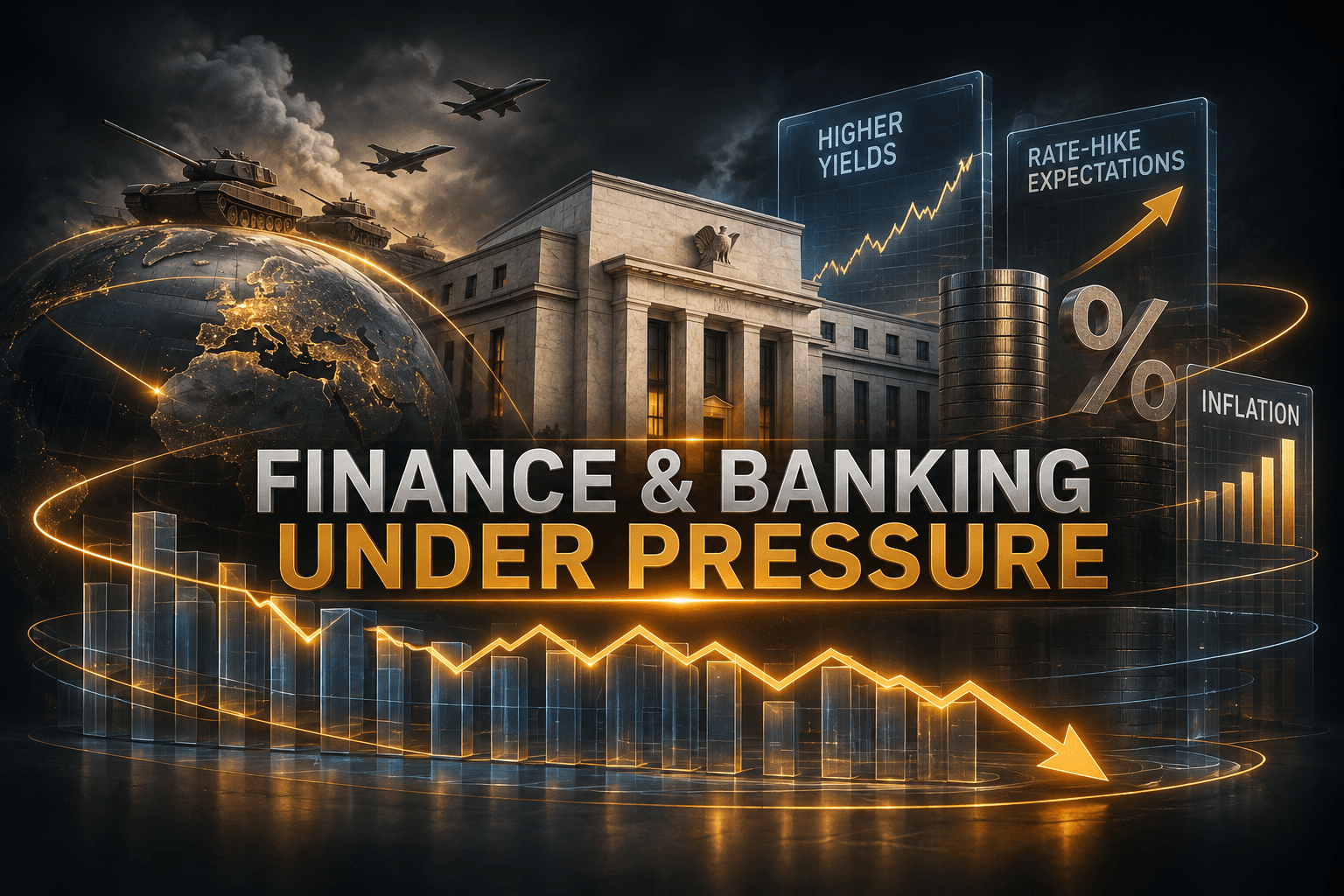
Rising yields and geopolitical uncertainty are setting a defensive tone for financial markets this Friday, with major U.S. stock indexes lower in premarket trading after a steep selloff on Thursday. For finance and banking investors, the key concern is the combination of persistent inflation worries and tighter monetary policy expectations, conditions that can affect borrowing costs, credit demand and asset valuations.
The news feed offers few direct developments at major banks, so today’s sector read-through is largely about the broader market environment. With the 10-year Treasury yield reported at 5.00% and markets pricing in a 98.7% chance of a December Fed rate hike, what should you watch first? Fed officials’ comments and fresh consumer sentiment data may help investors gauge whether rate pressure is building further.
Market Highlights
U.S. stock futures pointed lower Friday after Thursday’s losses. In premarket trading, the S&P 500-tracking SPY was down 0.27% at $713.96, while the Nasdaq 100-tracking QQQ fell 1.03% to $638.37. The Dow-tracking DIA was nearly unchanged, up 0.01% at $490.83.
- Thursday’s session saw the Dow fall 2.19% to 49,097.06, the S&P 500 decline 2.02% to 7,175.83, and the Nasdaq Composite lose 2.25% to 23,879.20.
- The 10-year Treasury yield was reported at 5.00%, while the two-year yield stood at 4.71%. Higher yields can raise funding costs for financial institutions and make interest-sensitive assets less attractive.
- Crude oil futures were lower in early trading, with WTI down 0.99% near $81.62 a barrel. The dollar index was down 0.09%, and Bitcoin slipped 0.17% to $61,806.
Geopolitical risk is part of the market’s calculation. A vessel off Oman was reportedly struck by an unknown projectile while transiting the Strait of Hormuz, and uncertainty around a U.S. decision on Iran is keeping attention on energy supply and global risk appetite. For financial stocks, any sustained market volatility could influence trading activity, investor confidence and expectations for economic growth.
Key Developments
Rates and inflation concerns take center stage
Wells Fargo Investment Institute global macro analyst Jennifer Timmerman warned that markets may be underestimating accumulated risks, including firming inflation, potentially higher rates, elevated valuations and unresolved geopolitical tensions. She estimated that the 12-month Consumer Price Index rate accelerated to 4.0% in October, a level well above the Federal Reserve’s target.
That assessment matters for banks and other lenders because rates shape funding costs, loan pricing and the value of securities held on balance sheets. The effect isn’t uniform: higher rates can support lending yields, but they can also pressure borrowers and increase sensitivity to credit deterioration. You’ll want to distinguish between short-term market moves and evidence of a lasting change in inflation or lending conditions.
Market stress spreads beyond the finance sector
Several individual-company stories underline the unsettled backdrop, though they aren’t direct banking updates. A Seeking Alpha article argues that Alphabet’s roughly 30% retreat from its all-time high may not be enough, while another cites slower Q3 ANKTIVA momentum and cash burn at ImmunityBio in reaffirming a negative view. These are analyst opinions, not company-wide sector data, and the supplied reports don’t provide enough detail to assess their underlying forecasts.
Intuit fell 10.56% in premarket trading despite reporting first-quarter fiscal 2027 adjusted earnings of $2.91 per share on $4.35 billion in revenue, both above estimates according to Benzinga. The reaction is a reminder that a reported earnings beat doesn’t always settle questions about expectations or valuation. Meanwhile, a Seeking Alpha transcript of a PDI Gold shareholder and analyst call was listed, but no summary was provided, so its implications can’t be determined from the available information.
Bitcoin’s risk profile debate offers a counterpoint
Grayscale says Bitcoin’s annualized realized volatility has fallen from peaks near 200% in its early years to roughly 43% to 45% today, citing institutional participation, deeper liquidity and regulated investment products as contributing factors. Its report also argues that Bitcoin has become less tied to the performance of the broader crypto market, while noting that it has still experienced seven drawdowns exceeding 50% since 2011.
This is a more constructive long-term risk narrative, but it doesn’t remove the possibility of sharp losses or make digital assets a direct substitute for bank stocks. Grayscale’s conclusions and referenced portfolio back tests should be treated as analysis, not a guarantee of future returns. The contrast with Friday’s broader risk-off tone highlights why you should consider both asset-specific claims and the market conditions around them.
What to Watch
Fed Governor Christopher Waller is scheduled to speak at 8:25 a.m. ET, and November’s final University of Michigan consumer survey data is due by 10:00 a.m. Fed Governor Lisa Cook is scheduled to speak at 12:15 p.m., with another Waller appearance expected later at the National College Fed Challenge finals. Their remarks and the consumer survey may shape expectations for rates and household confidence.
For finance and banking, monitor Treasury yields, credit-sensitive market moves and any indication that inflation expectations are becoming less anchored. Geopolitical headlines around Iran and the Strait of Hormuz also warrant attention, given possible effects on oil prices and market volatility. The supplied stories don’t identify a bank earnings release or sector-specific policy announcement for today, so the broader rate and risk environment is the main near-term barometer.
Bottom Line
- The sector’s near-term backdrop is cautious, with elevated yields, inflation concerns and geopolitical uncertainty weighing on risk appetite.
- There is little direct bank news in the supplied reports; market rates and credit conditions provide the most relevant read-through.
- Fed speeches and the University of Michigan survey are today’s key scheduled catalysts.
- Thursday’s steep declines and Friday’s weaker futures point to continued volatility, but past streaks alone don’t establish what comes next.
- Bitcoin volatility data offer a more positive long-term narrative, but the report’s analysis doesn’t eliminate significant downside risk.
FAQ
Q: Why does the 10-year Treasury yield matter to banks? A: It influences market borrowing costs and the value of some fixed-income assets, while also providing context for loan pricing and economic expectations.
Q: What economic updates are scheduled today? A: The final November University of Michigan consumer survey is due by 10:00 a.m. ET, alongside scheduled remarks from Fed officials Christopher Waller and Lisa Cook.
Q: Is there a clear bank-specific catalyst in the news? A: No major bank earnings or policy announcement is identified in the supplied stories. Interest rates, inflation expectations and broader market volatility are the main sector-related issues to track.
This article is for informational purposes only and is not personalized investment advice or a recommendation to buy, sell or hold any security.