The Big Picture
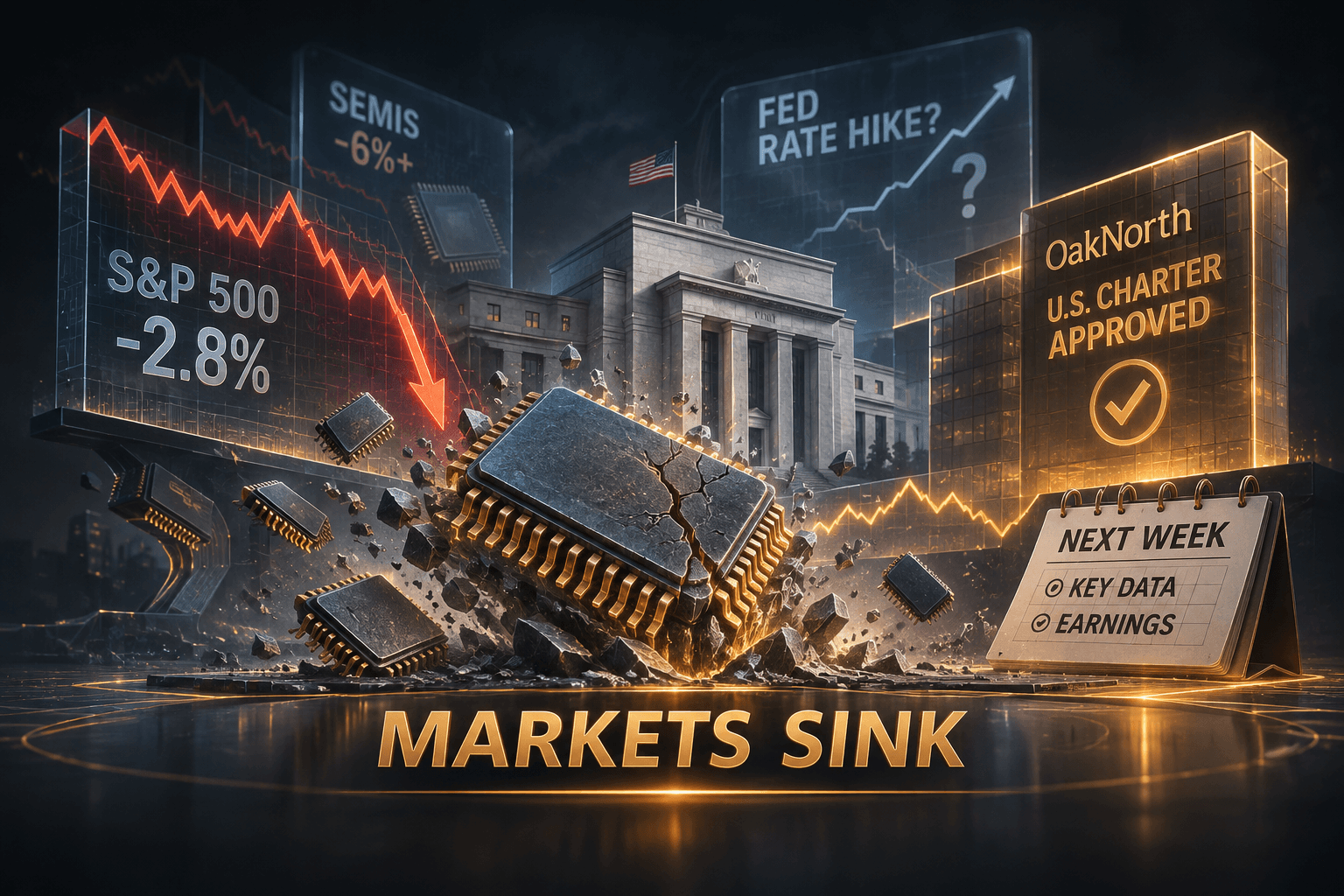
A semiconductor selloff of historic proportions pushed U.S. markets deeper into a risk-off stretch Friday, with the S&P 500 entering correction territory and volatility jumping. For finance and banking investors, the day's mix matters beyond technology: falling Treasury yields, inflation worries, and the prospect of tighter Fed policy are reshaping the backdrop for lending, markets, and risk appetite.
There was one notable bright spot in banking: regulators approved OakNorth's U.S. national banking charter after a 20-month wait. But a single expansion milestone can't erase the wider uncertainty. What should you take from a session where one bank gained a regulatory foothold as markets sold off? For now, the signals favor caution and close attention to the next policy and earnings catalysts.
Market Highlights
Technology and chip shares led losses, with the iShares Semiconductor ETF, iShares Semiconductor ETF (SOXX), down about 10% Friday and roughly 34.5% to 34.6% since the end of September, depending on the report. That puts its two-month decline near the worst recorded since 2001. Nvidia (NVDA) fell 13% to around $127, its lowest level since May 2025, while the latest weekly decline extended its losing streak to seven weeks.
The retreat reached beyond chips. The S&P 500 lost 3.2% to 6,949, its seventh consecutive decline, and finished about 11% below its October record. The Nasdaq 100 dropped 4.7% Friday and 9.5% for the week, while the VIX rose 20% to 34, a sign of sharply increased demand for protection against market swings.
- SanDisk (SNDK) fell 16%, Micron Technology (MU) dropped 14%, Advanced Micro Devices (AMD) lost 12.7%, and $AVGO declined 12.4% Friday.
- The 10-year Treasury yield fell to 4.92% from 5.14% a week earlier; the two-year yield eased to 4.62%.
- OakNorth received approval from the Federal Reserve and the Office of the Comptroller of the Currency for a U.S. national banking charter, becoming the first foreign digital bank to receive one.
Lower Treasury yields may offer some relief to borrowers, but the move came amid a broad flight from risk and does not resolve inflation concerns. The Michigan consumer sentiment index rose to 51.5 in November from 48.0, while year-ahead inflation expectations declined to 3.7% from 4.7%. Those figures provide a mixed counterpoint to Fed officials' warnings about persistent price pressures.
Key Developments
Chip losses raise questions about policy and AI demand
The week's steep semiconductor losses reflect more than concerns about sales. Reports pointed to U.S. restrictions on advanced chip exports to China, Nvidia's decision to halt H200 shipments to the country, and investigations and political scrutiny involving the company. Nvidia beat earnings estimates and guided to $130 billion in revenue, yet shares fell as investors focused on whether policy will constrain where products can be sold.
That shift from demand to access is relevant to financial markets because the AI trade has supported a substantial portion of recent equity momentum. If investors reassess the growth assumptions behind major chip and infrastructure companies, volatility may spill into indexes, funds, and portfolios beyond the technology sector. You may want to track company disclosures and policy developments separately: strong demand forecasts don't by themselves settle questions about export permissions or future spending.
Fed signals keep rate risk in view
Federal Reserve Governor Christopher Waller said inflation was moving in the wrong direction and raised the possibility that policymakers might need a half-point increase at the December 8-9 meeting. Chicago Fed President Austan Goolsbee also said he did not see the economy on a clear path back to 2% inflation. These comments are not a policy decision, but they keep the possibility of another hike in focus.
For banks, higher rates can support lending returns in some circumstances, but they can also raise funding costs and weigh on borrowers. Falling Treasury yields on Friday suggest investors were also seeking safety. The balance between inflation, policy, and credit conditions will matter more than any one day's move, particularly if market stress persists.
OakNorth approval marks a banking expansion milestone
OakNorth's approval from the Fed and OCC clears a significant regulatory hurdle after a 20-month process. The British lender is set to become the first foreign digital bank with a U.S. national banking charter, a notable development for international banks seeking broader access to the American market.
The approval is a positive company and industry milestone, but it isn't evidence of immediate revenue growth or a wider easing of regulatory standards. For investors, the next questions are how OakNorth establishes its U.S. operations and what competition and compliance costs it faces. The day's other company headlines included a Builders FirstSource investor day transcript and Riley Exploration Permian's reported 20% oil-production growth in the third quarter, but the supplied reports provide limited detail to assess their financial implications.
What to Watch
The next market session is Monday, with investors likely to continue assessing whether the selloff is concentrated in AI-related stocks or spreading further. Watch for changes in Treasury yields, volatility, and market breadth, along with any new guidance on chip exports or regulatory inquiries. A continued decline in yields could signal defensive positioning, while a rebound alone would not confirm that the underlying risks have passed.
Tuesday brings Dell Technologies' quarterly results after the close. The reported consensus is $6.55 per share on $49.48 billion in revenue, and options pricing implies a potential move of about 15.7%. Your focus can include not just server orders, but management's commentary on delivery constraints, customer demand, and the effect of trade rules on shipments. The Fed's December meeting remains another key catalyst, with inflation data and official remarks shaping expectations beforehand.
Risks include persistent inflation, a possible rate increase, tighter export rules, and a further reassessment of AI infrastructure spending. Banking investors can also monitor credit quality and funding costs if economic conditions weaken. Selectivity and attention to reported facts matter in a market where sharp moves can quickly change the outlook.
Bottom Line
- Semiconductor stocks and major indexes fell sharply, with the S&P 500 entering correction territory and the VIX reaching 34.
- Restrictions on advanced chip exports and scrutiny of Nvidia add policy uncertainty to concerns about the AI trade.
- Fed officials' inflation warnings keep a possible December rate hike in play, though no decision has been made.
- OakNorth's U.S. charter approval is a meaningful banking milestone, but its business impact will depend on execution.
- Next week's Dell results and incoming inflation and policy signals could influence whether volatility persists.
FAQ
Q: Why did semiconductor stocks fall so sharply? A: Reports cited export restrictions, political and regulatory scrutiny, and investor concerns about the outlook for AI-related spending and chip shipments.
Q: What does OakNorth's charter approval mean? A: It gives the British lender U.S. national banking charter approval from the Fed and OCC, a notable step toward operating in the U.S. market.
Q: Is the Fed certain to raise rates in December? A: No. Officials have discussed inflation risks and the possibility of a hike, but the Federal Open Market Committee has not made its decision.
This article is for informational purposes only and is not personalized investment advice or a recommendation to buy, sell, or hold any security.