The Big Picture
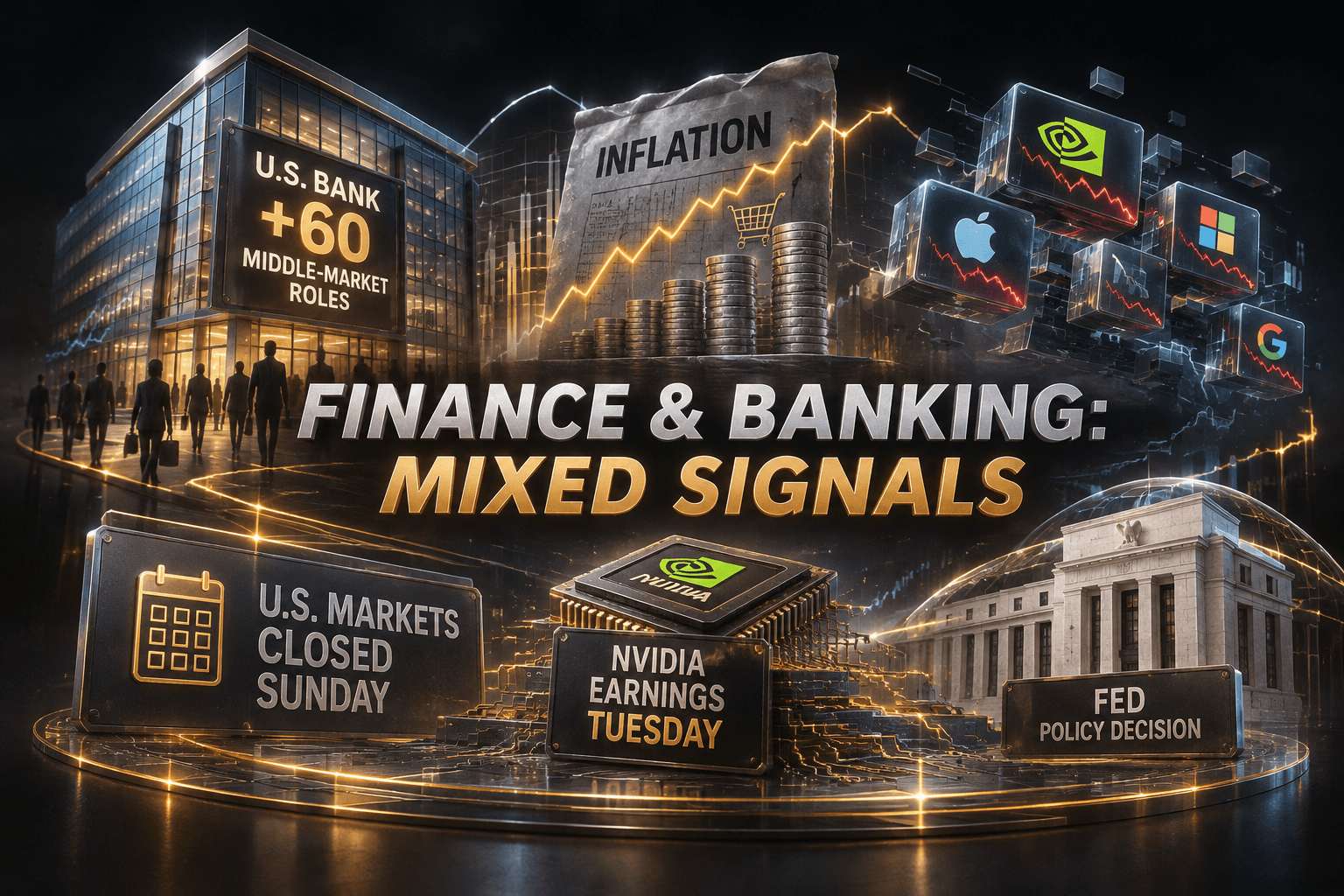
A planned expansion at U.S. Bank offers a constructive signal for business lending, but financial-sector investors face a more complicated backdrop: inflation has revived rate-hike concerns, and volatility in major technology stocks and crypto points to unsettled risk appetite. The bank plans to add 60 middle-market roles as it pursues national growth, including in Florida and Texas, where it has no branches.
U.S. stock markets are closed Sunday, November 15, so there’s no U.S. equity trading to interpret today. The next session is Monday, November 16. For your market read-through, Friday’s developments and Tuesday’s Nvidia earnings are more important than Sunday’s headlines, many of which concern companies outside finance and banking.
Market Highlights
The clearest direct banking development is U.S. Bank’s planned hiring. It signals an effort to build out middle-market business banking beyond its existing branch footprint, though the available report doesn’t provide a hiring timeline, investment cost, or expected revenue contribution. Those details will matter in assessing whether expansion can translate into meaningful growth.
- U.S. Bank plans to add 60 middle-market roles, with some positions in Florida and Texas, according to Banking Dive.
- On Friday, November 13, Nvidia was reported near $162, down about 13% for the week, while AMD gained about 18% and Broadcom nearly 18% over the same period.
- Bitcoin fell below $70,000 during the reported trading week. An analyst cited in Benzinga warned that a decline toward $40,000 is possible, but this is a scenario, not an established forecast.
- October U.S. consumer prices rose 0.4%, above the 0.3% forecast cited in the report. The 10-year Treasury yield reached 5.15% on Friday.
Those figures show why financial companies aren’t operating in isolation. Higher yields can influence funding costs and loan demand, while persistent inflation may affect expectations for Fed policy. What should you watch first? The next inflation and policy signals, alongside whether the reported stock-market moves hold when trading resumes.
Key Developments
U.S. Bank builds its middle-market reach
U.S. Bank’s addition of 60 roles supports its stated national business-banking ambitions. Hiring in states where the Minneapolis-based lender lacks branches suggests it may be pursuing clients through a broader coverage model, though the report doesn’t specify how the new positions will be organized or what products they’ll focus on.
For investors, the announcement is a growth initiative to monitor rather than proof of near-term earnings acceleration. Hiring can strengthen client relationships and expand reach, but its financial impact depends on execution, costs, and the business those teams bring in. You’ll want to look for further disclosures on the rollout and whether the bank reports measurable middle-market growth.
Inflation and yields complicate the banking outlook
Friday’s market recap described above-forecast October consumer inflation and a rise in Treasury yields. It also reported that Federal Reserve Governor Christopher Waller said a 50-basis-point hike should be considered at the December meeting. Bank of America, meanwhile, was reported to expect three consecutive rate increases. These are views and statements reported in the coverage, not a confirmed Fed decision.
Higher rates can support some lending revenue, but they can also raise deposit and wholesale funding costs, weigh on borrowers, and affect credit quality. The balance differs by institution, so a higher yield alone doesn’t determine whether a bank benefits. For your assessment, follow the Fed’s communications and banks’ updates on deposit costs, loan demand, and credit provisions.
Market rotation, crypto risk, and limited company details
Friday’s recap reported a sharp rotation among chip stocks following news that Nvidia founder Jensen Huang had resigned as CEO and board member, with CFO Colette Kress serving as interim CEO. Nvidia was reported down about 13% for the week, while AMD and Broadcom gained nearly 18% each. AMD also fell about 9% on Friday, illustrating how quickly a strong weekly move can reverse. Nvidia’s fiscal third-quarter results are scheduled for Tuesday, November 17, according to the report.
That story is relevant to financial markets through risk appetite, but it isn’t a banking earnings update. Crypto coverage adds another caution: Bitcoin was reported down 16% year to date, and one analyst outlined a possible further decline. A separate Sunday headline argues Celsius’s multi-brand growth story remains intact; other headlines cite an Edison International rating downgrade and an ArriVent BioPharma upgrade. Because the supplied summaries contain no supporting details for those three items, they don’t establish specific financial or company fundamentals. SpaceX’s rocket milestone and MarketWatch personal-finance columns are also outside the direct banking outlook.
What to Watch
Monday’s return to trading will show whether Friday’s broad market gains and volatile stock rotations persist. Pay attention to financial shares and Treasury yields, but avoid treating a single move as evidence of a lasting change in bank fundamentals. The key near-term event is Nvidia’s Tuesday report and its first earnings call without Huang, which may influence risk sentiment beyond the semiconductor sector.
For banking, watch for further details about U.S. Bank’s hiring plan and upcoming disclosures on loan growth, funding costs, and credit quality. For crypto, distinguish analysts’ downside scenarios from actual price levels and monitor reported ETF flows and Fed policy expectations. A hawkish shift could pressure risk assets and borrowers, while the effect on individual banks will depend on their balance sheets and customer mix.
Bottom Line
- Markets are closed Sunday; U.S. equities next trade Monday, November 16.
- U.S. Bank’s 60-role expansion is a measured growth signal, with execution and costs still to be assessed.
- Inflation and rising yields keep Fed policy and bank funding conditions in focus.
- AMD and Broadcom’s weekly gains contrasted with Nvidia’s reported losses, but Friday’s reversals underline volatility.
- Bitcoin’s possible $40,000 downside is an analyst scenario, not a certainty. Treat forecasts as risks to evaluate, not outcomes.
FAQ Section
Q: Are U.S. stock markets open on Sunday, November 15? A: No. U.S. stock markets are closed Sunday and are scheduled to reopen Monday, November 16.
Q: What is the main banking-sector development? A: U.S. Bank plans to add 60 middle-market roles as part of its national business-banking expansion.
Q: What is the next major market catalyst? A: Nvidia’s fiscal third-quarter results are scheduled for Tuesday, November 17, while investors also assess inflation and expectations for the Fed’s December meeting.
This article is for informational purposes only and isn’t personalized investment advice or a recommendation to buy, sell, or hold any security.