The Big Picture
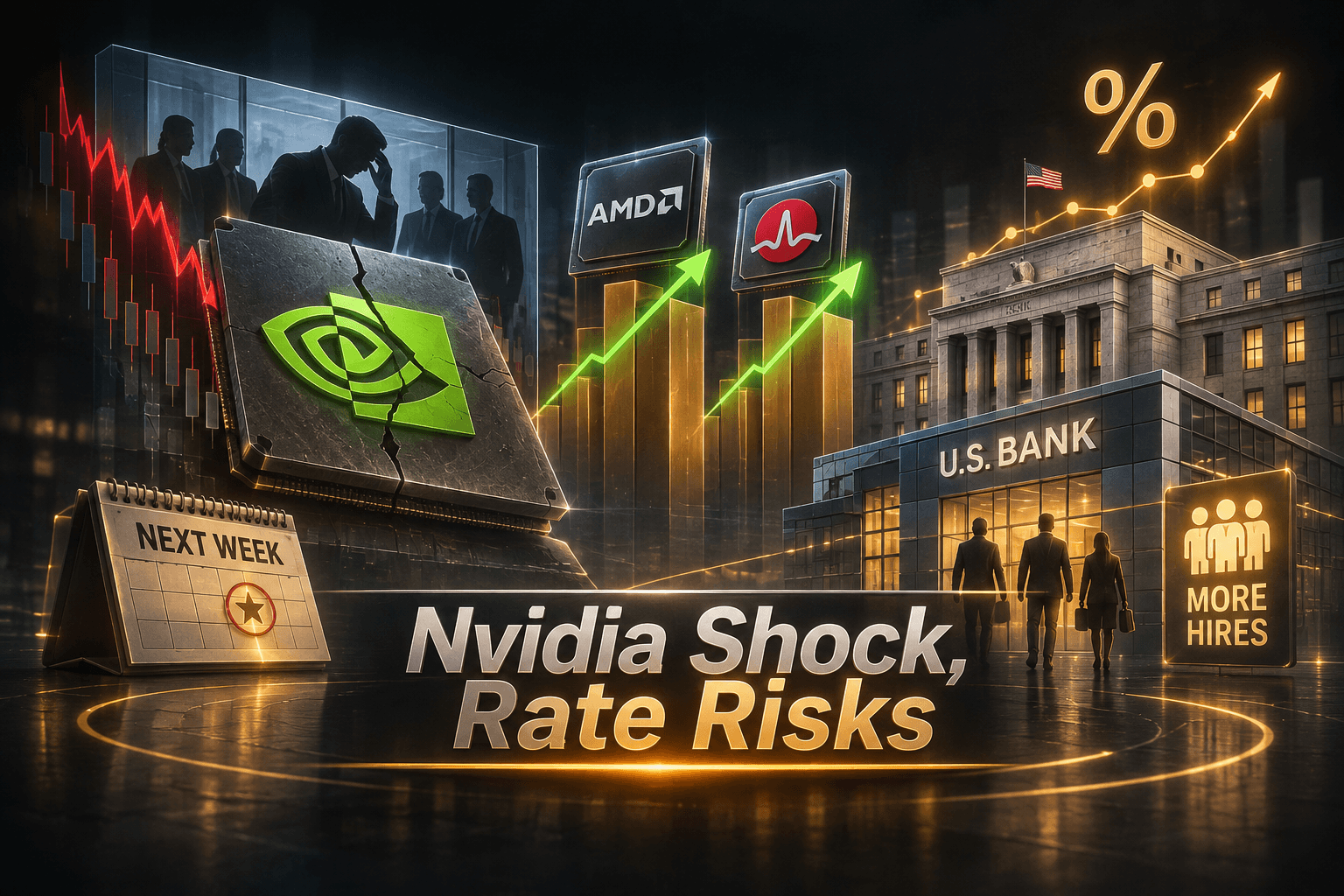
A sudden leadership change at Nvidia and a hawkish shift in rate expectations are shaping the market backdrop heading into the weekend, even as other chipmakers posted sharp weekly gains. The developments matter beyond technology: higher Treasury yields can affect bank funding and asset values, while changes in the AI trade influence broader risk appetite.
U.S. markets are closed Saturday, November 14, with the next session on Monday, November 16. The headlines point in different directions, so a selective approach and attention to company-specific catalysts may matter more than treating the week’s gains or losses as a single market signal.
Market Highlights
Friday’s close capped a volatile week in technology. Figures reported Friday afternoon showed the S&P 500 up about 2.4% for the week near 7,550 and the Nasdaq 100 up about 3.5% near 27,930, despite both indexes falling 1.3% on Friday. In semiconductors, gains were uneven and leadership shifted quickly.
- Nvidia (NVDA) traded near $162 on Friday, down about 13% from the prior week’s close of $186.64. The stock was on track for a sixth consecutive weekly decline.
- Advanced Micro Devices (AMD) gained about 18% for the week near $531, while falling about 9% on Friday. Broadcom (AVGO) rose nearly 18% for the week to about $345, then gave back roughly 5% in Friday’s session.
- The 10-year Treasury yield reached 5.15% Friday, its highest since mid-October, after October consumer prices exceeded forecasts. Bitcoin fell about 9% over the week and dropped below $70,000, according to the reports.
For banking investors, the most direct company-specific update was U.S. Bank’s plan to add 60 middle-market roles as it pursues national business-banking growth. Some positions are planned for Florida and Texas, including markets where the bank has no branches, suggesting the expansion isn’t limited to its existing branch footprint.
Key Developments
Nvidia’s succession uncertainty reshapes the chip trade
Benzinga reported that Jensen Huang resigned as Nvidia CEO and a board member Thursday after the board opened a probe related to reports that he had been targeted by a foreign intelligence effort. CFO Colette Kress was named interim CEO. Nvidia’s shares fell about 13% for the week, while investors rotated toward $AMD and $AVGO. Both stocks were among the S&P 100’s strongest performers for the week, though each fell Friday, a reminder that sharp rallies can bring volatility as well as momentum.
Questions about succession and execution are now central to the Nvidia story. HSBC downgraded the stock to Hold and cut its price target to $170 from $365, citing uncertainty until a permanent succession plan is in place. A separate report about restricted Nvidia chips in Dell-built servers also weighed on Dell Technologies (DELL), which fell more than 8% Friday. You’ll want to distinguish these reported risks from the longer-term demand outlook, which wasn’t resolved by a single week of share-price moves.
Nvidia is scheduled to report fiscal third-quarter results Tuesday, November 17, followed by its first earnings call without Huang as CEO. Reported options pricing implied a 9.1% move in the stock after results. Will the earnings and leadership update provide clarity? The response may help show whether this week’s rotation reflects changing business expectations or mainly a reassessment of leadership risk.
Inflation puts rate expectations back in focus
October consumer prices rose 0.4%, above the 0.3% forecast, while core prices increased 0.3%, versus expectations of 0.2%. Fed Governor Christopher Waller said a 50-basis-point rate increase should be considered at the December meeting. Bank of America forecast three consecutive increases in December, January and March, which would take the federal funds rate to a 4.5% to 4.75% range. Those are reported expectations, not a confirmed policy path.
Wholesale prices rose 0.3% in October, below the 0.4% forecast, but annual producer inflation reached 6.5%, its highest since November 2022. The 10-year yield’s rise is relevant to banks because rates can affect lending economics, deposit competition and securities valuations. The net effect varies by institution, so you should look for company disclosures rather than assume higher rates benefit every lender.
Bank expansion and other investor signals
U.S. Bank’s 60 planned middle-market hires point to an effort to broaden its national business-banking reach. Hiring plans are a growth signal, but the report doesn’t provide expected revenue, costs or a timeline for returns. Investors can watch for details on the markets targeted and how the bank measures progress.
Other stories offer context, but limited evidence of a sector-wide shift. A Seeking Alpha headline linked Constellation Energy’s outlook to rising power prices and Calpine synergies, without a supplied summary or figures. MarketWatch reported a list of 14 dividend stocks described by John Buckingham of Value7 Investment Partners as attractively priced for long-term growth, but did not include the names in the provided details. An Ave Maria Value Fund Q3 commentary and an article comparing an investor’s holdings with a historical pick were also listed without summaries, so no performance conclusions can be drawn from those headlines alone.
Two broader items may affect household and business sentiment. The FAA lifted a rare nationwide flight ground stop, with officials saying there was zero evidence of a cyberattack; the report said recovery could take days and that higher fuel costs may complicate rebookings. A separate MarketWatch article raised concerns about Social Security’s long-term finances and demographics. Neither item, based on the available information, establishes a direct change in bank earnings.
What to Watch
Next week brings Nvidia’s results and its first earnings call under interim leadership. Listen for updates on succession, execution and the company’s outlook, and compare those details with the sharp moves in $AMD and $AVGO. Their weekly advances don’t by themselves show that customers or revenue have shifted from Nvidia.
Rate expectations remain another key catalyst. Watch upcoming inflation and Federal Reserve communications for signs that policymakers are leaning toward, or away from, the rate increases described in market commentary. For bank stocks, monitor earnings guidance on deposit costs, loan demand and securities portfolios. U.S. Bank’s expansion plans may also draw attention to the costs and pace of building business outside established branch markets.
Bitcoin’s outlook is uncertain as well. The supplied report said it was down 16% year to date in 2026 and would need to reclaim $87,500 to finish the year higher. It also cited ETF outflows and a most-likely prediction-market range of $70,000 to $75,000. These figures are snapshots, not forecasts, and crypto trades through the weekend even while U.S. stock markets are closed.
Bottom Line
- Finance and banking signals are mixed: rate risk and Nvidia’s leadership change contrast with gains elsewhere and U.S. Bank’s hiring plans.
- U.S. markets are closed Saturday; Friday, November 13, is the latest trading reference, and the next session is Monday, November 16.
- Nvidia’s November 17 earnings and leadership update are a major near-term test for semiconductor sentiment.
- Higher yields could affect banks differently. Company-level deposit, lending and securities disclosures will be more informative than broad assumptions.
- Several investment and fund stories arrived without supporting details in the supplied summaries, so their implications remain unclear.
FAQ
Q: Are U.S. stock markets open today, November 14? A: No. Saturday markets are closed; the next U.S. trading session is Monday, November 16.
Q: What is the main upcoming catalyst for semiconductor stocks? A: Nvidia is scheduled to report fiscal third-quarter results on Tuesday, November 17, with an earnings call under interim CEO Colette Kress.
Q: Why are Treasury yields relevant to bank investors? A: Higher yields can influence funding costs, lending economics and securities valuations, but the effects vary by bank and its balance sheet.
This article is for informational purposes only and does not provide personalized investment advice or recommend any security.