The Big Picture
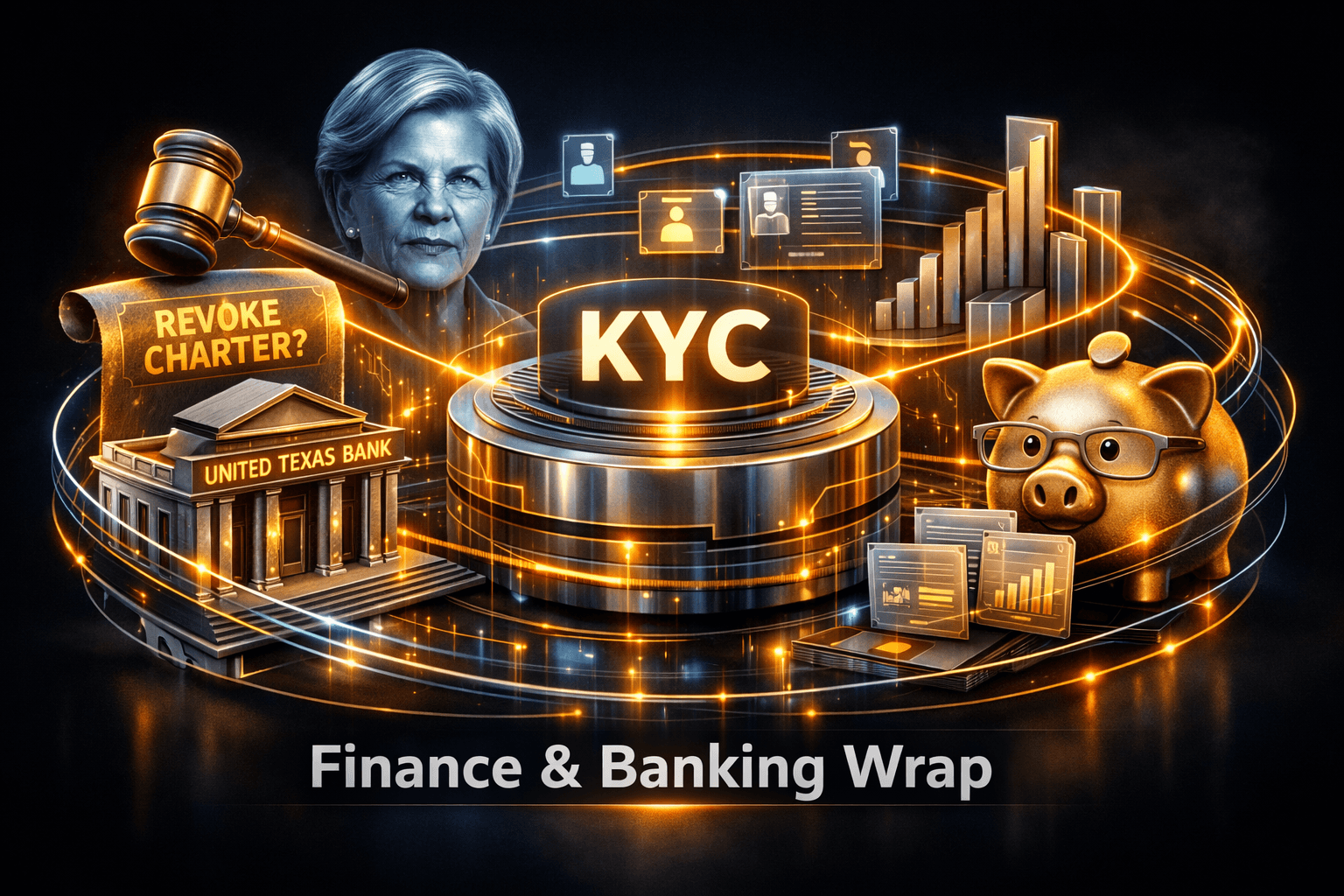
Regulatory scrutiny emerged as the most consequential finance story over the weekend, after Senator Elizabeth Warren urged the OCC and Federal Reserve to revoke United Texas Bank’s national charter conversion amid an active consent order. That development matters because it raises questions about supervision, chartering rules, and how regulators will treat troubled institutions going forward.
At the same time you saw practical advances in compliance technology and a batch of earnings transcripts that investors will parse for credit and cost signals. Markets were closed on Saturday, Aug 8, so the next trading session is Monday, Aug 10, and investors will be watching for reaction when markets reopen.
Market Highlights
Here are the quick facts and names to note heading into the long weekend.
- Regulatory pressure: Senator Warren called for revoking United Texas Bank’s charter after the bank converted from state to national oversight while under an active consent order, a rare and politically charged request.
- Fintech progress: Solo demonstrated a reusable customer-vetting tool in coordination with regulators aimed at removing duplicate know-your-customer steps for banks and fintechs.
- Earnings transcripts: Seeking Alpha published Q2 2026 call transcripts for $FPLPF (Vanquis Banking Group), $PTRRY (Prio S.A.), and $TNZ (Tenaz Energy), offering management commentary that you can use to gauge credit trends and operational priorities.
- Consumer focus: MarketWatch ran retirement pieces on Social Security claiming when you work beyond 70 and on tax timing for a $2.3 million nest egg, topics that matter to savers and bank customers planning withdrawals.
- Mergers and CX: Banking Dive highlighted that customer experience often suffers during M&A, a reminder that integration risk is also customer risk.
Key Developments
Regulatory Heat: United Texas Bank and Charter Oversight
Senator Warren’s call to revoke United Texas Bank’s charter centers on the bank’s conversion to national oversight while it remained under a consent order. Regulators rarely see calls for charter revocation, and this one shines a spotlight on oversight gaps and conversion protocols. For you, that means regulatory risk is back in focus for regional banks and any institution that recently switched charters.
KYC Reinvented: Solo’s Reusable Vetting Tool
Solo has shown a prototype for sharing customer-vetting artifacts across institutions and auditors, coordinated with regulators. If adopted at scale that model could cut onboarding duplication, lower compliance costs, and shorten customer acquisition times. Will banks and fintechs embrace shared KYC workflows, or will operational and privacy hurdles slow uptake?
Earnings Transcripts Offer Color on Credit and Costs
Seeking Alpha released Q2 call transcripts for $FPLPF, $PTRRY, and $TNZ. Transcripts are useful because they capture management tone on loan losses, underwriting, and cost control. Analysts and retail investors often mine these for forward-looking cues about credit quality at specialty lenders like $FPLPF and for margin commentary at energy names such as $TNZ.
What to Watch
As you prepare for the next trading day, keep these catalysts and risks on your radar.
- Regulatory follow-up: Watch for statements from the OCC and Federal Reserve on the United Texas Bank matter and for any enforcement or rule-change signals. Analysts note that any escalation could pressure similar regional lenders.
- KYC pilots and standards: Track Solo’s pilot outcomes and whether other banks participate. Progress could translate into measurable compliance savings over time.
- Earnings color and credit metrics: Review Q2 management remarks, especially provisions for credit losses and guidance updates in the transcripts you saw. Those items often indicate how loan books are performing.
- M&A integration risk: If you hold or follow banks involved in deals, monitor customer-experience metrics and retention data, because CX missteps can affect deposit stability and fee income.
- Retirement tax timing: For high-net-worth clients or your own planning, timing withdrawals and state moves still matter. Data suggests careful sequencing can reduce taxes, but the optimal path depends on your specific situation.
Bottom Line
- Regulatory risk is back in focus after Senator Warren’s call on United Texas Bank, and you should expect more scrutiny on charter conversions.
- Efficiency gains from reusable KYC tools could lower compliance costs, but adoption and privacy hurdles remain.
- Q2 transcripts from $FPLPF, $PTRRY, and $TNZ provide management color that you can use to assess credit trends and cost discipline.
- Customer experience during M&A is an often overlooked risk that can affect deposits and revenue, so integration plans deserve scrutiny.
- Retirement planning articles underscore that timing and state residency still matter for taxes and Social Security claiming decisions, especially if you keep working past age 70.
FAQ Section
Q: Could a charter revocation affect regional bank stocks? A: Yes, heightened enforcement or notable revocations can weigh on sentiment for peers and raise funding costs, but outcomes depend on regulatory responses and company-specific fundamentals.
Q: How will reusable KYC tools change bank costs? A: Shared customer-vetting artifacts can reduce duplication and onboarding time, which data suggests could lower compliance expense, though scaling and data governance will determine the magnitude of savings.
Q: If I work beyond age 70 will my Social Security continue to grow? A: Delayed retirement credits stop at age 70, but continued high earnings can replace lower earlier years in your earnings record, potentially raising your benefit; consult official Social Security guidance for your situation.