The Big Picture
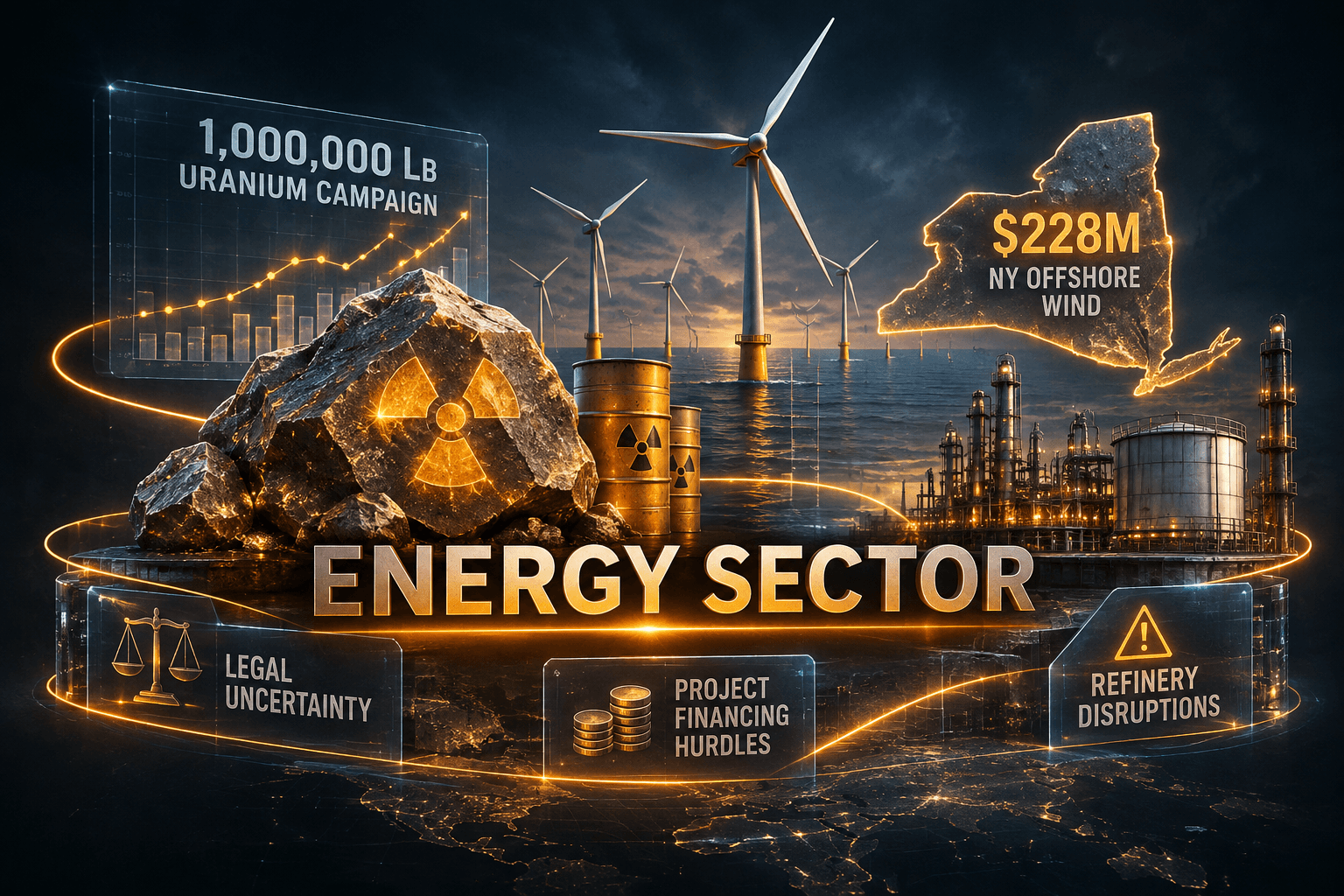
The U.S. energy story is pulling in two directions: plans to build domestic supply and clean-energy infrastructure are advancing, while legal and geopolitical risks remain hard to ignore. Energy Fuels is preparing a major uranium-processing campaign, and New York is putting more than $228 million toward port improvements intended to support offshore wind.
At the same time, a court ruling has clouded the path for U.S. deep-sea mining, and Russian refinery runs have fallen to a decades-low level, according to Rystad Energy. U.S. stock markets were closed Saturday, November 28. The next session is Monday, November 30, so these reports do not represent Saturday trading moves or price reactions.
Market Highlights
The day’s developments point to investment in energy security and infrastructure, but they don’t amount to a single sector-wide signal. You’ll find a mix of near-term operational issues and projects whose economic impact depends on future permitting, financing and execution.
- Energy Fuels plans to begin a uranium-processing campaign next month, with a goal of processing one million pounds of natural uranium concentrate by early next year.
- New York announced more than $228 million for five maritime infrastructure projects expected to support offshore-wind development and port-related jobs.
- Harbinger has secured access to $340 million through recent funding rounds, following a reported $300 million FedEx order and a U.S. military contract. Harbinger is a private company, not a publicly traded stock.
- Rystad Energy says Russian refinery runs have dropped to their lowest level in more than two decades amid Ukrainian strikes. The report provided no percentage change or specific production figure.
- Researchers modelled satellite-focused perovskite-silicon tandem cells with projected efficiencies of up to 29%. That is a simulation result, not a report of commercial operating performance.
There were no U.S. share-price changes to report while markets were closed. For publicly traded names mentioned in these stories, Energy Fuels trades as $UUUU and Tesla as Tesla (TSLA). No price or percentage move was provided in the source reports, so the next session’s response remains unknown.
Key Developments
Uranium expansion meets deep-sea mining uncertainty
Energy Fuels is shifting attention from rare earths to uranium processing as it prepares for a one-million-pound campaign. The company’s stated target and timing signal an effort to respond to anticipated demand and expand domestic processing capacity. For investors, the key measures to follow will be whether the campaign starts as planned, how much material is processed and what the company later reports about costs and sales. A production goal alone does not establish the eventual financial return.
The broader push for U.S. resource development faces a different test in deep-sea mining. The administration has auctioned federal-water mining leases, but the story reports that a court found the environmental clearance violated federal law. That ruling leaves uncertainty about whether projects can proceed, while international pressure to delay seabed mining reflects unresolved environmental concerns. The contrast is important: energy and mineral security may encourage new supply, but permitting and legal challenges can alter project timelines and economics.
Infrastructure and storage offer a longer runway
New York’s $228 million commitment is aimed at preparing five port projects for offshore-wind activity. Port upgrades can support future construction and operations, but the announcement is an infrastructure investment, not confirmation that a specific wind project has reached completion. You’ll want to distinguish public spending and preparation from the eventual build-out, which can depend on project approvals, financing and execution.
Other clean-energy reports underline the same gap between promise and deployment. A PV Magazine analysis says Romania’s solar-and-storage projects need more than ready-to-build status to secure financing: grid connections, remaining development work and revenue assumptions all matter. Research on satellite solar cells points to potential efficiencies up to 29%, while agrivoltaics paired with batteries could support energy reliability and food production in rural West Africa. Both are encouraging technical or market themes, but neither report establishes broad commercial scale.
Home resilience also featured in the news. Electrek discussed battery alternatives to Tesla’s Powerwall, including a newly added 16-kWh Briggs & Stratton SimpliPHI system, and reported on a Georgia driver’s experience with an EV during hurricane disruption. The articles highlight how outages can affect both electricity and fuel access. They don’t establish that one vehicle or home-storage option is right for every household; costs, backup needs and local power conditions matter.
Refinery disruption and electric-truck financing
Russia’s refinery slowdown is the clearest near-term supply concern in the reports. Ukrainian strikes are cited as a cause, and the decline to the lowest level in more than two decades could affect refined-product availability. The story gives no estimate of the volume lost or resulting price impact, so it’s too early to quantify consequences for global oil markets from this information alone.
Harbinger’s reported funding access is a positive financing development for the electric-truck maker, particularly alongside its FedEx order and military contract. Still, private-company funding is not equivalent to public-market performance, and orders and contracts must be fulfilled to translate into revenue. For the wider EV supply chain, the story is a sign of commercial interest, not proof that adoption or margins are accelerating across the sector.
What to Watch
When U.S. trading resumes Monday, November 30, watch for company or government updates rather than assuming Saturday’s headlines have already been priced in. Energy Fuels’ planned campaign next month is a near-term operational milestone. Its start date, processing pace and later disclosures could help investors assess whether the production target is progressing.
For offshore wind, monitor the schedule and use of New York’s port funding, as well as any project approvals or financing announcements. In deep-sea mining, further legal proceedings or agency action could clarify whether leases can move forward. On the oil side, new data on Russian refinery operations and any reported effects on product supply will help determine whether the disruption is contained or more consequential.
Across solar, storage and electric vehicles, bankability and execution remain central risks. Project revenue assumptions, grid access, equipment costs and dependable customer demand can matter as much as technical potential. What would change the picture? Verified operating results, financing commitments and clear permitting decisions would offer more concrete evidence than plans or models alone.
Bottom Line
- Energy Fuels’ one-million-pound uranium-processing target is a notable domestic-supply milestone, but execution and economics remain to be seen.
- New York’s $228 million port plan supports offshore-wind readiness, not a guarantee of completed wind projects.
- Deep-sea mining faces legal and environmental uncertainty that could affect project timing.
- Russian refinery runs are at a reported multi-decade low, but the available report doesn’t quantify market impact.
- Markets were closed Saturday. Treat these developments as information to monitor, not as evidence of a specific stock move or personalized investment advice.
FAQ
Q: Why is Energy Fuels planning a large uranium campaign? A: The company is preparing to process one million pounds of natural uranium concentrate by early next year amid anticipated demand and efforts to expand domestic supply.
Q: Did U.S. energy stocks react to these stories on Saturday? A: No. U.S. stock markets were closed Saturday, November 28. The next trading session is Monday, November 30.
Q: What is the main risk for offshore-wind and solar projects? A: Project readiness doesn’t guarantee construction or financing. Permitting, grid connections, development obligations and revenue assumptions can all affect whether projects proceed.