The Big Picture
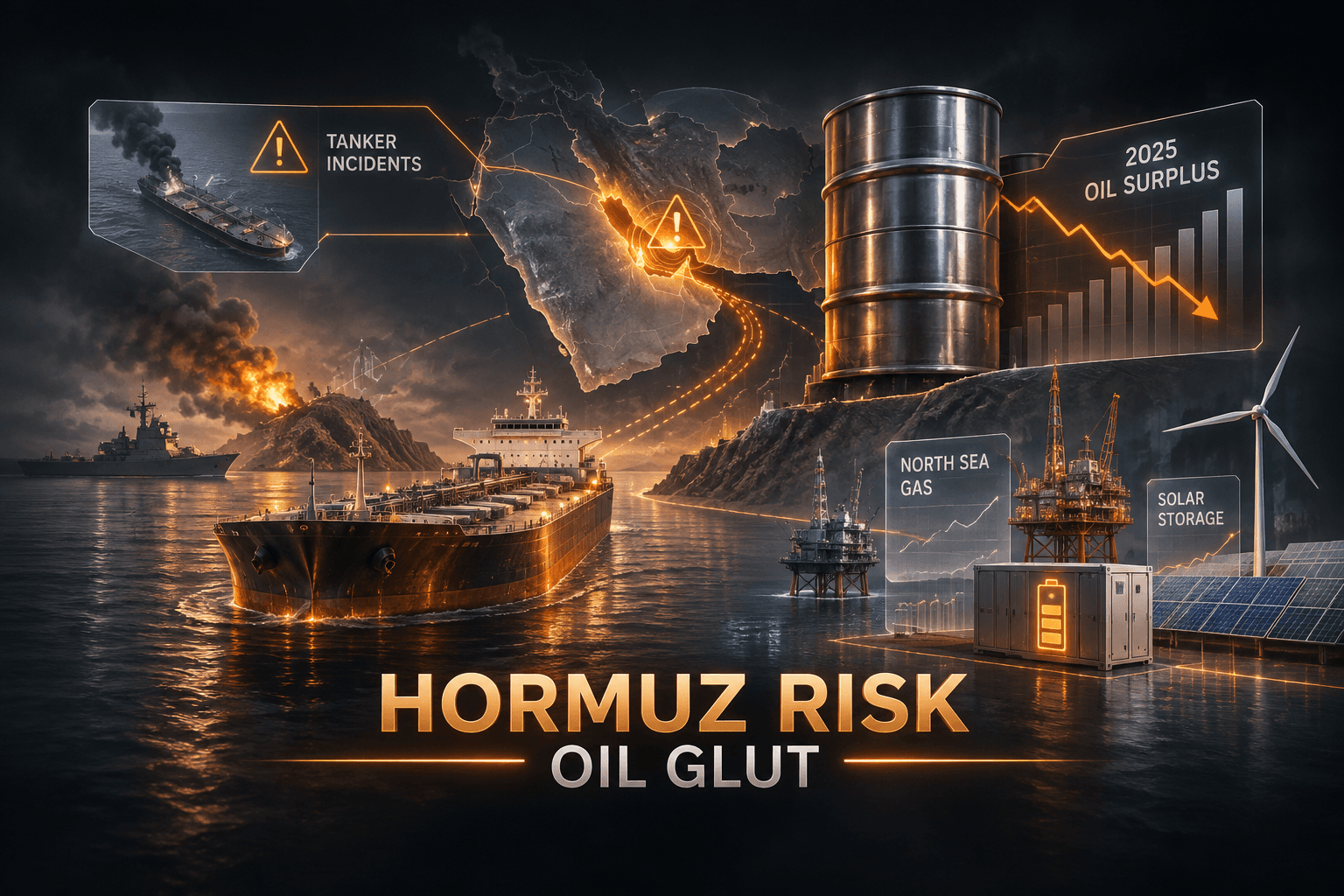
Energy investors face a sharp contrast this morning: Iranian claims of tanker explosions in the Strait of Hormuz raise concern about immediate supply disruption, while Goldman Sachs analysts warn that global oil supply could exceed demand by 2 million barrels per day in 2027. The two stories point to different time horizons, with geopolitical risks affecting near-term sentiment and the forecast surplus weighing on the longer-term outlook.
Other developments are more constructive but less directly measurable, including the start of gas deliveries from the UK’s Jackdaw field and a South Korean subsidy program for community solar storage. What should you make of the mix? For now, it calls for a selective view of headlines and careful attention to what is confirmed, rather than treating any one report as a settled market direction.
Market Highlights
Oil supply risk is the morning’s most immediate market issue. Iran’s Islamic Revolutionary Guard Corps said two tankers caught fire after hitting mines while transiting the Strait of Hormuz, and the report describes the route and alleged U.S. involvement as claims made by the IRGC. Those details have not been independently established in the information provided, so the story should be treated as a developing report, not confirmation of a broader interruption to oil flows.
At the same time, Goldman Sachs’ outlook highlights potential pressure on crude prices beyond the current geopolitical window. The bank reportedly expects Brent to average $88 per barrel in 2027 and decline toward $78 by year-end, citing a possible supply surplus and weaker Chinese transport-fuel demand. The supplied reports don’t include current oil prices, premarket moves or percentage changes for energy stocks, so there’s no verified share-price reaction to report.
- Oil outlook: Goldman Sachs sees supply exceeding demand by 2 million barrels per day in 2027, with Brent forecast at $88 per barrel on average and $78 toward year-end.
- UK gas: The Jackdaw field has begun supplying gas, with first production expected to reach British homes and businesses in time for winter.
- Solar and storage: South Korea has opened applications for storage subsidies supporting virtual power plant operators in grid-saturated areas.
- Energy technology: North Sea operators are using AI and intelligent inspection tools, while researchers say manufacturing ecosystems helped crystalline silicon outcompete thin-film solar.
- Adjacent transport news: Tesla opened invite-only Cybercab orders at $29,990, with deliveries reported for December; the story is relevant to electrification, but isn’t a direct update on energy producers.
Key Developments
Hormuz claims meet the oil-surplus forecast
The Strait of Hormuz headlines add a substantial risk factor to a market already weighing supply, demand and geopolitics. Iran also targeted Bahrain for a second time in three days, according to a separate report, while saying that a path to ending its conflict with the United States remains open. These accounts underline the uncertainty around regional security, but the supplied stories don’t establish the effect on tanker traffic or quantify any lost production.
China’s independent refiners are reportedly seeking Iraqi crude through global trading houses as a U.S. blockade constrains Iranian exports and Russian crude has become more expensive. That shift suggests refiners are adapting their sourcing, though the report gives no volumes or price terms. For you, the key distinction is between changing trade routes and an actual reduction in total supply: the former can reshape flows without necessarily negating Goldman’s projected surplus.
North Sea production and technology gain attention
Jackdaw’s start-up provides a concrete addition to UK gas supply ahead of winter, though the report doesn’t specify production volumes or the field’s expected contribution to national demand. Separately, North Sea reporting points to AI and intelligent pipeline inspection tools being used to support production. Without disclosed output or cost figures, the announcements are operational developments to monitor rather than evidence of a quantified earnings boost.
These stories share a practical theme: technology and new production can matter most when they translate into reliable output. The solar research makes a related point about industrial ecosystems. Researchers in the UK concluded that crystalline silicon’s market leadership depended not only on panel performance, but also on competitive manufacturing capacity, a lesson that may matter for perovskite and tandem technologies seeking commercial scale.
Storage policy targets grid constraints
South Korea’s new subsidy application program is aimed at energy storage operated by virtual power plant providers in areas with saturated grids, where the government is promoting solar villages. Storage can help manage the timing of renewable generation, but the announcement provides no subsidy size, project count or award schedule. Those details will determine how much near-term business the program creates for equipment providers and operators.
A preliminary investigation into Sri Lanka’s October 17 blackout identified the sudden loss of coal-fired generation as the trigger, rather than solar PV. However, investigators have not resolved the cause of the plant failure or the potential role of distributed solar. The finding challenges a simple claim that solar caused the outage, but it doesn’t settle the broader questions about grid stability and system planning.
What to Watch
First, watch for independently verified updates on the alleged Strait of Hormuz incidents, tanker movements and any operational disruption. A confirmed change in shipping or supply would matter differently from unverified claims, especially against a forecast that already assumes a large surplus next year. You can also track whether the Iran-related reports produce a measurable change in crude benchmarks, but no such price move is included in today’s source material.
Second, look for detail on Goldman’s assumptions, including the pace of supply additions and the scale of Chinese demand weakness. The 2027 outlook is a forecast, not an established outcome, and geopolitical disruptions could complicate its supply picture. For North Sea gas, Jackdaw’s production volumes and reliability will help clarify its practical contribution through winter.
Finally, follow implementation details for South Korea’s storage subsidies and further findings from Sri Lanka’s blackout investigation. Updates on AI-enabled North Sea operations and emerging solar manufacturing could also show whether technology announcements are moving toward measurable deployment. Tesla’s Cybercab orders may attract attention around the $29,990 price and December delivery target, but the report does not establish a broader impact on energy-sector earnings.
Bottom Line
- Energy headlines are mixed: geopolitical supply concerns compete with a forecast 2027 oil surplus.
- Treat the reported tanker incidents as claims pending confirmation, and distinguish shipping risks from verified production losses.
- Goldman’s Brent estimates are forward-looking projections, not current prices; the supplied news includes no verified stock moves or percentage changes.
- Jackdaw’s start-up and South Korea’s storage program are developments to monitor, but production and subsidy details remain limited.
- This summary is for informational purposes only and isn’t personalized investment advice or a recommendation to buy, sell or hold any security.
FAQ
Q: What is the main oil-market risk today? A: Iranian claims of tanker explosions in the Strait of Hormuz raise concern, but the supplied report does not independently confirm the incidents or quantify a supply disruption.
Q: Why is Goldman Sachs forecasting lower oil prices in 2027? A: The bank reportedly expects supply to exceed demand by 2 million barrels per day, citing weaker Chinese transport-fuel demand and projecting Brent at $88 per barrel on average, then $78 toward year-end.
Q: What does Jackdaw’s start-up mean for UK gas supply? A: The North Sea field has begun supplying gas, with deliveries expected to reach homes and businesses before winter, but no production volumes were provided.