The Big Picture
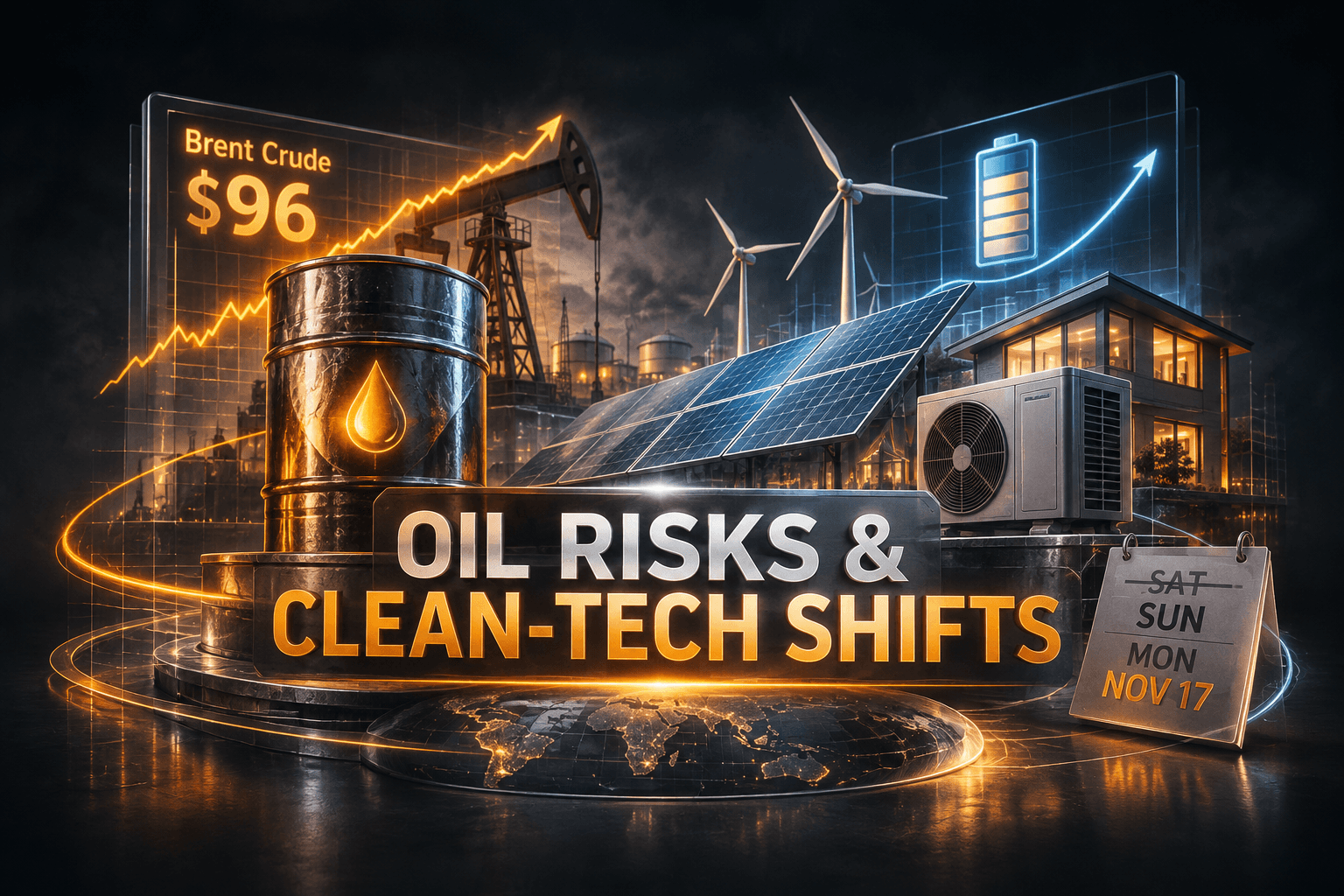
Oil-market risk and clean-energy innovation are pulling the Energy sector in different directions this weekend. Brent settled near $96 on Friday, November 13, as Middle East supply concerns offset signs of a possible surplus, while new research on solar manufacturing and battery testing points to incremental progress in the energy transition.
US stock markets are closed today, Saturday, November 14, and reopen Monday, November 16. For your watchlist, the immediate question is whether the latest Iran supply concerns or the prospect of additional crude exports from Benin will shape oil sentiment more strongly. Longer term, advances in batteries, solar production and efficient appliances could influence costs and deployment, but the reports don't establish near-term revenue or earnings impacts for publicly traded companies.
Market Highlights
Oil headlines are the most direct near-term market signal. Brent settled near $96 on Friday, with the report describing prices as fluctuating as Iran-related risks competed with indications of an oil surplus. No percentage change was provided, and the supplied stories do not report Friday share-price moves for energy companies.
- Brent: settled near $96 on Friday, November 13, amid competing supply-risk and surplus signals.
- Iran: officials are preparing a budget that could assume zero oil revenue; the country reportedly has not loaded crude since August 25.
- Benin: shipped its first crude cargo in decades from a revived oil field, returning to the group of West African oil exporters.
- Solar resource: North American irradiance was 0.8% above average in October, with a 14% surplus in the Northeast and Great Lakes, but readings were 9% below normal in the Southwest and northern Mexico.
- Electricity and transport: a Senate bill, a new Rinnai heat-pump water-heater lineup, a Volkswagen affordable-EV plan, and Tesla Cybercab orders add policy and product developments to the week's energy picture.
These figures describe resource conditions and reported developments, not stock performance. Since markets are closed, you won't see US equity trading reflect Saturday's news until the next session, and any response will depend on how investors weigh the broader outlook.
Key Developments
Iran supply risk meets a new West African cargo
Iran's budget planning reflects a severe revenue scenario. OilPrice reported that senior budget official Mohammad Ghasemi told the government to prepare for the possibility of no oil revenue. The report says Iran has loaded no crude since August 25, citing the US Treasury, and that oil held at sea outside the US blockade fell from 88.8 million barrels in mid-July to zero by mid-October. Kpler also expects revenue could stop, in part because Chinese buyers typically pay one to two months after delivery.
Against that backdrop, Brent's settlement near $96 shows how supply risks can counter surplus concerns. Benin's first crude shipment in decades adds a new source of exports, although the supplied report gives no cargo volume or expected production path. For investors tracking oil, the distinction between a symbolic return to exports and a material change in global supply will matter.
Solar and battery research targets practical bottlenecks
Researchers in China identified a degradation mechanism in copper-plated heterojunction solar cells: screen-mesh wear can damage passivation layers during printing and reduce cell efficiency. An optimized emulsion buffer layer reportedly prevented the degradation over 40,000 consecutive printing cycles. That result addresses a manufacturing challenge, but it is a research finding rather than evidence of broad commercial adoption.
Separately, the University of New South Wales developed a prototype that assesses lithium-ion battery health in under three minutes per cell using electrical pulses and statistical models. Faster screening could help sort retired batteries for reuse or recycling. What would make these advances more consequential? Evidence of reliable performance at commercial scale, along with adoption and cost data, will be important to follow.
Energy policy, appliances and EVs widen the transition picture
The US Senate approved a preliminary version of the Bipartisan Affordability and Jobs Act, or BAAJA, on Friday, according to OilPrice. A related commentary raises concerns that large AI companies could gain latitude to build power-generation facilities, potentially affecting utilities. The supplied report doesn't establish the bill's final provisions or outcome, so its implications remain uncertain. You can watch for legislative details that clarify how new generation, affordability and utility responsibilities would be treated.
On the consumer side, Rinnai launched electric heat-pump water heaters with Wi-Fi controls and more installation options. Volkswagen is preparing an EV priced at about €20,000, or $22,000, for 2027, while a newly filed trademark may hint at its name. Tesla is inviting select customers to order a Cybercab for $29,990, plus a $299 monthly autonomy subscription, but use is restricted to Robotaxi zones in Texas and Florida. The limited service area and subscription cost are key context for assessing the announcement from Tesla (TSLA).
What to Watch
When US markets reopen Monday, November 16, watch for any response to Friday's oil settlement and for follow-up reporting on Iran's exports, payments and remaining supply. The news flow is especially relevant because the reported supply concerns are set against expectations of surplus, not an unambiguous shortage.
For the coming weeks, monitor the next steps for BAAJA, including the bill's provisions and legislative path. For clean-energy technologies, look for validation beyond prototypes and laboratory or production-cycle tests: commercial deployment, costs, and measurable efficiency or recycling benefits would provide stronger evidence of business impact. October's regional irradiance gap is also a reminder that solar output can vary materially by location and weather; one month's data shouldn't be treated as a forecast.
Product announcements from Rinnai, Volkswagen and Tesla may offer clues about electrification demand and consumer economics, but the reports provide no sales guidance or market-share figures. Keep product availability, pricing, operating restrictions and adoption data in view rather than treating launches as proof of financial performance.
Bottom Line
- Brent settled near $96 Friday as Iran supply risks competed with signs of a potential oil surplus.
- Iran's reported preparation for zero oil revenue raises a supply and payment question, while Benin's cargo is a new export development with no reported volume.
- Solar and battery research addresses manufacturing and reuse challenges, but commercial-scale evidence remains a key test.
- BAAJA's eventual provisions could matter for utilities and AI-related power demand; the current report describes a preliminary version.
- US markets are closed Saturday and reopen Monday, November 16. Treat these developments as information to monitor, not as a basis for a specific investment decision.
FAQ
Q: Why did Brent settle near $96 on Friday? A: The report says Middle East supply risks, including Iran-related tensions, offset signs of a possible oil surplus.
Q: What did the UNSW battery test demonstrate? A: Its prototype assessed a lithium-ion cell's health in under three minutes, with a potential use in sorting retired batteries for reuse or recycling.
Q: Are US stock markets open on Saturday, November 14? A: No. US markets are closed Saturday and are scheduled to reopen Monday, November 16.