The Big Picture
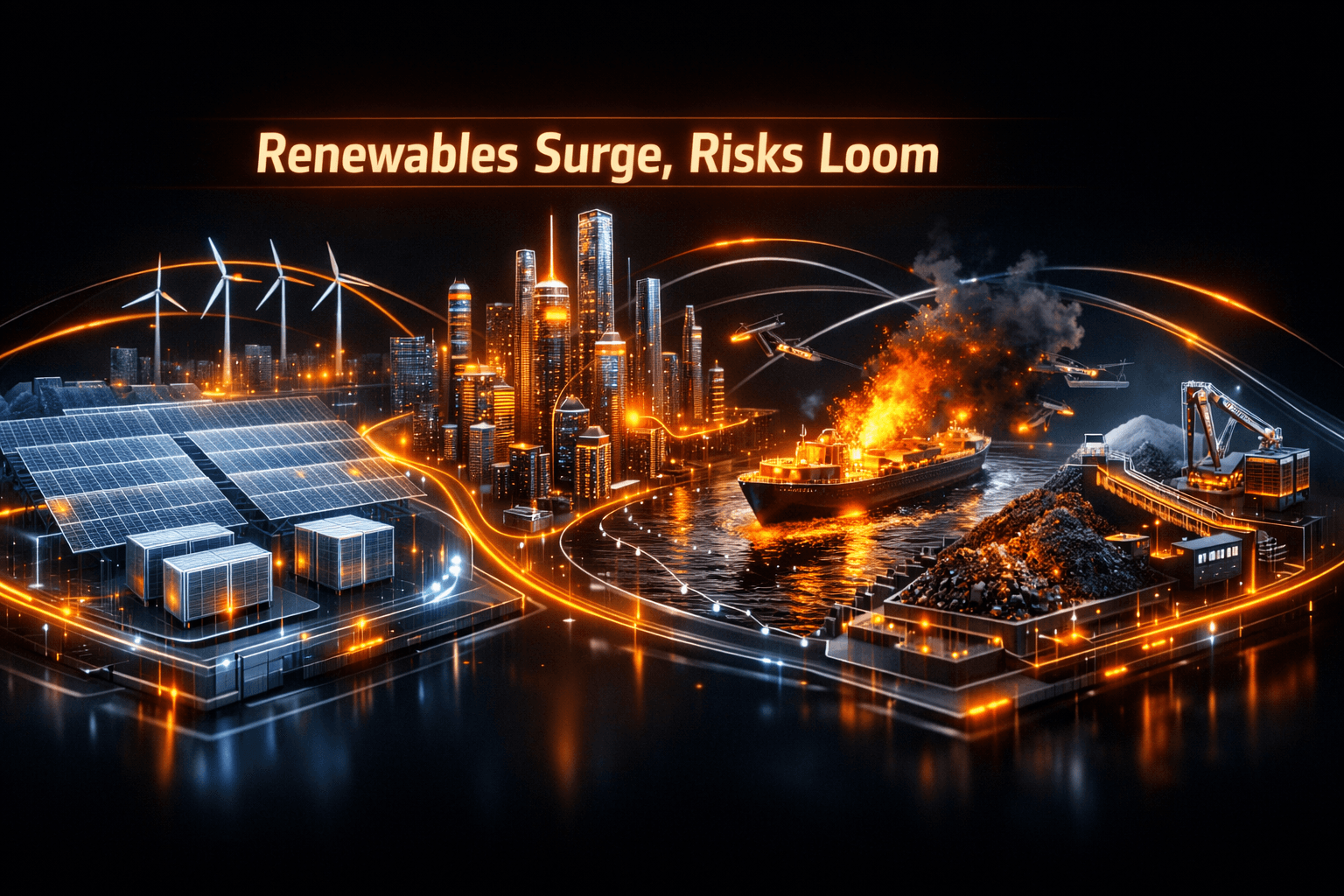
Today’s energy landscape is a study in contrasts, as big renewable project announcements collide with geopolitical risk and fossil-fuel stress. Major solar and battery builds in Southeast Asia and a report showing China’s dominant clean-industry push point to accelerating energy transition investment, while attacks on tankers and India’s fast-track coal stocking plan underline persistent supply risks.
Why does this matter to you? Renewables are proving their commercial scale, but oil and coal market shocks can still move prices and company fundamentals quickly, so stay selective and watch near-term catalysts closely.
Market Highlights
Quick facts and numbers to start your day.
- Malaysia: A 500 MW solar plant paired with 1 GWh of battery storage will supply DayOne data centers, backed by $IOI and $TNB under Malaysia’s Corporate Renewable Energy Supply Scheme.
- Vietnam: Dak Lak province approved a 452 MW floating solar project valued at about $355 million, with completion expected by late 2028.
- China: New data shows China hosts 49 percent of the world’s clean industrial plants and invested roughly $45 billion in energy transition projects this year.
- Geopolitics: Iran’s Islamic Revolutionary Guard Corps reported four oil tankers destroyed by mines south of the Strait of Hormuz, adding fresh transport and supply risk.
- India: Authorities aim to raise coal stockpiles to 55 million tons from 18 million tons now, a threefold jump to avoid next summer’s power shortfalls; current inventories are enough for roughly six days of generation.
- Grid capacity: The Dutch grid operator warns of high-voltage connection bottlenecks, with some customers likely put on waiting lists in early 2027.
Key Developments
Malaysia’s 500 MW solar plus 1 GWh battery for data centers
A consortium involving IOI Corporation and Tenaga Nasional Berhad will support DayOne data centers with a 500 MW solar farm and 1 GWh of battery storage under the country’s Corporate Renewable Energy Supply Scheme. For you that means large-scale corporate demand is continuing to drive utility-scale renewables in Southeast Asia, and corporate offtake deals are scaling up to match hyperscaler needs.
Vietnam approves 452 MW floating solar
Dak Lak province approved a 452 MW floating solar plant on the Ea Sup Thuong reservoir, a roughly $355 million investment scheduled for completion by late 2028. Floating solar remains attractive where land constraints exist, and this project adds to Asia’s expanding pipeline of utility-scale and innovative solar deployments.
China’s clean industrial buildout vs. grid and coal stresses
A new report finds China is responsible for nearly half of global clean industrial plants, reflecting $45 billion in transition spending this year. That scale is a tailwind for renewable equipment makers and project developers, but the sector is not risk free. Grid bottlenecks in the Netherlands and India’s urgent coal restocking plan show that transmission constraints and near-term fuel shortages can complicate the shift away from fossil fuels.
Strait of Hormuz attacks raise oil transport risk
Iran’s IRGC said four tankers were destroyed by mines south of the Strait of Hormuz, and two vessels were seized. Shipping disruptions in the region have historically produced outsized moves in crude markets, so oil price volatility could spike if insurance premiums rise or vessels reroute.
What to Watch
Here are the catalysts and risks that could move energy stocks and commodities today and in the near term, and what you should track.
- Oil flows and insurance costs: Monitor crude spreads and shipping insurance notices. Could insurance hikes or route changes push spot volatility higher?
- Project milestones and offtake deals: Watch announcements from $IOI and $TNB for contracting details and timelines on the Malaysia solar-plus-storage deal.
- India coal inventories: Weekly stock reports and rail freight throughput will reveal whether the government can hit the 55 million ton target by March 31.
- Grid connection updates: Follow Dutch TSO communications and European interconnection notices, since waiting lists may delay project tie-ins and affect regional developers.
- China investment signals: Data on further industrial plant approvals or export orders could point to continued demand for wind, solar, and battery supply chains.
- Earnings and guidance: Keep an eye on utility and renewables developers scheduled to report this quarter for any comments on project backlogs or grid constraints.
If you’re tracking the sector, ask yourself which exposures in your portfolio could be helped by accelerating renewables investment, and which could be hurt by short-term fuel and transit disruption. Where does that leave you in terms of risk and timing?
Bottom Line
- Renewable project announcements in Malaysia and Vietnam signal continued large-scale corporate and public investment in solar and storage.
- China’s sizable clean-industry investment supports global supply chains, but policy and capacity differences mean benefits will be uneven.
- Geopolitical incidents near the Strait of Hormuz and India’s coal scramble create near-term upside risk for fossil fuel prices and volatility.
- Grid bottlenecks, such as those in the Netherlands, show that transmission constraints remain a practical barrier to faster renewables deployment.
- Maintain a selective approach, monitor project execution and supply-chain signals, and be ready for episodic price swings driven by geopolitics or supply shortages.
FAQ Section
Q: How could the Malaysia solar and storage deal affect utility and EPC names? A: Large corporate-backed projects typically boost visibility for engineering, procurement and construction contractors and utilities participating in offtake, analysts note, but execution timelines and grid access will determine near-term revenue recognition.
Q: Will tanker attacks near the Strait of Hormuz move oil prices sharply? A: Disruptions in that chokepoint have historically pushed prices higher, especially if shipping routes change or insurance premiums spike, so data suggests short-term volatility is likely.
Q: Should I expect faster renewable deployment globally because of China’s investment? A: China’s scale accelerates manufacturing and project capacity, yet local grid constraints and regional policy differences mean rollout will be uneven; it’s a mixed bag for global deployment speed.