The Big Picture
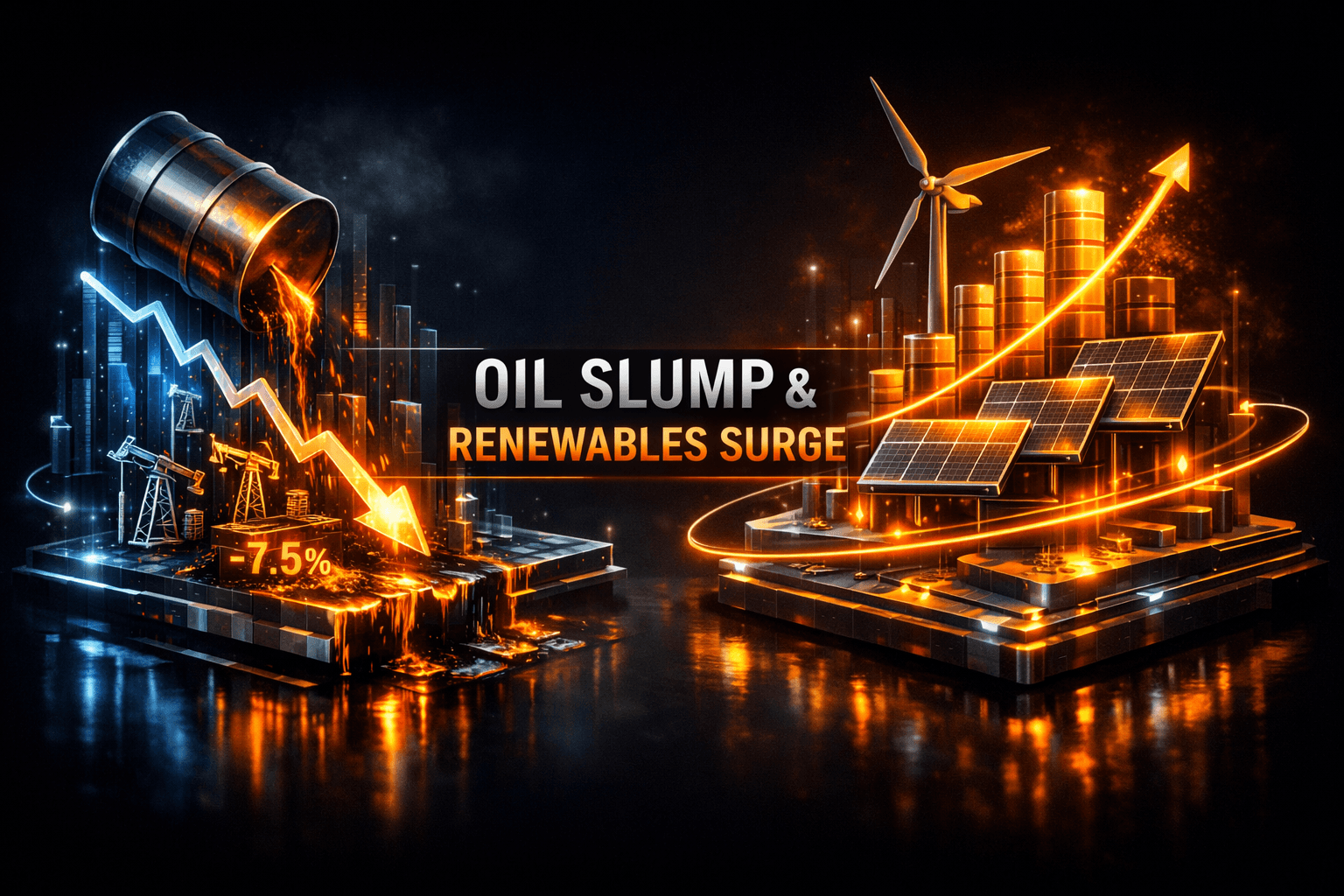
Oil markets grabbed headlines today as global crude prices plunged more than 7% after signals that Washington and Tehran might resume talks. That abrupt drop set the tone for energy trading and offset a string of positive developments in renewables and power storage that also landed today.
This matters to you because the price move hits producers, midstream names, and commodity-driven earnings now, while longer term growth in solar, EVs and residential storage continues to reshape demand. What does a 7% oil drop mean for producers and your exposure to the sector?
Market Highlights
Traders reacted swiftly and sharply to geopolitical cues, while corporate and technology updates showed the energy transition continuing to gain steam. Here are the quick facts you need from today.
- Oil prices fell more than 7% after news that Washington and Tehran signaled openness to renewed talks, according to reporting by Rigzone.
- A sanctioned Iranian tanker reportedly delivered about 500,000 barrels of LPG to China, underscoring enforcement challenges for U.S. sanctions and adding supply noise, per OilPrice.com.
- TotalEnergies agreed to acquire a 30 percent operating stake in the SK410B Lang Lebah and B14 gas fields off Sarawak, a strategic upstream move, reported by Rigzone. Company ticker $TTE.
- Tesla launched Heat Pump Optimization for Powerwall 3 in Europe, letting Tesla (TSLA) power storage systems bank cheap solar energy as heat for compatible heat pumps, according to Electrek.
- Equator Renewables Asia unveiled a modular 250 kW containerized PV system, highlighting faster solar deployment options for distributed sites, reported by PV Magazine.
Key Developments
Oil rout after Iran signals talks
Oil prices sank more than 7% on talk of renewed negotiations between the U.S. and Iran. The immediate market implication was lower near-term risk premia and downward pressure on benchmark crude, which will compress near-term revenue for producers and could pressure upstream names into lower guidance.
Meanwhile the report that a sanctioned Iranian tanker moved about 500,000 barrels of LPG into China suggests sanctions enforcement is imperfect, adding a second layer of uncertainty for traders and policy makers.
Renewables and storage keep advancing
Tesla $TSLA rolled out a Powerwall 3 feature in Europe that tells compatible heat pumps when to run harder to store cheap solar energy as heat, a step that adds value to behind-the-meter storage in cold climates. That feature may influence adoption where compatible hardware exists, though Tesla hasn’t confirmed a U.S. rollout.
Separately Equator Renewables Asia launched a relocatable 250 kW containerized PV system that can be deployed quickly by two workers. That kind of plug-and-play solar can help commercial and industrial customers accelerate decarbonization and may broaden demand for rooftop and brownfield projects.
Corporate moves and political overhang
TotalEnergies $TTE agreed to take a 30 percent operating stake in Malaysian gas fields tied to LNG projects. This is a clear upstream expansion into gas that supports LNG supply ambitions and underlines how major oil companies continue to invest in gas as a transition fuel.
At the same time, political stories kept risk sentiment elevated. Reporting on U.S. policy and Venezuelan investment outreach, along with President Trump’s comments about vetoes if Democrats win control, add policy risk for energy firms operating across jurisdictions.
What to Watch
Tomorrow and the rest of the week will test whether today’s oil slide is a one-off reaction or the start of a new leg lower. You should monitor crude inventories and any follow-up diplomatic statements from Washington or Tehran.
Look for updates on enforcement around Iranian ship movements and any official reaction from U.S. agencies. That could swing sentiment back toward risk if enforcement tightens, or keep pressure on prices if supply flows persist.
On the transition side watch for product availability news from Tesla about Powerwall heat pump features outside Europe and any commercial announcements for containerized solar rollouts. Can renewables momentum offset an oil selloff over the medium term? That question matters if you have exposure across the energy spectrum.
Bottom Line
- Oil prices dropped more than 7% after Iran and U.S. signals about talks, creating immediate headwinds for producers and commodity-linked earnings.
- Supply-side complexities persist, with a sanctioned Iranian tanker reported to have delivered about 500,000 barrels of LPG to China, highlighting enforcement gaps.
- Renewables and storage showed tangible progress today, from $TSLA’s Powerwall 3 heat-pump feature in Europe to Equator Renewables’ 250 kW container PV product.
- Major energy companies are still investing in gas and LNG, illustrated by $TTE taking a 30 percent operating stake in Malaysian fields, which supports longer-term gas supply dynamics.
- Expect volatility ahead as diplomats, regulators, and company product rollouts create near-term catalysts. Stay selective and watch the data and policy signals closely.
FAQ Section
Q: How will a 7% drop in oil prices affect energy company earnings? A: A sudden price drop typically reduces upstream revenue and can pressure margins for producers that have high exposure to spot crude. Midstream and service providers may feel a second-round impact through reduced activity levels.
Q: Does Tesla’s Powerwall 3 heat pump feature matter for U.S. homeowners? A: The feature is live in Europe now and relies on hardware standards uncommon in the U.S. It matters for you if the capability is expanded to North America because it increases the value of solar plus storage setups.
Q: Should I be worried about sanctions enforcement after the tanker report? A: The report suggests enforcement faces practical limits. That can influence trade flows and pricing. Analysts note this increases uncertainty, so policy updates are worth monitoring closely.