The Big Picture
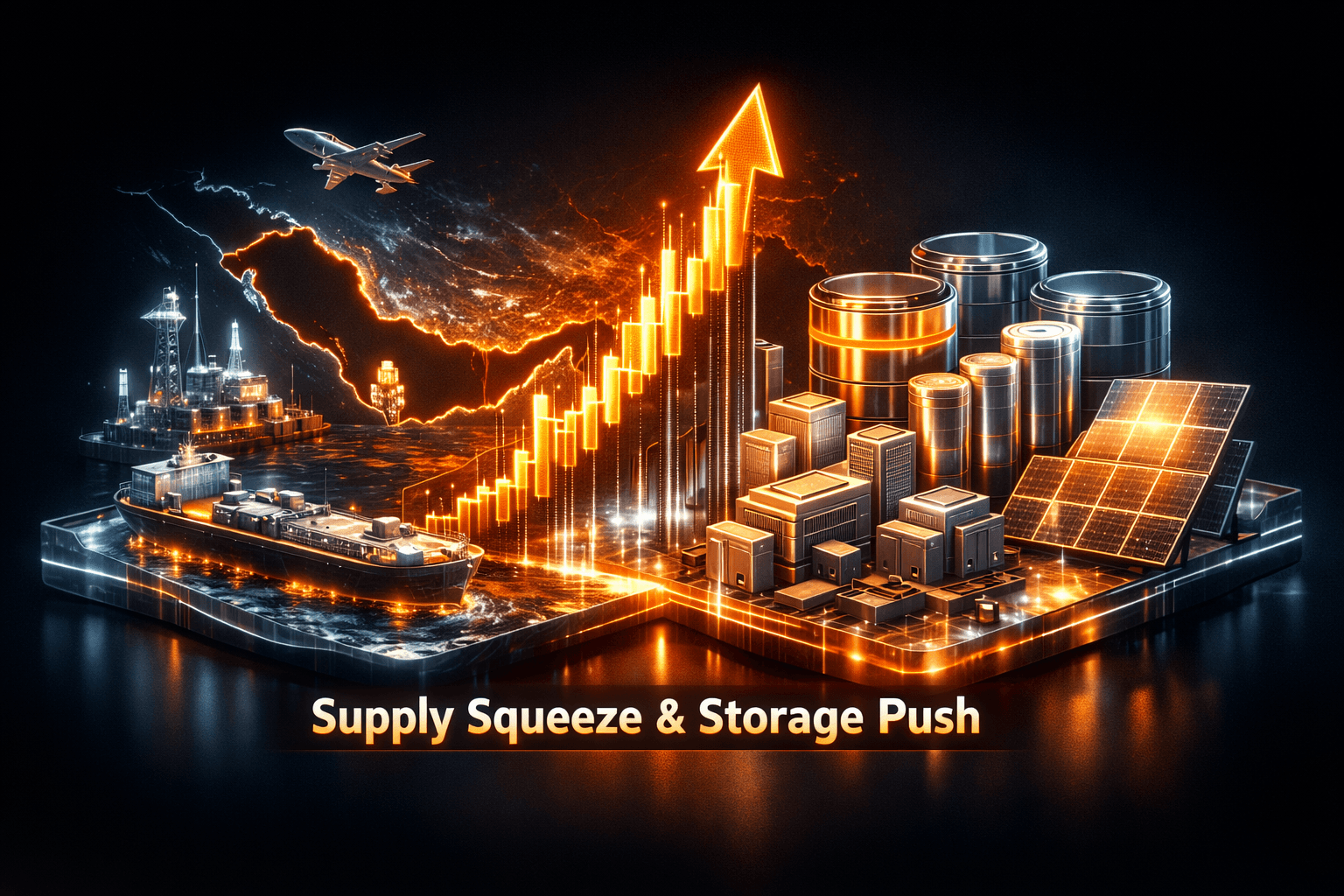
Overnight developments centered on a renewed supply squeeze in global oil markets and concrete moves toward large scale energy storage that could reshape industrial fuel demand. Iran's claims of attacks on vessels and reporting that its floating oil stockpiles have fallen sharply have pushed prices up, while miners and researchers unveiled thermal battery and heat pump gains that point to faster decarbonization in energy intensive industries.
That mix means you need to watch both near term price drivers and longer term structural shifts. A rising tide lifts all boats in commodity markets, but it also highlights winners and losers among producers, service providers, and technology vendors.
Market Highlights
- Oil supply tension: Iran says seven ships were hit in the Persian Gulf, contributing to a sharp move higher in oil prices after reports the country’s floating storage fell from roughly 150 million barrels to under 50 million barrels, about a two thirds decline.
- Coal and power: India is delivering a record 2.6 million tons of coal daily to power plants as authorities scramble to avoid a power crisis.
- Industrial storage: $RIO is evaluating a 360 MWh thermal battery for its Australian alumina refinery, a project Rio says could cut about 67,000 metric tons of CO2 annually.
- Solar tech: Researchers report a solar-assisted CO2 heat pump achieving an 18.7% increase in coefficient of performance as irradiance rises.
- Policy and projects: The Spanish region Castilla y León plans a 2027 tax on ground-mounted PV projects, while the UK government has approved the Jackdaw gas field, drawing union support.
- Regional exploration: Libya endorsed maritime boundaries that pave the way for broader Turkish exploration in the eastern Mediterranean.
Key Developments
Geopolitical supply tightening lifts oil prices
Reports that Iran’s Revolutionary Guard claimed strikes on tankers and mines in the Persian Gulf came as data showed Iranian floating oil inventories have dropped from near 150 million barrels to below 50 million. That reduction, along with a U.S. naval blockade, tightens global seaborne crude flows and helps explain the recent spike in oil market volatility.
What does that mean for you and the market? Short term, oil and shipping insurers may see higher premiums and spot freight rates could rise. Longer term, sustained disruption could accelerate investment in domestic production and alternative supply routes.
Industrial-scale heat storage gains momentum
Rio Tinto’s assessment of a 360 MWh thermal battery for its Yarwun alumina refinery is a tangible example of how heavy industry is seeking to shift from fossil heat to stored renewable electricity. The project targets a 67,000 metric ton annual CO2 cut if deployed.
Related reporting on hot brick style heat batteries shows firms are seriously testing non‑electrochemical storage for industrial steam and heat. You should watch project permitting and power contract terms closely because economics will hinge on cheap midday power and reliable dispatch.
Solar policy and efficiency: mixed signals
On the technology side, Italian researchers demonstrated an 18.7% COP gain for a CO2 heat pump when assisted by PV thermal collectors at higher irradiance. That implies better on‑site integration of solar and heating for commercial and district applications.
Policy however remains uneven. Castilla y León proposed a 2027 tax on ground‑mounted PV, drawing criticism from Spain’s UNEF group. That tax could slow new projects in the region and is a reminder that regulatory risk still matters even as technology improves.
What to Watch
Keep an eye on oil market indicators and regional geopolitics because supply shocks are driving price action. You’ll want to monitor weekly inventory data, tanker tracking, and any escalation in Gulf incidents.
For transition bets watch Rio Tinto’s project milestones, contracts for renewable power at Yarwun, and any announcements on partners or funding. Can thermal batteries reach commercial scale as fast as advocates hope? That will determine how quickly industrial fuel demand shifts.
On the solar side, track the Spanish regional vote and similar policy moves across Europe. Are regulators likely to add levies that change project returns? Also follow commercialization timelines for solar-assisted heat pumps and their potential market uptake.
Bottom Line
- Near term bullish bias for oil prices due to reported attacks and a sharp drop in Iran’s floating storage, increasing market volatility.
- Large scale thermal storage projects from $RIO and others are moving from concept to pilot, signaling industrial decarbonization is becoming investable at scale.
- Solar technology shows efficiency gains, but localized taxes like Castilla y León’s proposal can alter regional deployment economics.
- India’s record coal deliveries underscore persistent demand for thermal fuel, reinforcing a bifurcated market between short term fossil tightness and long term electrification trends.
- Watch supply chain, permitting, and contract details closely because execution risk will determine winners among storage and electrification plays.
FAQ Section
Q: How immediate is the oil supply risk from the Persian Gulf incidents? A: Supply risk is already affecting markets as tanker operations and floating inventories are constrained, and price volatility may continue while maritime security remains uncertain.
Q: Will Rio Tinto’s thermal battery reduce refinery emissions quickly? A: The planned 360 MWh design targets a 67,000 metric ton CO2 cut annually if built, but timelines depend on engineering, permits, and power contracts, so adoption will be phased.
Q: Should solar developers worry about regional taxes like Castilla y León’s proposal? A: Yes, such levies can change project returns in affected areas, so you should track local policy and advocacy outcomes because they influence where projects are built.