The Big Picture
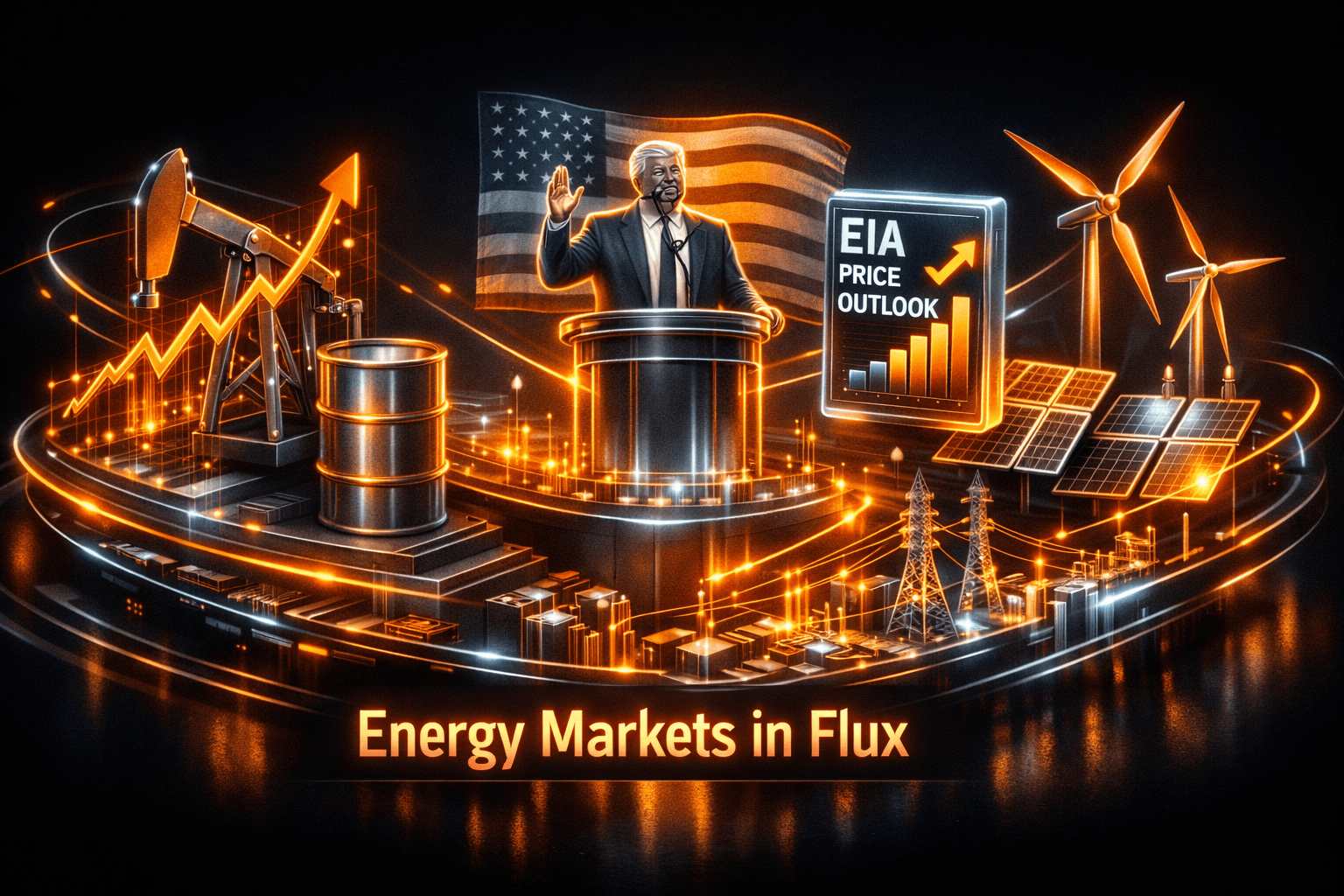
Today delivered a split message for energy investors: short-term oil volatility collided with a firmer medium-term outlook from the U.S. Energy Information Administration, while clean-energy growth and grid innovations continued to gather pace. You saw headlines that moved markets intraday, but underlying structural trends in renewables and storage remain intact.
Why does this matter to you as a retail investor? Geopolitics still drives short-term price swings, yet data and transactions are signaling steady investment in solar, batteries, and distributed resources that could reshape energy returns over the next several years. What happens next will depend on policy moves, midterm politics, and how quickly new technologies scale.
Market Highlights
Quick facts and market moves from today’s top stories.
- EIA outlook: The U.S. Energy Information Administration raised its Brent crude forecasts by about $5 per barrel for 2026 and by $10 per barrel for 2027, signaling a higher-price baseline this cycle.
- Oil volatility: Oil prices dipped intraday after President Trump said he would not order strikes on Iran before the midterms, though commentators noted oil remained higher on the day compared with earlier periods.
- M&A: ONEOK $OKE closed its acquisition of Midland Basin midstream assets from Brazos for $4.425 billion, a significant liquidity event in the midstream sector.
- Grid flex: More than 140,000 home batteries dispatched simultaneously to provide roughly 580 megawatts over three hours in California, a vivid example of virtual power plant capacity in action.
- Fuel costs: AAA reports the U.S. national gasoline average at $4.36 per gallon, down about $0.05 from last week, roughly a 1.1% weekly decline, but the highest October average on record versus $3.12 a year ago.
- EV and consumer deals: $RIVN rolled out a 2026 Halloween software update, BYD $BYDDY previewed a tech-heavy 5-seat Tang interior with dual 30-inch+ screens, and consumer battery makers like EcoFlow featured deep sale pricing including $889 bundles.
Key Developments
Oil volatility and the EIA’s firmer outlook
Short-term oil moved on a high-profile political signal today after President Trump said he would rule out strikes on Iran before the midterms. That statement caused an intraday dip in oil, though market commentary emphasized the reaction was temporary.
At the same time, the EIA raised its Brent forecasts by $5 for 2026 and $10 for 2027, a reminder that supply fundamentals and longer-term demand assumptions are pushing planners to assume higher prices. For you, that means expect continued headline-driven swings even as the baseline outlook moves up.
Grid evolution: Virtual power plants and Texas solar surge
Virtual power plants made headlines after 140,000 home batteries discharged more than 580 megawatts during a California stress event. That’s roughly the output of a large conventional plant delivered without new construction or fuel burn.
Meanwhile Texas remains the fastest-growing U.S. solar market with nearly 54 gigawatts of installed solar and more than 29 gigawatt-hours of battery capacity, according to industry tallies. Collectively, these developments point to a shift in how capacity is built and dispatched, and they create new opportunities and competition for traditional generators.
EV updates, retail deals, and solar supplier scrutiny
On the EV front, $RIVN released a themed Halloween software update, and BYD $BYDDY previewed a high-tech interior with two massive 30-inch-plus displays for its next-generation Tang SUV. Those items matter for consumer adoption and feature differentiation, though they don’t directly alter core energy markets.
On policy, an EU expert group recommended curbs on high-risk solar suppliers and tighter certification for inverters under the Cyber Resilience Act. That regulatory pressure is a potential headwind for some module and equipment supply chains and a reminder that supply-side risk is rising even as demand grows.
What to Watch
Expect continued headline sensitivity around geopolitics and midterm calendar risks. The U.S. political timeline is shaping oil market moves now, so watch for any further public statements that could shift sentiment quickly. How should you navigate near-term volatility?
Look for these specific catalysts: upcoming EIA and IEA reports, quarterly results from major energy and utility players, regulatory milestones in the EU for solar equipment, and further deployments or demonstrations of virtual power plant technology. You should also monitor refining margins, U.S. gasoline inventories, and state-level grid procurement decisions in Texas and California.
Risk factors include regulatory curbs on suppliers, cyber and certification requirements for inverters, and the usual weather and geopolitical shocks that can push oil and power prices. There is a small silver lining in growing distributed storage, but timing and policy will matter.
Bottom Line
- Markets are sending mixed signals today: short-term oil volatility coexists with a firmer multi-year price outlook from the EIA.
- Clean-energy deployment and storage are accelerating, illustrated by virtual power plant dispatch and Texas solar scale, which change long-term capacity dynamics.
- M&A activity like $OKE’s $4.425 billion acquisition shows capital continues to flow into midstream assets.
- Regulatory scrutiny in the EU and cyber certification proposals add a supply-chain risk layer for solar equipment makers and installers.
- Watch near-term headlines around midterms and energy policy, and follow EIA data releases for directional guidance.
FAQ Section
Q: How do EIA forecast changes affect energy prices? A: Higher EIA price forecasts signal a revised baseline for crude that can influence company planning, budgets, and market sentiment, but they do not eliminate short-term volatility caused by geopolitics.
Q: What is a virtual power plant and why does it matter? A: A virtual power plant aggregates distributed batteries and controls them with software so they can supply hundreds of megawatts without new generation build, improving grid flexibility and reducing peak stress.
Q: Should EU supplier curbs affect U.S. solar deployment? A: U.S. deployment may be indirectly affected through global supply chains and price pressure, but domestic policy and manufacturing expansion in places like Texas are important counterweights.