The Big Picture
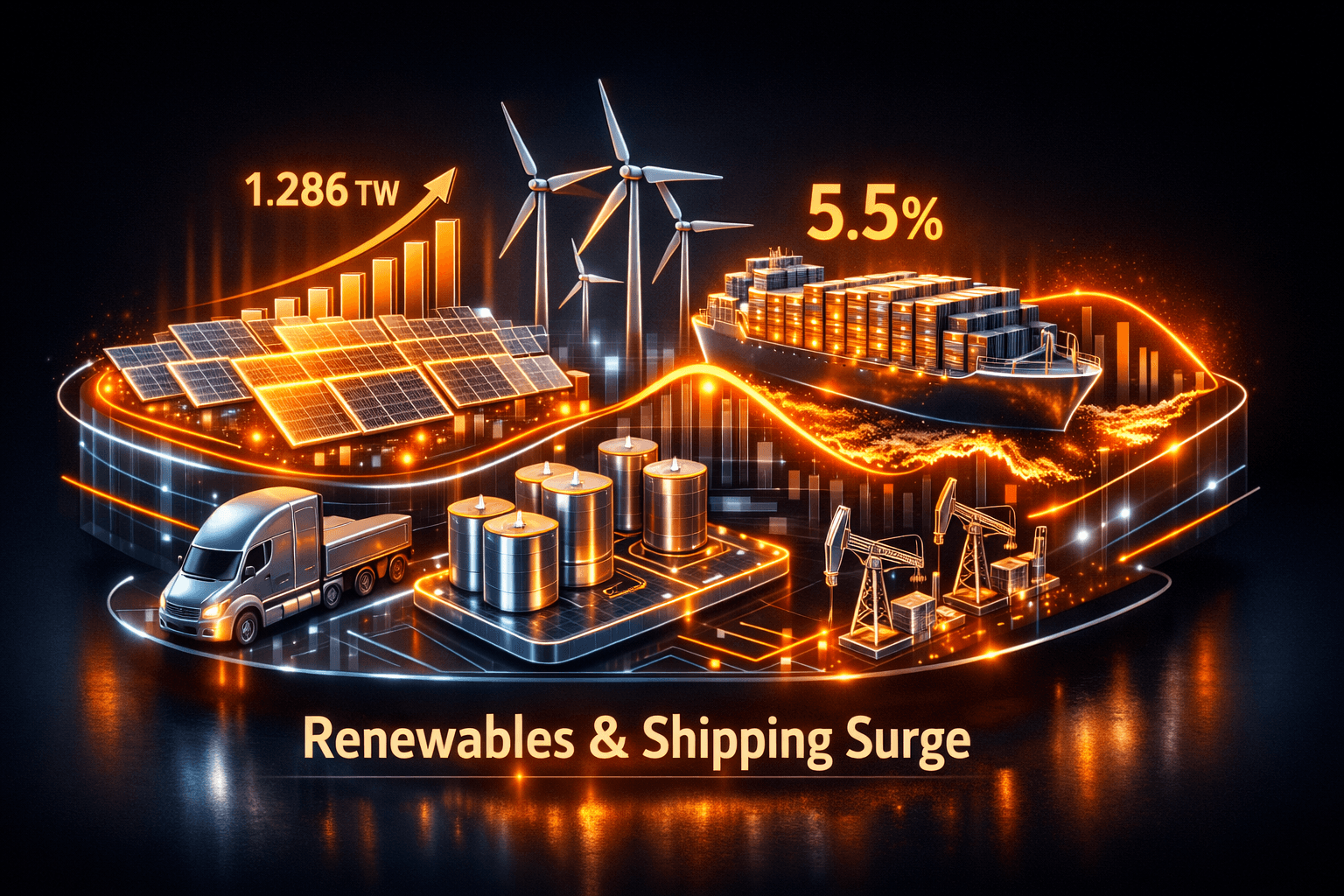
The Energy complex sent a clear signal today, with multiple demand and capacity stories pointing to momentum across renewables, storage and freight. China’s cumulative solar capacity reached 1.286 terawatts and the Baltic Dry Index surged, highlighting both accelerating clean-energy build and tighter commodity logistics.
These developments matter because they affect supply chains, capex plans and revenue backdrops for utilities, storage developers and integrated energy companies. If you follow energy themes, today’s news gives several near-term catalysts to watch and positions where momentum indicates change.
Market Highlights
Quick facts and numbers from the day that moved markets and strategic plans.
- Baltic Dry Index, a freight-cost benchmark, jumped 5.5% to 3,331 points in London, its highest since December 2023, as typhoons cut Capesize supply and miners ramp shipments.
- China’s cumulative solar capacity hit 1.286 TW at the end of July, now about 31.5% of total installed power capacity, even as installations show signs of slowing.
- Equinor commissioned a 100 MW battery project in South Texas, adding flexible capacity to the grid and reinforcing storage deployment trends, ticker $EQNR.
- Global sales of zero-emission medium and heavy-duty vehicles rose 86% in 2025, underlining rapid uptake in electric trucking and fleet electrification.
- BP and Shell expanded exploration positions, with Shell joining BP on Brazil’s Tupinamba block and U.S. Gulf leases, signaling continued upstream cooperation by majors, tickers BP p.l.c. (BP) and $SHEL.
- AVILOO’s largest battery-health study covered over 500,000 tests, showing Mercedes EQA, Hyundai IONIQ 5 and BMW i4 among top retainers, tickers $MBGYY, $HYMTF, $BMWYY.
Key Developments
Baltic Dry Index Breakout, Shipping Tightness
The Baltic Dry Index’s 5.5% jump to 3,331 reflects a near-term squeeze on Capesize capacity caused by typhoons and higher iron ore tonnage. That hits industries that rely on seaborne bulk freight, including miners and commodity traders. For you, tighter freight generally means higher input costs for commodity-intensive producers and potential upside to shipping-related equities and freight-rate linked instruments.
Renewables Scale Up, Storage Comes Online
China’s solar capacity milestone, 1.286 TW, is a watershed moment because solar now exceeds coal in capacity share. Growth is shifting from pure deployment to integration and reliability, with grid constraints and overcapacity in some regions. At the same time, $EQNR brought 100 MW of battery storage online in Texas, a reminder that storage is moving from pilot to utility-scale operations.
That combination suggests you should be looking beyond headline GW numbers and tracking grid upgrades, firming capacity and storage project pipelines.
EVs, Battery Health and Heavy-Duty Electrification
Consumer EV stories mixed with structural progress for fleets. Retail incentives surfaced as Hyundai IONIQ 5 and Toyota bZ models are discounted to clear inventory for 2027 models. Sales incentives are normal seasonality, but you might ask, will discounts pressure margins for OEMs? Meanwhile, AVILOO’s battery-health dataset of more than 500,000 tests shows certain models retain battery capacity far better than peers, a positive signal for used-EV valuations.
On the commercial side, electric trucks are no longer theoretical. Global sales of zero-emission medium and heavy trucks surged 86% in 2025, and industry coverage argues electrification is becoming inevitable for many routes. That points to accelerating demand for charging infrastructure, batteries and grid upgrades.
What to Watch
As you position information flow into actionable monitoring, here are the near-term catalysts and risks that will matter tomorrow and beyond.
- Freight and commodity flow: follow Baltic Dry moves and weather in key shipping lanes, because freight-cost spikes can feed through to commodity prices and margins.
- Storage project rollouts: watch announcements and interconnection milestones for battery projects, including additional Equinor deployments and utility procurement tenders.
- Solar integration: monitor China policy updates and grid curtailment reports, since they will determine how fast new solar capacity converts to usable generation.
- EV inventory and pricing trends: watch OEM pricing and incentive reports for the September selling season to assess whether discounts are transitory fleet-clearing or signs of margin pressure.
- Upstream deal activity: follow BP and Shell filings on the Tupinamba and Conifer positions for partner stakes and exploration timelines, which will affect exploration risk profiles.
Bottom Line
- Momentum is bullish across several Energy themes, led by renewables scale, storage deployments and tighter shipping capacity, according to today’s data and announcements.
- Operational milestones matter more now than headlines. You should track grid integration, storage commissioning and freight rates to judge real economic impact.
- EV market signals are mixed, with consumer discounts offset by improving battery longevity and rapid adoption in heavy trucking.
- Major upstream moves by $BP and $SHEL keep exploration activity on the radar, supporting medium-term supply optionality.
- Data suggests opportunity and risk will come from execution, not just announcements, so selectivity and monitoring are key for your exposure decisions.
FAQ Section
Q: How does the Baltic Dry Index move affect energy companies? A: Freight-cost rises can increase input costs for commodity producers and lift revenue for shipping and logistics firms, altering margins across supply chains.
Q: Should you worry that China’s solar growth is slowing? A: Slower installation rates shift the focus to grid integration and storage. That may slow module demand but create opportunities for storage and grid services providers.
Q: Do EV discounts mean the sector is weakening? A: Short-term discounts are often seasonal model-year clearing. Long-term indicators like battery longevity studies and heavy-truck electrification growth point to durable demand trends.