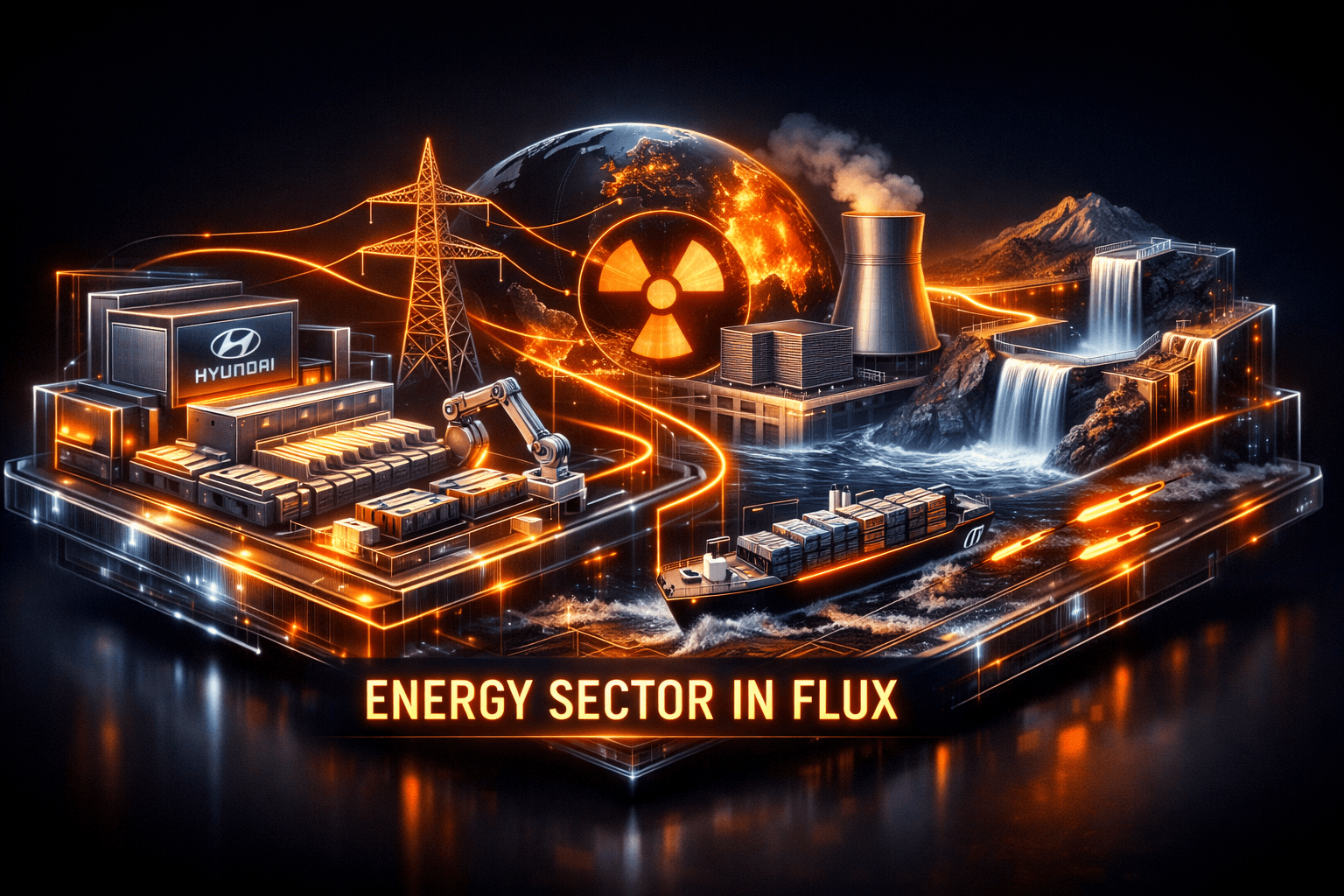
The Big Picture
Expansion and risk shared the spotlight in energy today. Big-cap industrial moves and storage project awards signal fresh supply and resilience, while infrastructure gaps and geopolitical flareups kept downside risk on the table.
This matters because you need to weigh near-term volatility against longer-term demand and capacity shifts. Will new battery and storage capacity ease transition bottlenecks, or will grid and geopolitical headwinds blunt the gains?
Market Highlights
Key facts and market-moving items from today's coverage. These bullets focus on the companies and projects making headlines and the practical numbers you can use to follow developments.
- Hyundai opened a $5 billion EV battery plant in Georgia, with capacity to support roughly 300,000 EVs annually, underpinning U.S. EV supply chains.
- Spain awarded €165 million to seven pumped storage projects, adding more than 21 GWh of storage capacity across six regions, a material push for grid flexibility.
- The U.S. continues to lag on transmission buildout, adding an average of 392 high-voltage miles annually versus an estimated 5,000 miles needed, highlighting a major infrastructure gap.
- $TSLA saw renewed attention after reports a Full Self-Driving session led to a speeding ticket and questions about the company’s response to safety issues.
- Shell-led LNG Canada agreed terms for up to about $712 million of investment from five neighbouring First Nations for phase 2, reinforcing social license and project finance.
- Geopolitical risk flared as the Houthis announced plans for a maritime blockade on Saudi Arabia and Russia-linked developments, including Rosatom cuts, added uncertainty for nuclear and hydrocarbon projects.
Key Developments
Hyundai’s Battery Plant Boosts EV Supply Chain
Hyundai’s new $5 billion battery factory in Georgia will supply cells sufficient for about 300,000 EVs annually, with the first production slated for the three-row IONIQ 9. For you, that means more local battery capacity and potential relief for vehicle production bottlenecks.
The plant strengthens the U.S. EV ecosystem and may ease raw-material logistics for automakers. At the same time, you should monitor battery raw material prices and regional incentives that will determine long-term cost dynamics.
Storage and Grid: Progress and a Big Gap
Spain’s €165 million award for 2 GW of pumped storage and 21 GWh of capacity is a concrete example of governments funding long-duration storage. These projects help integrate renewables and reduce curtailment risk.
By contrast, the U.S. transmission picture remains weak. Analysts say the U.S. needs roughly 5,000 high-voltage miles of new lines annually to meet electrification goals, but has averaged only 392. That gap could slow renewable buildouts and increase congestion costs, so you’ll want to watch permitting and federal transmission incentives closely.
Geopolitics, Nuclear Finance and Shipping Risk
Geopolitical headlines were a mixed bag. The EU’s continued struggle to finalize another sanctions package for Russia keeps energy trade and commodity risk elevated. Russia’s Rosatom announced steep cuts to its investment program and operating budgets, which may affect nuclear plans in Central Asia, particularly projects in Kazakhstan and Uzbekistan.
Meanwhile, the Houthis’ threat of a maritime blockade on Saudi Arabia raises shipping risk for the wider Middle East, potentially increasing short-term oil market volatility. You might ask, how quickly would disruptions translate into price moves? Short-term spikes are possible but depend on scope and duration of any blockade.
What to Watch
Here are the near-term catalysts and risks to monitor as markets head into tomorrow.
- Regulatory and legal updates on autonomous driving after the Tesla FSD ticket report, which could affect manufacturer liability and product rollouts.
- Announcements on U.S. transmission permitting reforms or funding, which would address the 5000-mile target versus current build pace.
- Progress on Spain’s pumped storage projects and timelines for construction milestones, as they will affect regional grid stability forecasts.
- Updates from LNG Canada on First Nations investment implementation and financing terms, which will influence phase 2 construction pacing and cost sharing.
- Geopolitical developments in the Red Sea and Gulf of Aden linked to Houthi activity, and any EU decisions on Russia sanctions that could shift risk premia in energy markets.
- Macro demand signals, including updates from the EIA on consumption and inventory trends, since the EIA has edged up U.S. consumption forecasts for 2026 and 2027.
Bottom Line
- Expansion momentum is real, with new battery capacity and pumped hydro awards offering a silver lining for the energy transition.
- Critical bottlenecks remain, especially U.S. transmission buildout and permitting, which could slow renewables integration.
- Geopolitical and corporate governance risks, ranging from Rosatom cuts to maritime threats and autonomous driving incidents, keep near-term volatility elevated.
- Social-license financing like the First Nations stake in LNG Canada may de-risk projects, but watch execution timelines and funding details.
- For you, that means staying selective and watching catalysts that will move prices and project timelines over the coming weeks.
FAQ Section
Q: How will Hyundai’s new battery plant affect EV supply and prices? A: The plant increases domestic cell supply and may ease production bottlenecks, but battery material costs and demand will still drive pricing dynamics.
Q: Could the U.S. transmission shortfall derail renewable growth? A: It could slow large-scale integration and raise congestion costs unless permitting and funding accelerate, so monitor federal and state transmission initiatives.
Q: Should I be worried about oil market disruption from Houthi threats? A: Short-term spikes are possible if shipping is disrupted, but the scale and duration of any blockade will determine lasting market impact.