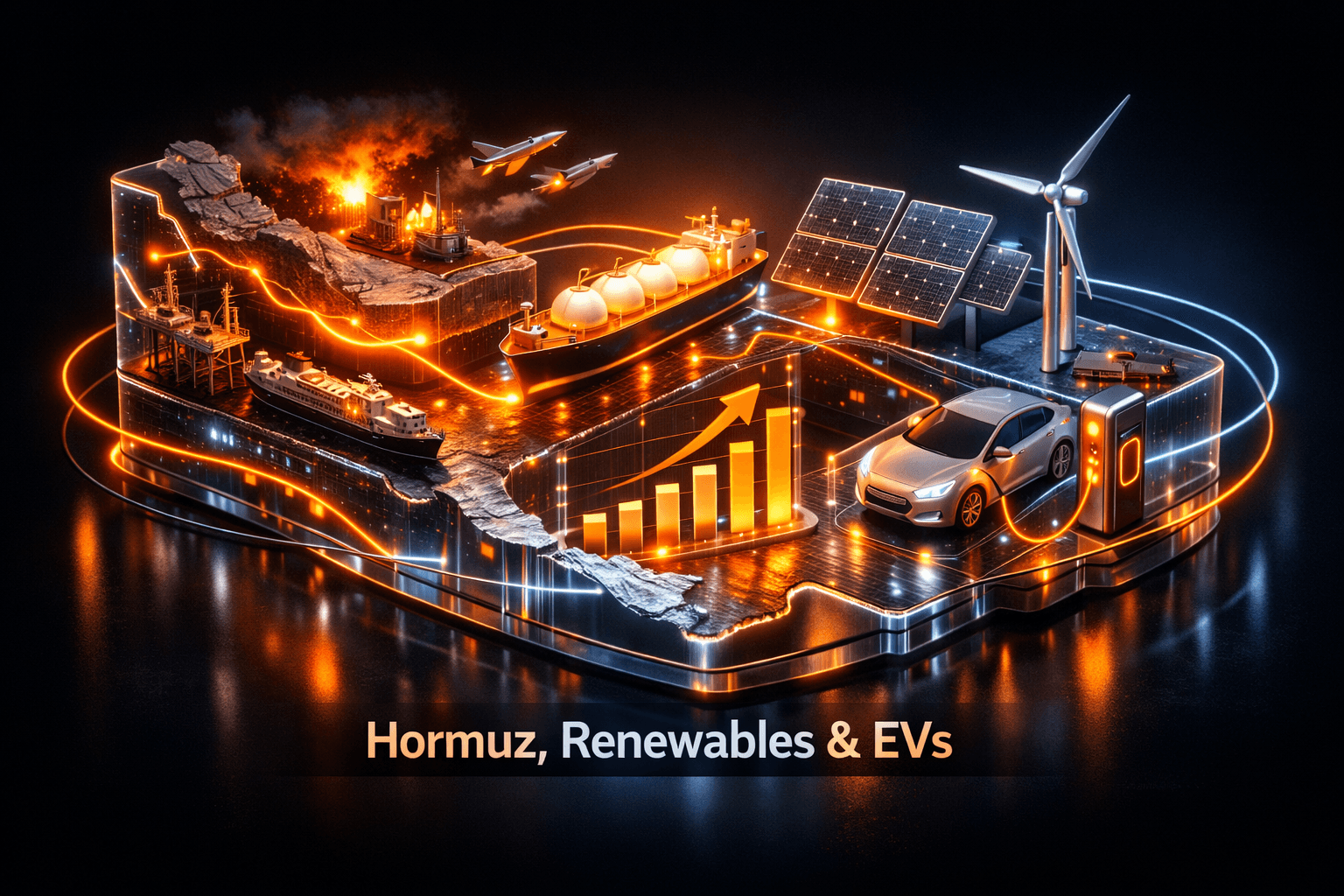
The Big Picture
Overnight events leave the energy complex with mixed drivers for prices and investor sentiment. More than 40 India-bound ships, many carrying crude, LPG and LNG, remain trapped near the Strait of Hormuz after fresh U.S.-Iran clashes, a development that directly threatens tanker flows and short-term supply reliability.
At the same time you should note several positive threads for the clean energy transition. Czech policy makers are moving to ease tax burdens on small solar plus storage projects, researchers reported major efficiency and stability gains for perovskite and TOPCon cell technologies, and EV charging networks announced plug-and-charge expansion. So you have geopolitical risk on one hand and structural renewables momentum on the other.
Market Highlights
- Shipping disruption: Indian officials say more than 40 India-bound vessels are trapped west of the Strait of Hormuz, with 13 India-flagged ships specifically stuck and 41 vessels named for priority evacuation.
- IEA warning: The International Energy Agency estimates about 14 million barrels per day of supply have been lost because of the Middle East war, a point cited as a "golden opportunity" for Canadian oil and gas exporters.
- LNG stress: Pakistan rejected the lowest of seven bids in an urgent tender for two LNG cargoes, underlining tight gas markets in South Asia.
- Solar policy and tech: Czechia is considering raising the electricity tax threshold to 100 kW and preventing double taxation on solar plus storage. New TOPCon research highlights ultraviolet degradation mechanisms. An indoor perovskite cell reached 37.44% efficiency with over 2,000 hours of stability.
- EV and autos: $TSLA's 2026 Model Y passed NHTSA's new ADAS tests covering eight evaluations. $BLNK and Emobi announced plug-and-charge access for 56,000 Blink ports. E-bike maker Ride1Up began shipping a suspension version of a popular commuter model.
Key Developments
Hormuz traffic jam and security risks
The immediate market mover is the bottleneck in the Strait of Hormuz and renewed clashes between U.S. and Iranian forces. The trapped vessels include tankers loaded with crude, LPG and LNG, and Indian authorities have begun drafting a 41-ship evacuation priority list. You should expect heightened volatility in tanker rates and near-term upward pressure on regional benchmark prices if the situation persists.
Global gas stress, Pakistan tender shows tightness
Pakistan's rejection of all acceptable LNG bids in an urgent tender indicates buyers are unwilling to pay prevailing spot premiums or that supply windows are constrained. Seven firms bid including $BP and $TTE as market participants, yet none met Pakistan's price tolerance. That underscores acute short-term demand for LNG in South Asia and the potential for tighter spot pricing if deliveries remain disrupted.
Renewables policy and technology advancing
Policy moves in Czechia to increase the tax-free threshold to 100 kW and prevent double taxation on solar paired with storage lower project economics for small-scale deployments. At the same time, lab breakthroughs matter for your long-term view on solar returns. Researchers pinpointed interface-level degradation in TOPCon cells, which can guide more durable module builds. Separately, a bandgap-engineered perovskite device hit 37.44% indoor efficiency with over 2,000 hours of stability, a result that could accelerate niche indoor PV markets and IoT power solutions.
EV charging and automotive safety updates
Connectivity and interoperability gained a leg up as $BLNK and Emobi move to enable plug-and-charge across 56,000 ports. That should make charging more seamless for drivers and could help utilization rates for networks. Meanwhile $TSLA cleared NHTSA's new ADAS tests, passing all eight evaluations. These auto and charging developments feed demand expectations for electricity and grid investments over time.
What to Watch
Monitor developments in the Strait of Hormuz closely, because even short interruptions can ripple through tanker schedules and spot crude benchmarks. Will the 41-ship evacuation plan be implemented quickly, or will clashes slow passage further?
Keep an eye on LNG tenders and spot price movements, particularly bids affecting South Asian buyers like Pakistan. You should also watch IEA commentary and Canadian export announcements that could shift global flows as buyers seek alternate supplies.
On the clean side, follow the Czech government's vote on the tax threshold and any similar policy moves in Europe that could accelerate small-scale solar plus storage. Track commercialization milestones for perovskite and TOPCon fixes, and watch how $BLNK and other charging operators report utilization and rollout metrics.
Bottom Line
- Geopolitical flare-ups around the Strait of Hormuz are the dominant near-term risk for oil and LNG supply; shipping delays could push regional prices higher.
- LNG market tightness is visible in Pakistan's failed tender, signaling elevated spot demand for cargoes in South Asia.
- Policy relief in Czechia and PV research advances provide constructive signals for renewables and storage adoption across Europe.
- EV charging interoperability and ADAS safety milestones support longer-term electricity demand growth linked to transport electrification.
- You should balance short-term supply risks against structural clean-energy momentum when evaluating sector exposure, and watch the listed catalysts for fresh clarity.
FAQ Section
Q: How could trapped ships near Hormuz affect oil prices? A: Shipping bottlenecks can tighten available cargoes and raise tanker freight costs, which usually puts upward pressure on regional crude and product benchmarks until transit resumes.
Q: Will Czech policy changes meaningfully boost solar installations? A: Raising the tax threshold to 100 kW and blocking double taxation would improve economics for small projects, making rooftop and community installations more viable in the near term.
Q: Do the PV and perovskite lab results affect utility-scale markets now? A: Lab breakthroughs point to future gains in efficiency and stability, but widespread commercial impact will depend on scale-up, certification and manufacturing timelines over the coming years.