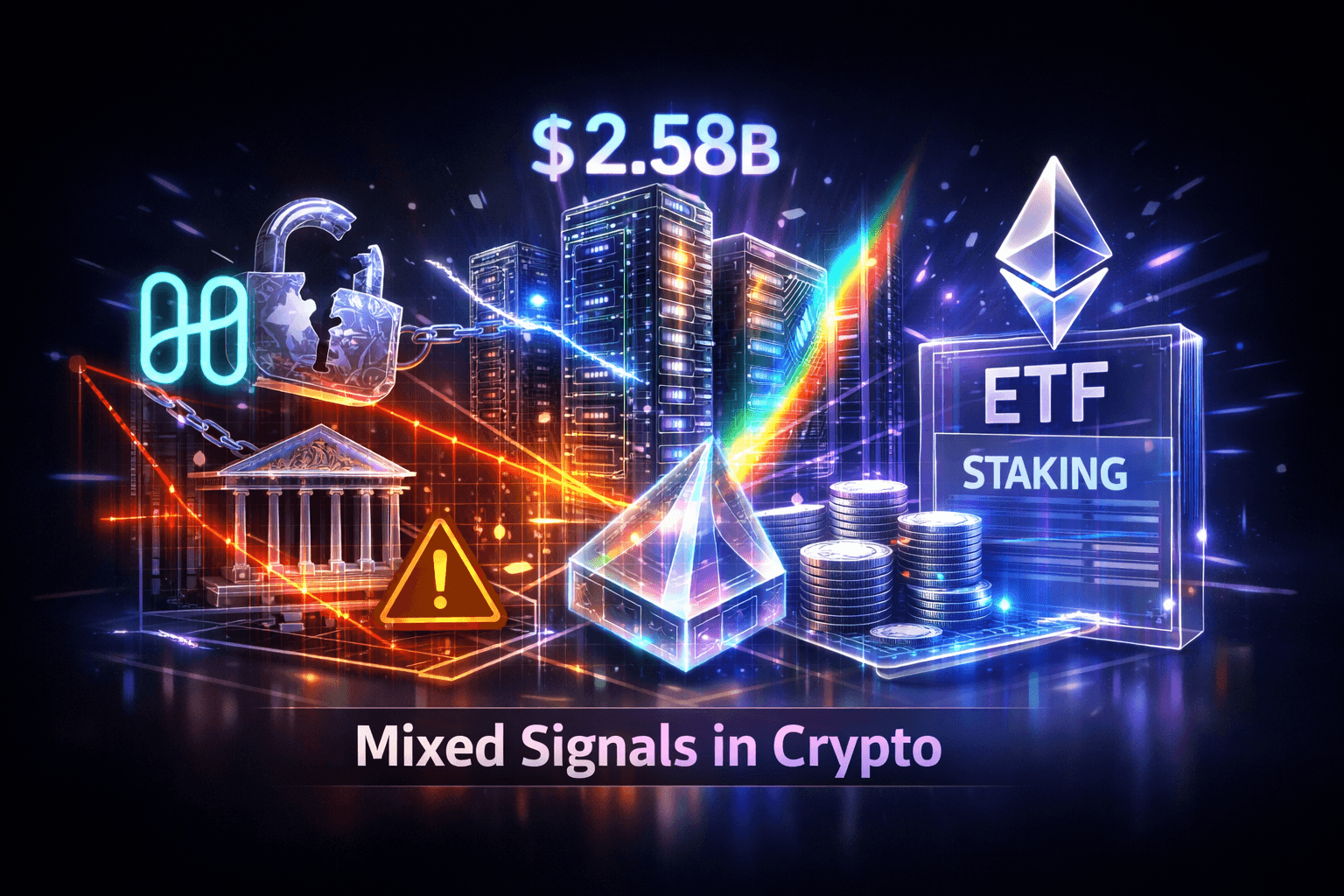
The Big Picture
A suspected exploit that minted roughly 4 billion ONE tokens dominates headlines this morning, forcing Harmony to consider a rollback and prompting exchanges to freeze funds. At the same time, demand for AI compute and institutional products is reshaping investor interest in the sector.
CoreWeave climbed after a blowout quarter, and Fidelity is seeking to add staking with quarterly payouts to a near $900 million ether ETF, signaling continued institutional product sophistication. But you should not ignore the regulatory takedowns, miner selling pressure, and on-chain security risks that are keeping volatility high.
Market Highlights
Quick facts to start your day.
- CoreWeave ($CRWV) surged 16% after reporting $2.58 billion in revenue for the quarter, with investors favoring compute infrastructure over crypto-native businesses.
- Fidelity filed to add staking and quarterly payouts to its ETH ETF, which manages near $900 million, proposing an 85/15 split of gross staking rewards to the fund and service providers.
- Harmony confirmed an unauthorized mint of about 4 billion $ONE tokens, with reports that 2.8 billion may have reached trading platforms, and exchanges are working with Harmony to freeze affected funds.
- Public miners have added roughly $1.78 billion of selling pressure to the bitcoin market, a recent analysis shows, creating supply-side downward pressure at the margin.
- Australia’s ASIC took down Yepbit websites after users reported blocked withdrawals, and regulators denied the platform's claims that funds were frozen by the regulator.
- The CFTC used emergency powers to keep Kalshi trading after a New York suit sought to bar contracts nationwide, and FlightAware dropped a lawsuit against Kalshi a day after filing.
Key Developments
Harmony exploit and potential rollback
Harmony confirmed that an attacker minted about 4 billion $ONE tokens without authorization. Cointelegraph reported that 2.8 billion of those tokens hit trading platforms, prompting Harmony to coordinate with exchanges to freeze funds and prepare a patch.
This is a live operational risk. A rollback is on the table as a remediation option, which raises questions about chain finality and exchange support. You should watch exchange announcements closely for which markets resume trading and whether a rollback is executed or avoided.
CoreWeave surge, AI demand reshaping flow
$CRWV jumped 16% after a $2.58 billion revenue quarter driven by booming AI infrastructure demand, according to CoinDesk. The report says investors are rotating toward computing infrastructure names and away from some crypto-native services.
That rotation could widen sector dispersion. You may see infrastructure and GPU-related plays outperform while pure protocol and consumer-facing crypto assets lag, at least until macro or sector catalysts shift sentiment.
Institutional products and regulatory noise: Fidelity, Kalshi, and enforcement moves
Fidelity's filing to add staking and quarterly payouts to an ether ETF managing near $900 million signals deeper product innovation in regulated markets. The proposed split keeps 85% of gross staking rewards for fund investors and directs 15% to service providers.
At the same time, the CFTC invoked emergency powers to keep Kalshi trading after New York tried to halt contracts nationwide. FlightAware dropped its suit against Kalshi a day after filing. These legal moves show regulators and courts remain pivotal to market access and product continuity.
What to Watch
Here are the near-term items that can move prices and risk profiles.
- Harmony remediation and exchange responses, including any vote or coordination around a rollback and which exchanges support such a move.
- Follow-up filings and approvals related to Fidelity's staking proposal, and whether other issuers file similar changes for ETH products.
- Public miner balance sheet and sales data, plus reported transfers to exchanges that could add further bitcoin supply pressure.
- Regulatory enforcement updates for Yepbit and similar platforms, along with any international spillover from national regulator actions.
- Kalshi litigation and CFTC rulings, since market access rulings could affect prediction markets and derivative liquidity broadly.
How will these items affect price action? Watch liquidity on affected tokens and infrastructure stocks to see whether flows reinforce or reverse early moves.
Bottom Line
- Security events are front and center this morning, with Harmony's unauthorized minting creating acute market and governance risk.
- Institutionalization continues, as Fidelity's staking ETF move and CoreWeave's AI-driven quarter show growing non-crypto demand and product sophistication.
- Regulation and enforcement remain a wildcard, illustrated by ASIC's takedown of Yepbit pages and the CFTC's emergency action for Kalshi.
- Public miner selling has added meaningful supply pressure to bitcoin, so on-chain flows and exchange balances matter for near-term bitcoin dynamics.
- Given mixed signals you should stay selective, watch exchange statements closely, and monitor on-chain metrics for confirmed trend changes.
FAQ Section
Q: What happened with Harmony and $ONE? A: Harmony confirmed an unauthorized mint of about 4 billion $ONE tokens, with reports that 2.8 billion hit exchanges. The team is coordinating freezes and preparing a patch while considering a rollback.
Q: How could Fidelity's staking addition affect ether ETFs? A: Fidelity filed to add staking with quarterly payouts to a near $900 million ETH ETF, proposing an 85/15 split of gross staking rewards. Analysts note this could boost yield-bearing product appeal for regulated investors.
Q: Should I be worried about miner selling? A: Public miners reportedly added roughly $1.78 billion of selling pressure to bitcoin markets, which increases supply-side risk. You should monitor miner transfer data and exchange inflows to assess ongoing pressure.