The Big Picture
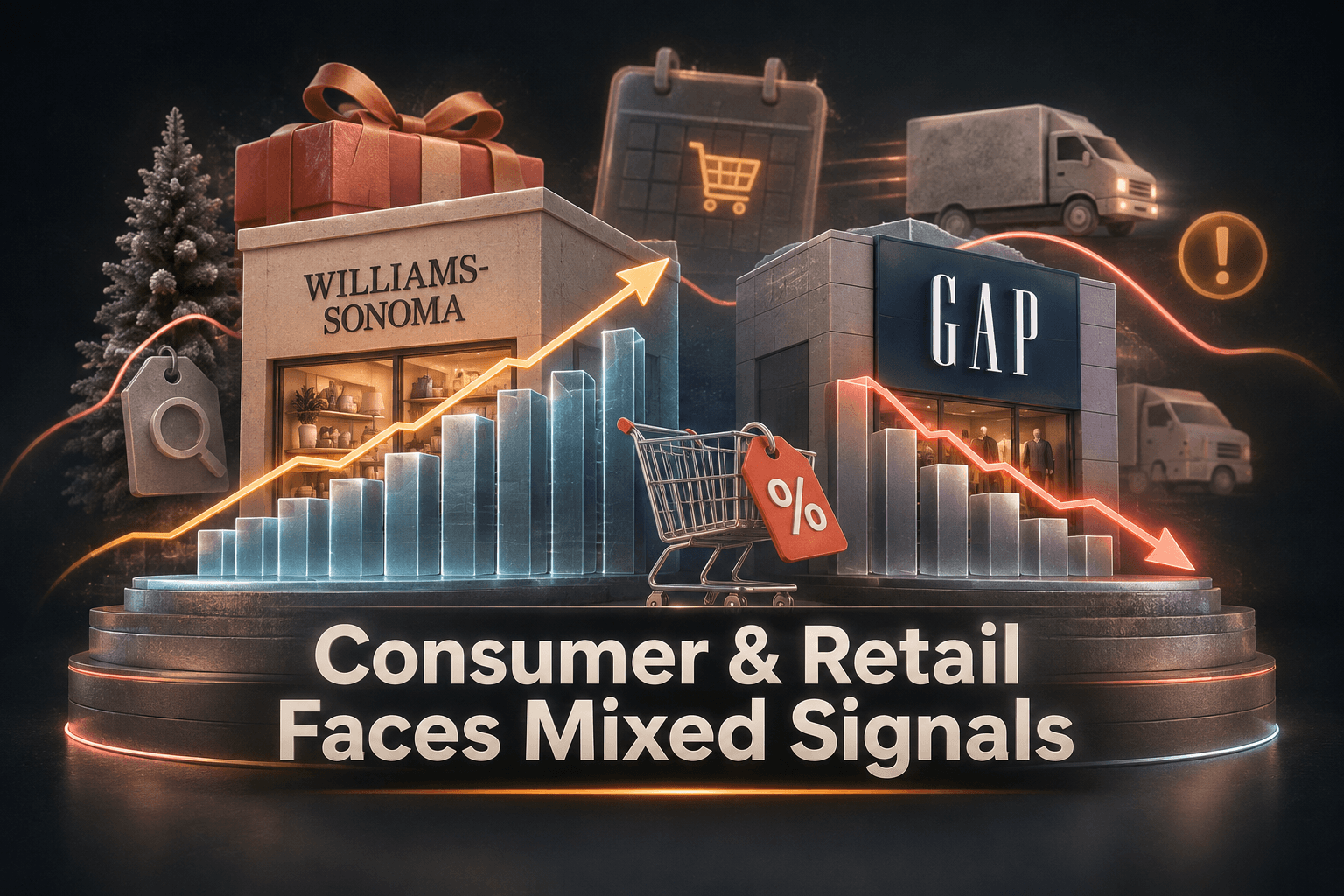
Consumer and retail companies enter Tuesday with a split scorecard: Williams-Sonoma posted growth across every brand and channel, while Gap lowered its full-year outlook after warm weather slowed fall-apparel demand. The contrast puts the focus on which retailers can sustain sales as the holiday season gathers pace.
At the same time, shoppers are spreading purchases across a longer promotional period, and regulatory and policy disputes could affect operating costs. For you, the key question is whether stronger company-specific execution can offset a more uneven seasonal backdrop.
Market Highlights
Overnight results and industry updates point to different demand conditions across retail. The reported figures show growth for home furnishings and online apparel sales, but Gap’s outlook and the Black Friday forecast temper the picture.
- Gap Inc. reported fiscal third-quarter net sales of $4.01 billion. Online sales rose 3%, but the company lowered its full-year outlook after unseasonably warm weather slowed fall-apparel demand.
- Williams-Sonoma revenue increased 5.8% year over year to $1.99 billion. Comparable brand revenue rose 5.1%, while ecommerce comparable sales increased 6.8%.
- The National Retail Federation expects Black Friday and Cyber Monday shopping to slip as extended promotions encourage consumers to start holiday shopping earlier.
- Reports provided no premarket share-price moves. Investors can watch how the market responds to the results and outlook during Tuesday’s session.
The Williams-Sonoma figures suggest demand remained broad across its business in the quarter ended Nov. 1. Gap’s results are more mixed: its namesake brand continued to improve, but that progress wasn’t enough to prevent a lower company outlook.
Key Developments
Gap’s turnaround meets a tougher holiday setup
Gap’s third-quarter performance shows the distinction between online growth and the broader outlook. Online sales advanced 3%, and the namesake brand helped offset weaker performance elsewhere in the portfolio. Yet warm weather reduced demand for fall apparel, prompting the company to lower its full-year outlook.
For investors, the near-term issue is whether holiday demand can make up for the slower fall season. The broader forecast for shoppers to spread purchases across more weeks may support retailers that maintain visibility and promotions, but it also makes the traditional Thanksgiving weekend a less complete measure of demand. You’ll want to compare subsequent updates on sales and margins with the company’s revised expectations.
Williams-Sonoma delivers growth across its business
Williams-Sonoma’s latest quarter was stronger and more consistent: ecommerce comparable sales rose 6.8% for a fourth consecutive quarter of ecommerce growth, and every brand and channel recorded positive comparable sales. Total revenue reached $1.99 billion, up 5.8%, while comparable brand revenue grew 5.1%.
The breadth of the results matters because it indicates the growth wasn’t limited to one sales channel or brand. That offers a useful counterpoint to Gap’s weather-related slowdown, though the two retailers serve different product categories and their results aren’t directly comparable. Investors will be watching whether Williams-Sonoma can maintain that momentum through the holiday period.
Retailers balance innovation with policy and compliance risks
Several other stories highlight how retailers are trying to improve engagement and execution. Fragrance-device company Pura is using collaborations, including partnerships with the New York City Ballet and Calm, to retain subscribers. Beauty brand Dibs Beauty says store and regional sales heat maps have helped improve cost efficiency by at least a double-digit percentage, as it sells through Ulta Beauty and directly to consumers.
Those strategies sit alongside more immediate policy questions. A new federal Common Cents law gives grocers and other merchants a legal basis to round cash transactions as pennies disappear. Meanwhile, the FTC and 30 states have filed a complaint alleging deceptive pricing practices at Dollar General, and Amazon is urging New York City customers to oppose a delivery-worker bill, warning that orders could cost up to $5 more if it takes effect. These developments could influence compliance, customer costs and operations, but their eventual effects remain uncertain.
Other signals are strategic rather than financial. Fareway announced nine appointments, including a new CIO and chief merchandising officer, while grocery retailers are using viral flavors and products to attract shoppers. These moves underline a competitive push to modernize operations and give customers new reasons to visit, though the reports don’t quantify their expected sales impact.
What to Watch
During Tuesday’s session, monitor how investors weigh Gap’s reduced outlook against Williams-Sonoma’s broad comparable-sales growth. For Gap, future updates on holiday demand, weather and performance across its portfolio may help clarify whether the third-quarter weakness was temporary or more persistent.
As Thanksgiving weekend approaches, track whether early promotions shift sales away from Black Friday and Cyber Monday, rather than eliminating purchases altogether. Also watch for further details on Dollar General’s pricing complaint and New York City’s delivery-worker legislation, both of which could carry implications for costs and customer experience. What matters most is whether companies can maintain demand without sacrificing profitability.
For grocers and specialty retailers, the Common Cents law, new leadership appointments and efforts to use data or trend-led products are worth following for signs of practical operational impact. The reports don’t establish a sector-wide sales trend, so company-level results and updates remain important.
Bottom Line
- Sector signals are mixed: Williams-Sonoma grew across brands and channels, while Gap lowered its full-year outlook.
- Gap’s 3% online sales increase offers a positive detail, but warm-weather demand weakness remains a concern.
- Earlier holiday shopping could soften the importance of Black Friday and Cyber Monday as standalone indicators.
- Pricing and delivery-policy disputes create added uncertainty around retailer compliance and customer costs.
- Use upcoming company updates to assess whether reported growth and operational initiatives continue into the holiday quarter.
FAQ Section
Q: Why did Gap lower its full-year outlook? A: Executives cited unseasonably warm weather that slowed demand for fall apparel.
Q: What were the main positives in Williams-Sonoma’s results? A: Revenue rose 5.8%, ecommerce comparable sales increased 6.8%, and every brand and channel posted positive comparable sales.
Q: Why could Black Friday and Cyber Monday shopping slip? A: Extended sales events have encouraged consumers to begin holiday shopping earlier, according to the National Retail Federation.