The Big Picture
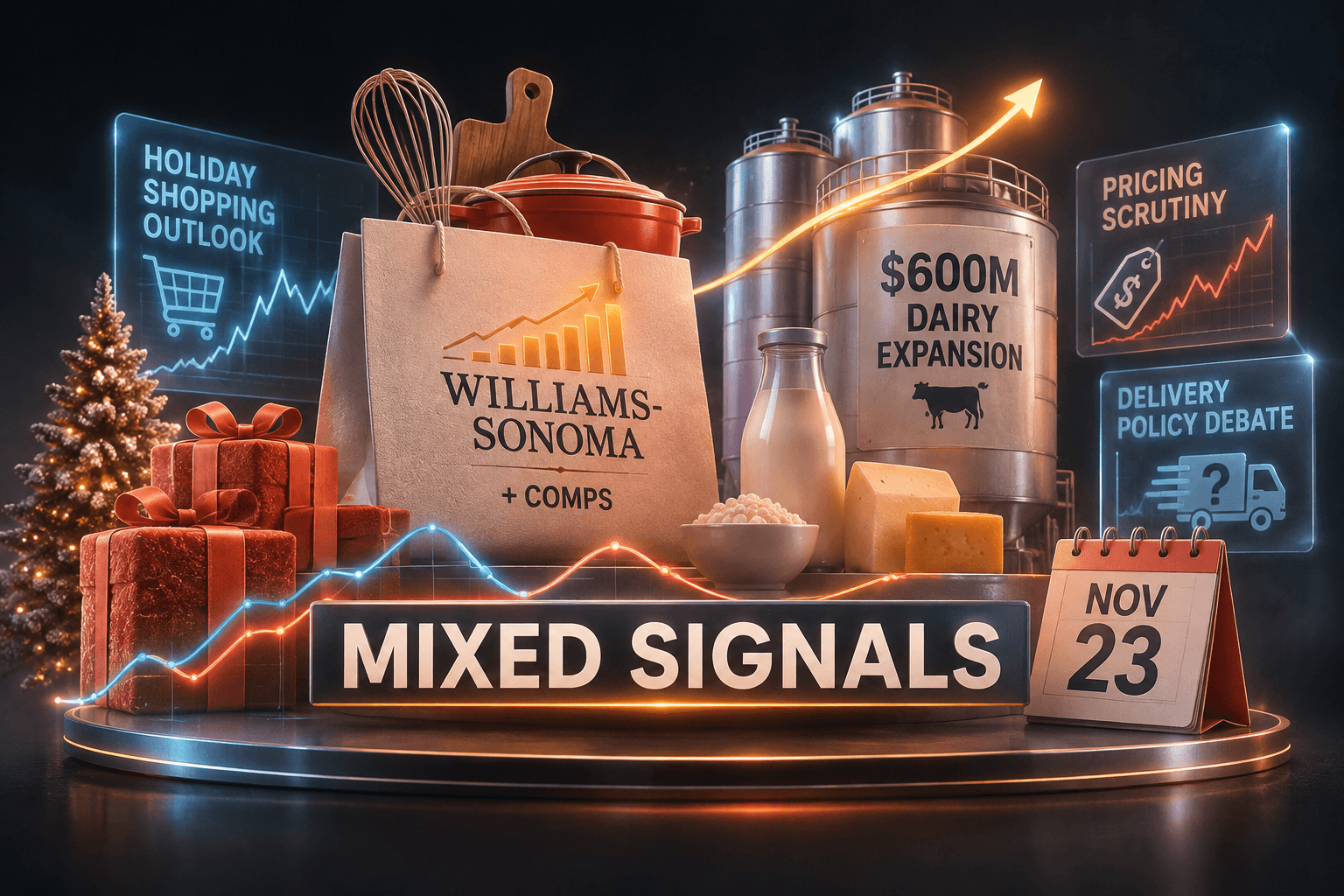
Consumer and retail companies enter Thanksgiving week with a split set of signals: Williams-Sonoma delivered growth across its brands and channels, while holiday shopping projections point to a softer Black Friday and Cyber Monday period. For investors, the contrast highlights how company-level execution can diverge from the broader seasonal outlook.
Retailers are also navigating legal and policy questions, from Dollar General’s pricing practices to Amazon’s opposition to a proposed New York City delivery law. There are growth avenues in product innovation and high-protein foods, but how much will those opportunities offset consumer and regulatory pressures?
Market Highlights
Williams-Sonoma’s fiscal third-quarter results were the clearest operating growth signal in today’s news. The home furnishings retailer grew online sales for a fourth consecutive quarter, with positive comparable performance across every brand and channel.
- Williams-Sonoma’s net revenue rose 5.8% year over year to $1.99 billion for the quarter ended November 1. Comparable brand revenue increased 5.1%, and ecommerce comparable sales rose 6.8%.
- The National Retail Federation expects Black Friday and Cyber Monday shopping to slip, as extended promotions have encouraged consumers to begin holiday shopping earlier. The report provided no specific forecast figure.
- Saputo plans to invest $600 million to expand high-protein dairy capacity, including products such as cottage cheese and functional beverages.
- Dibs Beauty says heat-map analysis of product placement and regional sales has produced at least a double-digit improvement in cost-efficiency at Ulta Beauty locations.
Other developments were more company-specific: leadership appointments at Fareway and Harps, a medical leave at Post Holdings and BellRing Brands, and ongoing disputes involving Dollar General and Amazon. The supplied reports didn’t include specific share-price moves, so today’s stock reactions can’t be quantified here.
Key Developments
Williams-Sonoma posts broad-based growth
Williams-Sonoma’s $WSM quarterly results suggest demand held up across its brand portfolio, rather than relying on a single channel. Revenue increased 5.8% to $1.99 billion, comparable brand revenue grew 5.1%, and ecommerce comparable sales climbed 6.8%. The company’s online growth extended a four-quarter streak.
For investors, the breadth of the gains is important: the comparable brand measure includes ecommerce, stores and business-to-business sales. That offers a wider view of performance than online growth alone. It doesn’t settle how demand will develop through the holiday period, but it provides a positive company-level data point as consumers face a busy shopping season.
Holiday timing and product strategy reshape retail
The NRF projection suggests some holiday spending may be shifting earlier, rather than disappearing altogether. Extended sales events have given consumers more time to shop ahead of Thanksgiving weekend, making traffic and sales concentrated on Black Friday and Cyber Monday less certain. You’ll want to distinguish a change in timing from a decline in total seasonal demand as retailers report results.
Retailers are also trying to stand out with products that tap into viral food trends, from unusual pasta dishes to purple sweet potato pie. Dibs Beauty’s use of heat maps shows a data-focused version of the same effort: it tracks sales by endcap placement and by region, down to the county level, and says the approach has improved cost-efficiency by at least a double-digit amount. Those examples point to sharper merchandising and placement decisions, though the reports don’t establish that the tactics will produce similar results across the sector.
Regulatory disputes and leadership changes add uncertainty
Dollar General Dollar General (DG) faces a complaint involving the Federal Trade Commission and 30 states over alleged deceptive pricing practices. The allegations have not been resolved in the reported news, but the breadth of the coalition raises the stakes for the discount retailer. The case could keep pricing accuracy and compliance costs in focus for retailers operating large store networks.
Amazon Amazon.com (AMZN) is urging New York City customers to oppose the proposed Delivery Protection Act, warning that orders could cost up to $5 more if the measure takes effect. That is the company’s stated warning, not a reported change in current delivery prices. Meanwhile, Fareway announced nine appointments, including a new CIO and chief merchandising officer, and Harps named a CFO, chief marketing officer and operations vice president. Post Holdings $POST chairman Rob Vitale is taking medical leave and is also stepping away temporarily from the top board role at BellRing Brands $BRBR. The reports did not specify the expected duration of the leave.
Saputo’s $600 million expansion provides a separate long-term investment signal. The cheesemaker is targeting opportunities in high-protein dairy, including cottage cheese and functional beverages. Capacity spending can position a company to serve demand, but the announcement alone doesn’t establish how quickly the investment will generate returns.
What to Watch
In the near term, watch holiday sales updates for evidence about whether earlier promotions are shifting the calendar or weakening overall demand. Retailer commentary on traffic, online conversion, discounting and inventory will help put the NRF projection in context. If you’re comparing companies, consider how their sales channels and product mix differ rather than treating one weekend as a full-season verdict.
Regulatory developments also merit attention. The Dollar General complaint could bring further detail on the allegations and the company’s response, while debate over New York City’s delivery bill may clarify potential costs for Amazon and other delivery operators. Neither issue is resolved in today’s reports.
Finally, monitor execution: Williams-Sonoma’s comparable growth, Dibs Beauty’s placement strategy and Saputo’s capacity plans each depend on sustaining demand and managing costs. Leadership transitions at Fareway, Harps, Post Holdings and BellRing are worth tracking for any follow-up on responsibilities or business priorities. The reports provided no company share-price data, so subsequent market reaction remains a separate measure to assess.
Bottom Line
- Williams-Sonoma delivered the day’s strongest reported growth signal, with revenue up 5.8% and ecommerce comparable sales up 6.8%.
- Holiday shopping may be starting earlier, leaving Black Friday and Cyber Monday activity less predictable.
- Dollar General’s pricing case and Amazon’s opposition to the NYC delivery bill keep regulatory and policy risks in view.
- Saputo’s $600 million investment targets high-protein dairy, while Dibs Beauty reports improved cost-efficiency from detailed sales data.
- Overall signals are mixed. Company execution, seasonal demand and regulatory outcomes remain important factors to monitor, not grounds for a one-size-fits-all sector conclusion.
FAQ
Q: What was the main growth signal in consumer and retail news today? A: Williams-Sonoma reported 5.8% revenue growth, 5.1% comparable brand revenue growth and a 6.8% increase in ecommerce comparable sales.
Q: Why might Black Friday and Cyber Monday shopping slip? A: The NRF says extended sales events have encouraged shoppers to start holiday shopping earlier, potentially spreading activity across a longer period.
Q: What are the main risks for retailers to watch? A: The reports point to uncertain holiday-event demand, Dollar General’s pricing complaint and potential delivery costs tied to New York City’s proposed bill.
This article is for informational purposes only and does not provide investment advice or a recommendation regarding any security.