The Big Picture
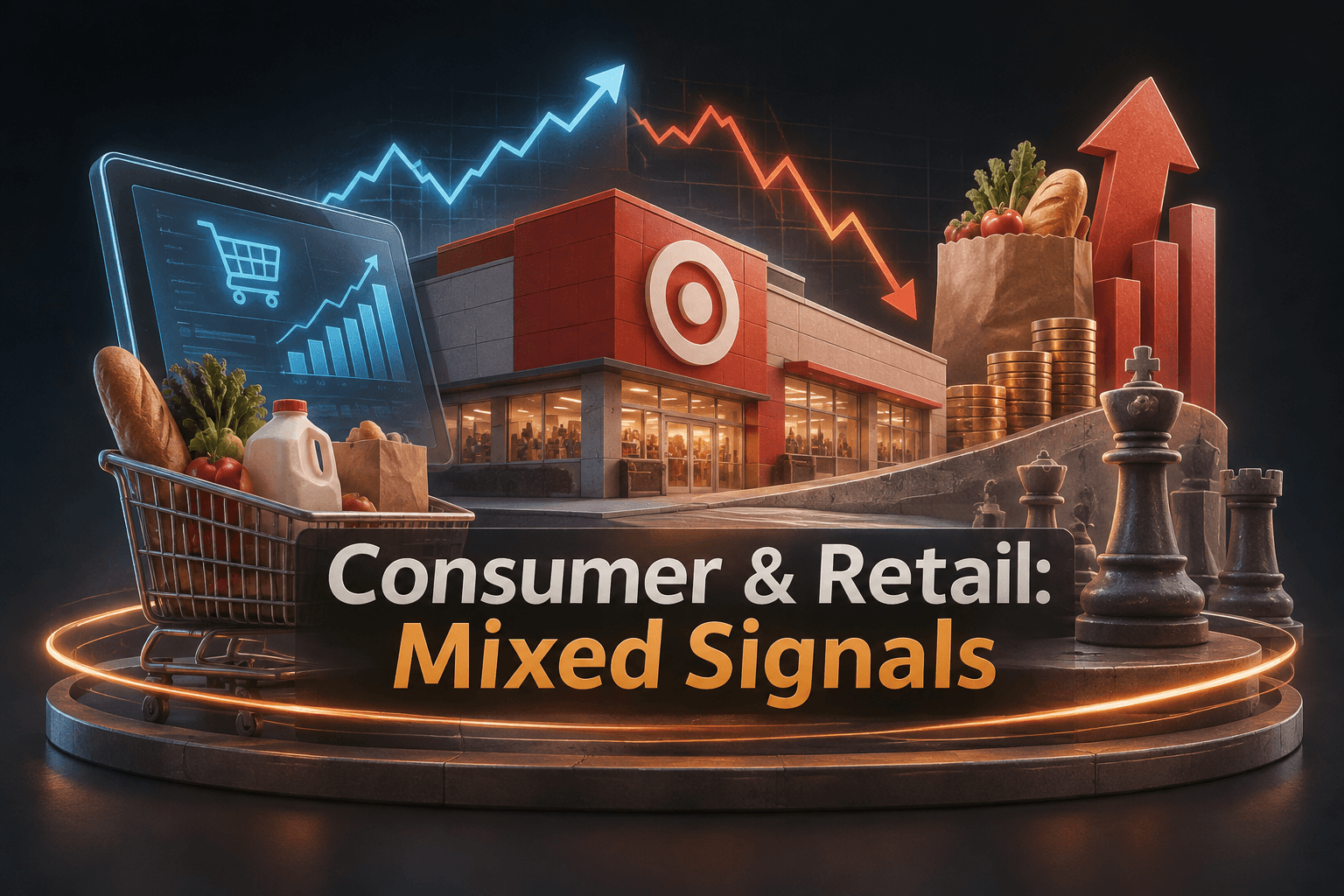
Consumer and retail companies are entering the holiday period with a split set of signals: digital channels and select merchandise categories are gaining traction, while inflation, competition and regulatory attention remain in view. Home Depot and Lowe’s reported double-digit gains in their digital businesses in the third quarter, and Target said its food-and-beverage revamp is delivering strong momentum.
Those bright spots sit alongside a warning that grocery prices could rise faster than usual in the coming months, plus pressure on off-price retailers and questions about delivery-app pricing. For you, the main takeaway is selectivity: companies are testing new ways to attract shoppers, but these updates don’t yet provide a consistent read on broad consumer demand.
Market Highlights
Several stories point to retailers investing in ways to meet shoppers where they are, from online home-improvement orders to social livestreams and holiday promotions. Yet the available reports provide few comparable sales or stock-price figures, so the initiatives shouldn’t be mistaken for proof of a sector-wide acceleration.
Key facts from the overnight and prior-day news:
- Home Depot (The Home Depot (HD)) and Lowe’s (Lowe's Companies (LOW)) recorded double-digit gains in their digital businesses in Q3, as both continue to invest in the online shopping experience.
- Target (TGT) added more than 2,000 food-and-beverage items in Q3. Executives said the category’s ongoing revamp is contributing to strong momentum.
- TJX ($TJX) benefited from recovering traffic at T.J. Maxx and Marshalls, though reported gains were described as somewhat tepid amid competition from resale, department-store promotions and Ross.
- A food economist cited higher energy costs and a powerful El Niño pattern as factors that could push grocery inflation above its average pace in the next few months.
Key Developments
Digital channels and social commerce draw investment
The Q3 digital gains at $HD and $LOW suggest that improvements to online shopping continue to matter in home improvement retail. The reports don’t specify the underlying percentage growth or how much digital gains contributed to total sales, so you’ll want to watch for further detail from company updates before judging the impact on overall performance.
Smaller and newer formats are also getting attention. ThredUp ($TDUP) has launched TikTok Shop livestreams featuring sweaters and dresses, filmed at its Atlanta and Dallas distribution centers. The effort gives the resale retailer another route to reach customers, although the report doesn’t quantify sales from the broadcasts. In a broader shift, OpenAI, Google, Amazon (Amazon.com (AMZN)) and Walmart (WMT) are betting on agent-led holiday shopping. The concept is gaining attention, but the coverage notes it still has ground to cover before its place in holiday commerce is clear.
Holiday campaigns meet a watchful consumer environment
Retailers and brands are using the launch of Grand Theft Auto VI to promote food, delivery, technology and other products to gamers. Amazon has also extended its “Joy Delivered” holiday campaign with an ad featuring Arnold Schwarzenegger as Santa, drawing on an upcoming Prime Video holiday movie. These campaigns highlight the competition for seasonal attention, but the reports don’t provide evidence of their sales impact.
For investors, the distinction between marketing activity and measurable results matters. Campaigns can help brands stay visible during a crowded holiday season, but you’ll need to look for reported traffic, conversion or sales figures to assess whether that visibility is translating into business.
Pricing scrutiny and grocery costs add pressure
DoorDash ($DASH) said it does not personalize prices or adjust them based on demand volume, following an initial Federal Trade Commission probe. The company’s denial puts pricing practices under a brighter regulatory and public spotlight. The news doesn’t establish a finding of wrongdoing, but the investigation remains a point to monitor for delivery and retail investors.
Grocery cost pressures could create another challenge for shoppers and retailers. If energy costs and weather patterns lift food prices at an above-average rate, household budgets and retailers’ pricing decisions may come under pressure. Meanwhile, Kroger ($KR) named Melanie Zimmermann to lead Kroger Precision Marketing as it reshapes its executive team amid a broader operational overhaul. The appointment signals a leadership change, but the report doesn’t detail specific financial targets tied to it.
What to Watch
As the regular trading session gets underway, watch for company commentary that connects these initiatives to measurable results. For home improvement, that means further detail on digital growth and whether online demand is supporting total sales. At Target, the key question is whether food-and-beverage momentum continues as the retailer works through its category reset.
Holiday shopping will test whether promotions, livestreams and agent-led shopping tools can attract customers and convert interest into orders. What would make these stories more consequential? Clear evidence of adoption, sales contribution or improved customer engagement. Also monitor updates related to the FTC’s inquiry into DoorDash and any signs that rising grocery costs are affecting consumer behavior or retailer margins.
TJX’s traffic recovery is worth weighing against its stated competitive pressures, including resale, department-store promotions and rival Ross. Across the sector, stronger digital activity is encouraging, but it doesn’t remove uncertainty about costs, pricing or the durability of demand.
Bottom Line
- Retail signals are mixed: digital gains and Target’s category momentum contrast with inflation and competitive headwinds.
- Look for reported sales and traffic data to determine whether holiday campaigns and social commerce are producing results.
- Monitor grocery cost trends, which could affect consumers and retailers over the coming months.
- DoorDash’s response to FTC scrutiny is a regulatory development to follow, not a finding of misconduct.
FAQ Section
Q: What is driving the mixed outlook for consumer and retail stocks? A: Digital growth and category-level momentum are positive signals, while grocery inflation, competition and regulatory scrutiny are risks.
Q: What did Home Depot and Lowe’s report about e-commerce? A: Both companies recorded double-digit gains in their digital businesses in Q3 as they continued improving the online experience.
Q: Does the DoorDash pricing story confirm that the company used surveillance pricing? A: No. DoorDash denied personalizing prices or changing them based on demand volume, and the report describes an initial FTC probe.
This article is for informational purposes only and is not personalized investment advice or a recommendation to buy, sell or hold any security.