The Big Picture
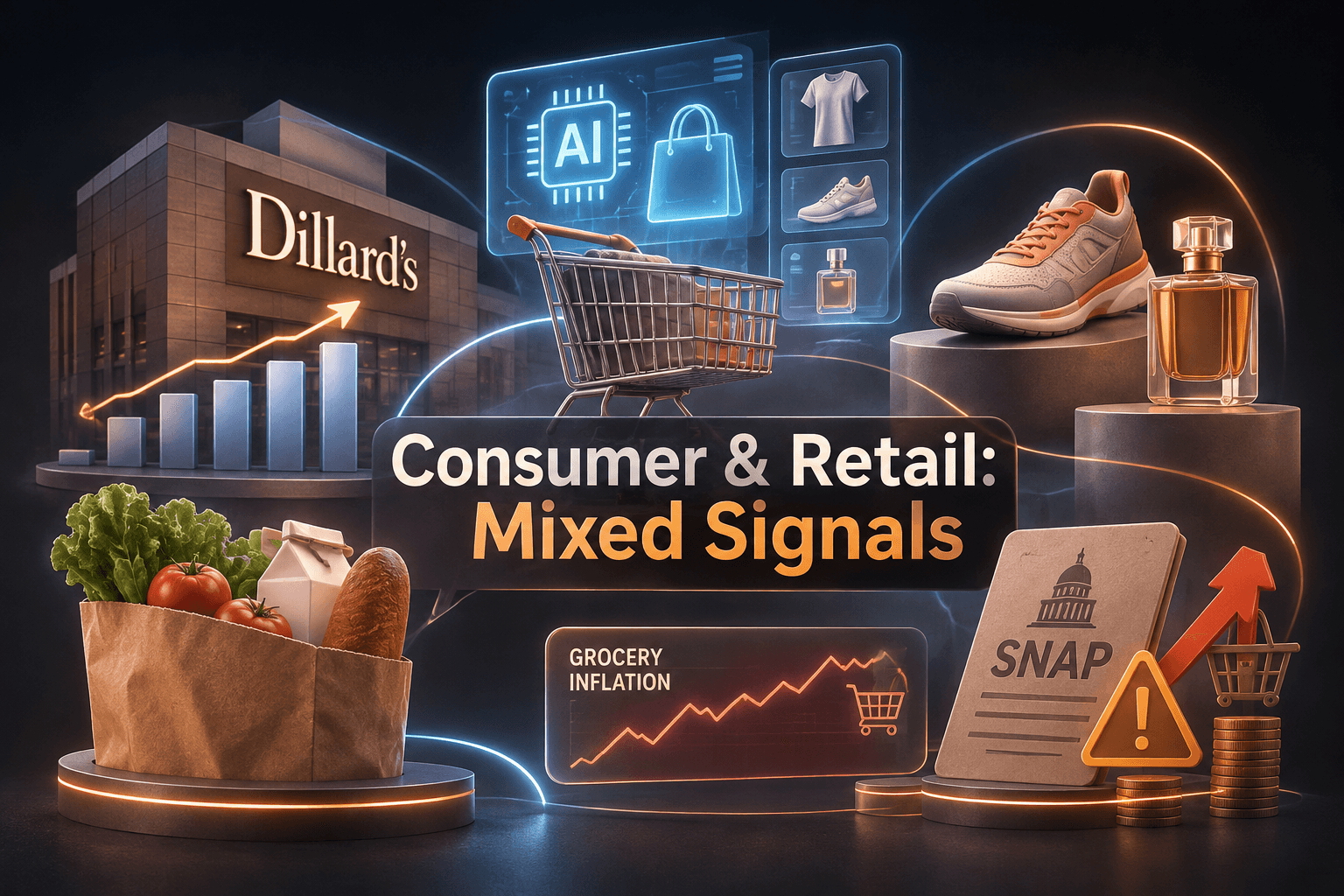
Consumer and retail companies are balancing new growth ideas against a tougher affordability backdrop this morning. AI-enabled shopping, product launches and a modest Dillard’s sales beat offer reasons for measured optimism, but rising grocery input costs and proposed SNAP eligibility changes could weigh on household budgets and food demand.
That split matters because retailers need to attract shoppers without losing sight of price sensitivity. The USDA has delayed new SNAP stocking standards by 90 days, giving stores more time to comply, while a separate proposal to tighten eligibility has prompted warnings that more than 6 million people could lose assistance. For you, the key question is whether retailers’ innovation can offset mounting pressure on consumers.
Market Highlights
Dillard’s reported 1% increases in both retail sales and comparable sales for its third quarter versus a year earlier. Growth was weak in absolute terms, but it beat expectations and helped the department store gain market share, according to the report. The provided news did not include a share-price move, so the result’s impact on trading will depend on how investors weigh the modest growth against the comparison with expectations.
- Dillard’s ($DDS): Q3 retail sales and comparable sales each rose 1% year over year, ahead of expectations.
- SNAP stocking standards: The USDA granted stores an additional 90 days to meet new product and SKU guidelines that were due to take effect Nov. 4.
- Grocery costs: An economist expects energy costs and a strong El Niño pattern to push food prices up at an above-average pace over the next few months.
Other developments are longer-term signals rather than immediate financial results. OpenAI launched ChatGPT Wallet on Nov. 13 with American Express, Chase, Mastercard and Visa, while J.Crew introduced an AI Style Advisor developed with Anthropic. Nike also highlighted an upcoming product pipeline as it seeks to regain momentum, and Express is using Y2K fragrance nostalgia to promote affordable scents and body mists.
Key Developments
AI shifts from product discovery toward checkout
ChatGPT Wallet gives OpenAI’s shopping agents, called dots, a way to complete purchases through retailer checkout systems. The launch extends the company’s agentic commerce strategy from helping shoppers find products toward handling payment, with major card networks and issuers involved. For retailers, that could create another route to customers, but the news doesn’t yet quantify adoption or sales impact.
J.Crew’s desktop Style Advisor takes a related but distinct approach. Rather than responding only to individual product searches, the Anthropic-developed assistant offers a broader styling experience. These efforts show retailers and technology companies exploring how AI can support shopping, though you’ll want to watch whether the tools improve customer engagement and conversion enough to justify the investment.
Product stories meet cost and consumer pressure
Nike (NKE) is previewing innovation intended to address turnaround fatigue, including a refreshed training category and a new manufacturing process for its Air franchise. The announcements give investors products and execution to track, but they are pipeline developments, not evidence yet of stronger sales or a completed recovery. Express, meanwhile, is bringing back its Love and Loyalty Y2K fragrances and adding lower-priced fragrance and body-mist options to appeal to shoppers building fragrance wardrobes.
At the same time, grocery inflation presents a headwind for retailers and consumers. Higher energy costs and El Niño-related weather patterns could lift food prices faster than average in the coming months, according to a food economist cited in the report. A separate USDA proposal to tighten SNAP eligibility could add pressure: consumer and labor advocates warn that more than 6 million people may lose access to the program if the changes proceed.
Policy timing and corporate moves add context
The 90-day delay to new SNAP stocking standards eases the immediate compliance timetable for stores, but it doesn’t remove the underlying requirement. Retailers now have more time to adjust the types of products they carry, a relevant operational consideration as they manage costs and merchandise for SNAP shoppers. The delay is separate from the proposed eligibility changes, which could affect how many people use the program.
Target (TGT) has named Sally Grimes, former CEO of Clif Bar & Company and Diageo, to its board, with her appointment set for December. Separately, biotech firm Amyris acquired sugar-replacement maker Oobli, a deal intended to expand Oobli’s manufacturing scale as demand for clean-label sweeteners grows. Both developments point to food and retail companies’ interest in leadership experience and product capabilities, though the supplied reports don’t provide financial terms for the acquisition or quantify its expected contribution.
What to Watch
Today, focus on how retailers and consumers respond to the inflation and policy outlook, rather than treating any one product announcement as a near-term earnings catalyst. The reported cost pressures are expected over the next few months, while the SNAP stocking-standard delay creates a 90-day compliance window. Watch for further USDA details on both the store requirements and the proposed eligibility changes.
For company-specific developments, track whether Nike’s announced products move from pipeline to market and whether Dillard’s modest growth continues in subsequent results. Retailers’ AI tools also merit attention as they test whether shopping assistance and agent-led checkout deliver measurable engagement. You can also monitor Target’s board change in December and any details on how Amyris plans to scale Oobli’s manufacturing.
The main risks are that food costs rise faster than consumers can absorb, policy changes reduce food-assistance participation, or retail AI and product launches fail to translate into sales. The main potential offsets are stronger execution, relevant product assortments and shoppers responding to new digital experiences. Evidence on those outcomes remains limited in today’s reports.
Bottom Line
- Sector signals are mixed: innovation and a Dillard’s beat coexist with affordability and policy risks.
- Dillard’s 1% sales and comparable-sales growth exceeded expectations, but the reported growth rate remains modest.
- Higher grocery input costs could raise prices at an above-average pace in coming months, according to an economist.
- The SNAP stocking-standard delay offers retailers 90 more days to comply; proposed eligibility changes remain a separate risk.
- AI commerce and new product pipelines are worth monitoring, but the reports provide no evidence yet of their financial contribution.
FAQ Section
Q: What is the main risk for grocery retailers? A: Higher energy costs and El Niño-related weather patterns are expected to put upward pressure on food prices over the next few months.
Q: What changed for retailers under the new SNAP stocking standards? A: The USDA delayed the standards, giving stores 90 additional days to meet the requirements for the types of products they carry.
Q: What does ChatGPT Wallet do? A: It enables OpenAI’s shopping agents to make purchases through retailer checkout systems, with American Express, Chase, Mastercard and Visa involved in the launch.