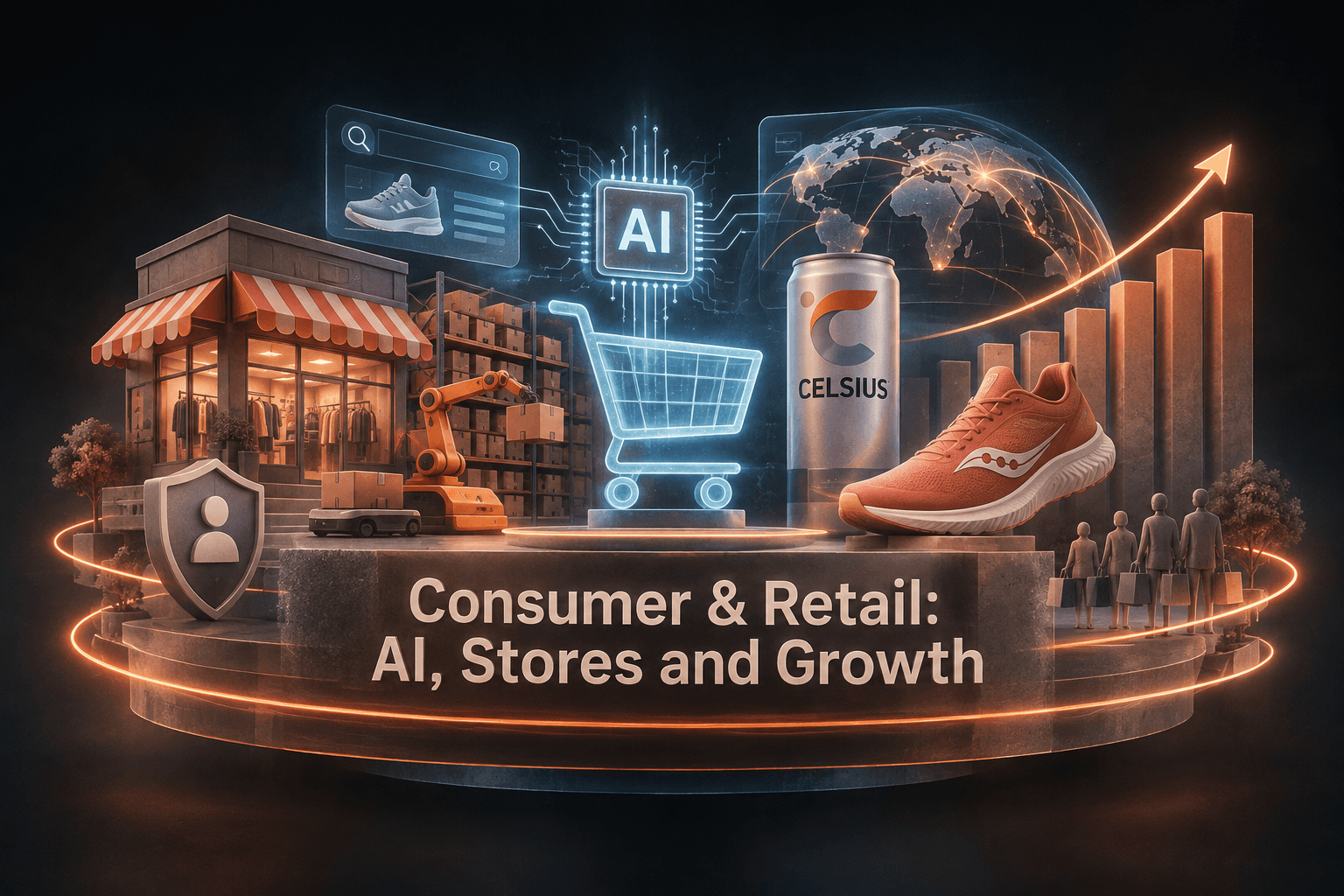
The Big Picture
Consumer and retail companies are testing new ways to do more with less space, more automation and increasingly digital customer journeys, but the stories offer more strategic direction than evidence of immediate financial gains. A central tension is whether technology and new formats can improve the shopping experience while meeting consumer expectations.
For investors, the developments point to areas to monitor rather than a clear sector-wide catalyst. Several stories are sponsored features, so you’ll want to distinguish their operational ideas from independently reported performance data.
Market Highlights
Today’s coverage spans retail operations, food and beverage brands, and international expansion. The clearest numerical signal comes from a report on AI in customer communications: 63% of retailers surveyed use AI in that area, while only 26% of shoppers believe it helps. That gap puts trust and the quality of customer interactions at the center of the technology debate.
- Warehouse automation and smaller store footprints are presented as ways to address operating needs, but the stories don’t report cost savings, investment levels or sales impacts.
- Celsius ($CELH) is broadening its sports marketing presence in 2026 through ESPN College GameDay, Formula 1, marathons and fitness events.
- Saucony, owned by Wolverine Worldwide ($WWW), is pursuing European growth through stores, run clubs and races. No store-count target or revenue contribution was provided.
The coverage does not include earnings results, analyst actions, stock-price changes or company guidance. That means you shouldn’t read these strategy updates as proof of changing fundamentals; investors will need company disclosures and financial results to assess their impact.
Key Developments
Technology meets a shopper trust test
Retailers are exploring warehouse automation and AI tools for customer communications, while grocery brands are looking at how to gain visibility in AI-powered search. The shared question is whether these tools solve a real customer or operating problem, rather than simply adding another technology layer.
The reported 63% adoption rate among retailers contrasts with the 26% of shoppers who say AI helps. That mismatch could matter for customer retention if automated interactions feel less useful than human support. A separate feature highlights traceability at the first mile, where a text message could help collect supply-chain information; the story points to a possible approach, not evidence of broad adoption or measurable results.
Store formats and service remain under scrutiny
Retailers and restaurants are trying to generate revenue from smaller spaces, while a separate podcast examines frustrations with self-checkout, locked products and inventory gaps. Taken together, the stories show why a smaller footprint alone isn’t necessarily a productivity win: the shopping experience still has to work for customers.
Warehouse automation raises a related capital-allocation decision: build systems in-house or outsource them, and how much capacity is appropriate? The sponsored feature frames the choice, but does not provide comparable costs or payback periods. For investors, execution, upfront spending and the effect on service levels are the details to seek in company updates.
Brands pursue new occasions and markets
Celsius is using sports and fitness events to reinforce its positioning as a functional energy drink. The mix of college sports, Formula 1, races and fitness events could put the brand in front of different audiences, but the coverage doesn’t quantify campaign spending, consumer response or incremental sales. Marketing reach is a useful input, not a substitute for evidence of profitable growth.
Saucony is treating Europe as a growth engine and is building its presence through physical stores and community activities. Meanwhile, food companies face portfolio questions as GLP-1 medications, other metabolic therapies and longevity-focused consumers influence dietary preferences. A sponsored feature also points to a trust gap for food brands. These shifts may create opportunities to adapt products, but the stories provide no company-specific forecasts or sales data.
What to Watch
Today’s headlines don’t identify a specific earnings release, policy decision or scheduled event as an immediate catalyst. Watch upcoming company reports and management commentary for measurable evidence: automation spending and payback, store productivity, inventory availability, marketing returns, and the contribution from international expansion.
For consumer-facing AI, look for signs that retailers are improving customer satisfaction as well as adoption. For food companies, monitor how firms describe changing consumer needs and product plans, while separating broad industry trends from demonstrated demand. What would turn these strategic themes into investable evidence? Reported results, guidance and operating metrics that connect initiatives to revenue, costs or customer retention.
Risks include technology costs that don’t deliver expected benefits, smaller stores that compromise service or product availability, and marketing campaigns that fail to convert attention into sales. You can use these stories to frame questions, but the available coverage doesn’t establish the financial impact of any initiative.
Bottom Line
- Sector sentiment is neutral: the stories highlight strategic activity, not a clear change in near-term financial outlook.
- Retail AI adoption is running ahead of reported shopper confidence, making customer response an important measure.
- Automation and smaller stores could reshape operations, but costs, productivity gains and service outcomes remain unquantified here.
- Celsius’s sports marketing and Saucony’s European push offer growth narratives, with no disclosed sales impact in the coverage.
- Several features are sponsored content. Treat their ideas as context, and look to company filings and results for financial confirmation.
FAQ
Q: What is the main consumer and retail theme today? A: Companies are exploring ways to improve efficiency and customer reach through automation, smaller store formats, AI and brand expansion.
Q: What does the AI shopper data show? A: The reported figures say 63% of retailers use AI in customer communications, while 26% of shoppers think it helps.
Q: Do these stories provide evidence of a near-term stock catalyst? A: No. They report strategic initiatives but do not include earnings results, share-price moves or quantified financial impacts.