The Big Picture
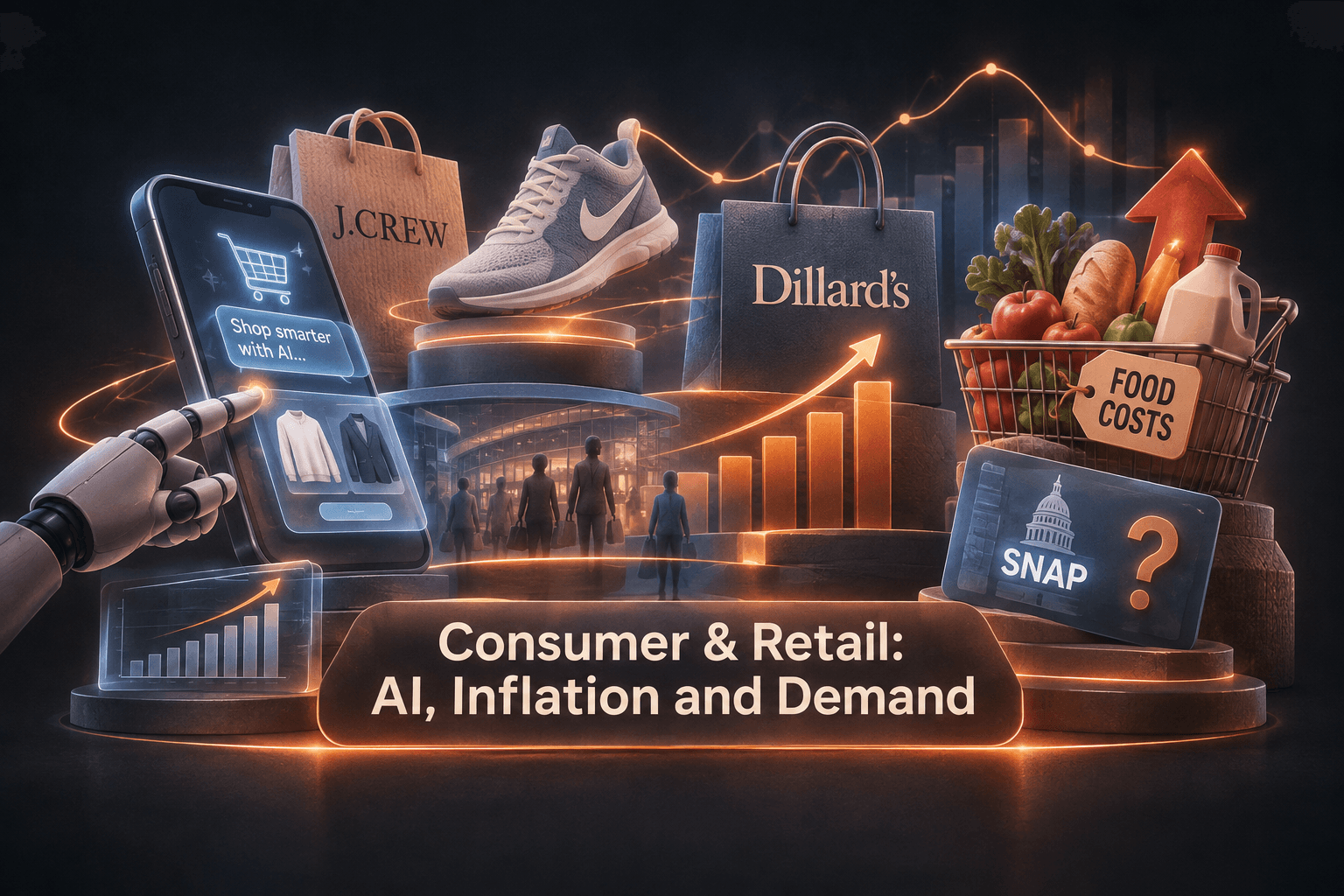
Retailers are pushing further into AI-enabled shopping just as food-cost and policy pressures threaten household budgets. OpenAI’s new payment wallet and J. Crew’s AI Style Advisor show how companies are trying to make digital shopping more personal and convenient, while economists expect grocery inflation to rise in the coming months.
For investors, the day’s developments point to a sector balancing new ways to attract shoppers against persistent affordability risks. Dillard’s reported 1% growth in retail sales and comparable sales, beating expectations, but that remains modest growth. The supplied reports don’t include share-price data, so they don’t confirm how stocks reacted during Monday’s session.
Market Highlights
AI is moving from product discovery toward transactions. OpenAI launched ChatGPT Wallet on Nov. 13 with American Express, Chase, Mastercard and Visa, allowing its personal agents, called dots, to make purchases through retailer checkouts. J. Crew also introduced a desktop Style Advisor developed with Anthropic, designed to suggest outfits rather than simply return individual products.
Retail performance and expansion were mixed. Dillard’s ($DDS) recorded 1% increases in third-quarter retail sales and comparable sales, a better result than expected despite limited growth. Vallarta is opening its first San Jose location, adding an in-house seafood restaurant, while Target (TGT) named former food executive Sally Grimes to its board, effective in December.
Costs and access to food assistance are key pressure points. A food economist expects high energy costs and a strong El Niño pattern to lift grocery prices at an above-average pace over the next few months. Consumer and labor advocates say proposed USDA changes to SNAP eligibility could remove more than 6 million people from the program.
- OpenAI’s wallet connects AI shopping agents with retailer checkout systems and major payment networks.
- Nike (NKE) previewed upcoming product work, including a training-category revamp and a new manufacturing process for its Air franchise.
- Oobli was acquired by biotech firm Amyris, which plans to expand manufacturing capacity for the sweet-protein maker.
- No percentage stock moves or closing prices were included in the reports summarized here.
Key Developments
AI commerce moves closer to checkout
OpenAI’s wallet is a notable step in its agentic commerce strategy because it gives its AI agents a way to complete purchases, not just help shoppers find products. The partnership with American Express (AXP), Chase, Mastercard (MA) and Visa (V) places established payment networks in the rollout, while retailers’ checkout systems remain part of the purchase process.
J. Crew’s Style Advisor points to another use of AI: translating a shopper’s needs into a broader styling experience. These launches could make online shopping more conversational, but the reports don’t provide adoption, conversion or revenue figures. If you’re assessing the business impact, those measures will matter more than launch announcements alone.
Retailers signal product and operating priorities
Nike is trying to address turnaround fatigue by emphasizing products in its pipeline. The planned training-category revamp and new Air manufacturing process offer concrete areas to watch, although the report doesn’t specify expected launch dates, sales targets or financial effects. For shareholders, execution and consumer response will determine whether product news supports a sustained recovery.
Dillard’s modest growth still stands out against a challenging sales backdrop because it exceeded expectations and gained market share, according to the report. It’s a relative positive, not evidence of a broad-based department-store rebound. Meanwhile, Vallarta’s San Jose opening adds a new location and food-service element, and Target’s incoming director brings experience in food and consumer businesses to its board.
Affordability and supply pressures remain in focus
Rising energy costs and weather risks could put additional pressure on grocery prices. If those costs reach shoppers, consumers may have less room in their budgets for discretionary purchases, though the report doesn’t quantify the expected increase or its timing beyond the next few months. What deserves attention first: retailer pricing responses or changes in shoppers’ purchasing patterns?
The USDA’s proposed SNAP eligibility changes add a separate demand risk for food retailers and the broader consumer economy. Advocates warn that more than 6 million people could lose access, but the report describes a proposal, not a finalized policy. Oobli’s acquisition by Amyris offers a counterpoint in food innovation: the deal is intended to increase manufacturing scale as demand for clean-label sweeteners grows, though no production or sales figures were provided.
What to Watch
Tomorrow, watch for company disclosures or trading data that clarify whether Monday’s news affected $NKE, $DDS or $TGT shares. The reports themselves don’t establish a market reaction. For AI shopping, look for evidence that wallet and styling tools reach more retailers and generate measurable engagement or completed purchases.
In the weeks ahead, track Nike’s product launches and any specifics on its Air manufacturing process, along with Dillard’s sales trends beyond the third quarter. Grocery investors and retailers will want updates on energy and weather impacts, food-price forecasts and the USDA’s SNAP proposal. For your assessment of consumer demand, distinguish between actual policy changes and advocacy estimates, and watch for signs that higher essentials costs are affecting discretionary spending.
Bottom Line
- AI is expanding across retail discovery and payments, but financial benefits remain unproven in the reports.
- Dillard’s beat expectations with 1% sales and comparable-sales growth, a modest but positive relative result.
- Nike’s product pipeline offers a potential operational catalyst, with execution and customer response still to come.
- Above-average grocery inflation and proposed SNAP changes could weigh on household purchasing power.
- Use company results, policy developments and actual market data to test these signals; today’s reports alone don’t establish a sector-wide direction.
FAQ
Q: What was the main consumer and retail theme on Nov. 16? A: Retailers advanced AI-powered shopping, while food inflation and potential SNAP eligibility changes highlighted affordability risks.
Q: Did Dillard’s report strong sales growth? A: Dillard’s reported 1% increases in third-quarter retail sales and comparable sales, beating expectations, though growth remained modest.
Q: What should investors monitor next? A: Watch for evidence of AI shopping adoption, Nike product execution, grocery cost trends and developments in the USDA’s SNAP proposal.