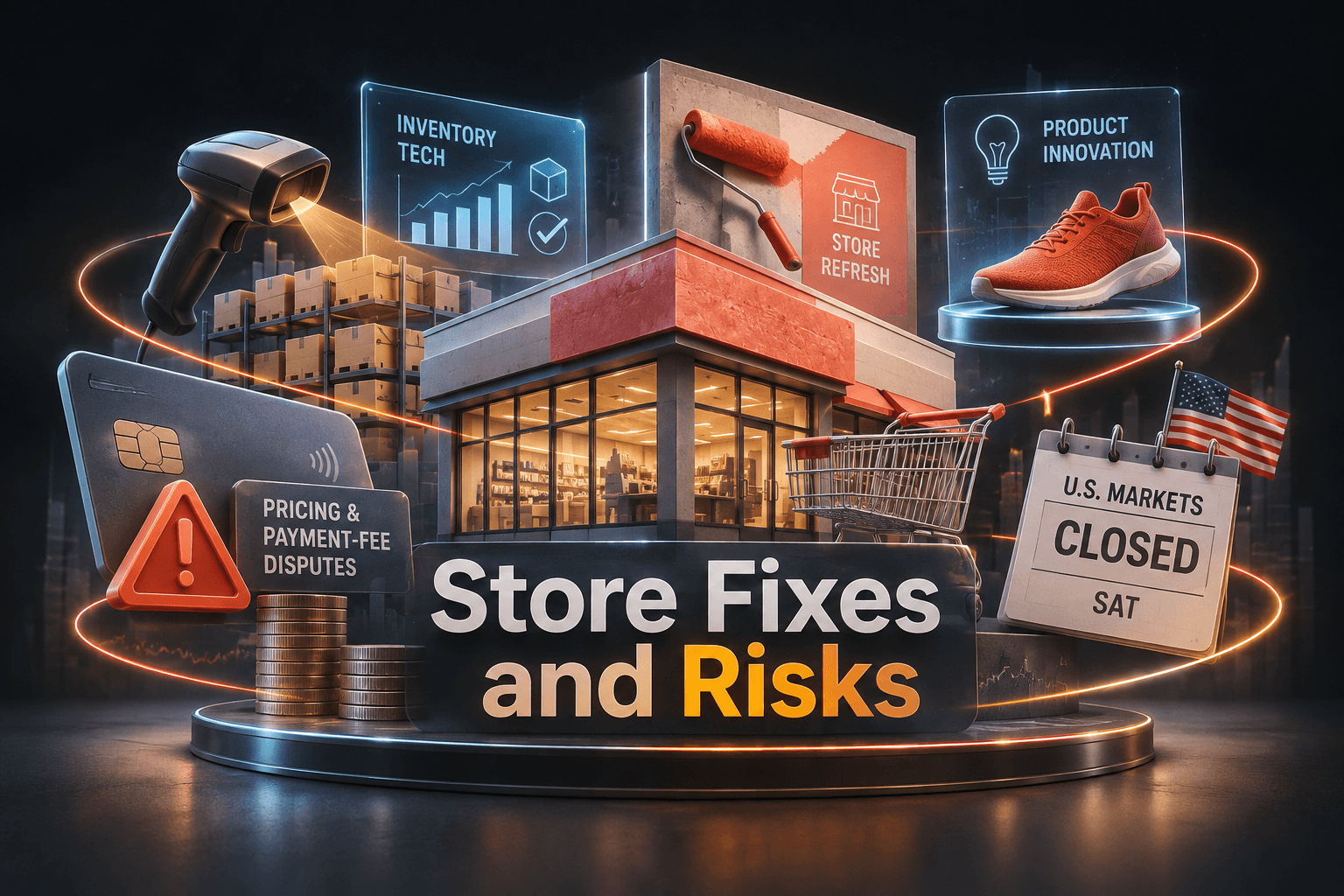
The Big Picture
Retailers are trying to improve the basics of shopping, from finding merchandise to getting the right price at checkout, even as investment in technology and new products offers a path to growth. The stories point to a sector focused on execution: Asics says drones are speeding inventory recovery, Sally Beauty plans a broad store refresh, and Kraft Heinz expects innovation to help return it to growth in 2027.
But the customer experience remains vulnerable to locked products, self-checkout friction and inventory gaps, while Family Dollar’s $63 million settlement underscores the financial and reputational cost of pricing errors. U.S. stock markets were closed Saturday, Nov. 14, so there was no Saturday equity session to react to these reports. For your next review of retail shares, the relevant reference point is Friday, Nov. 13, with trading set to resume Monday, Nov. 16.
Market Highlights
Operational improvements and growth plans were balanced by regulatory and legal concerns. The reports didn’t provide share-price changes or closing prices, so no percentage moves in the named stocks can be attributed to these stories.
- Asics America says AI-powered drones from Corvus Robotics helped it recover misplaced distribution-center inventory about 60% faster.
- Kraft Heinz ($KHC) expects to return to growth in 2027, citing launches such as lower-sugar ketchup and lactose-free cream cheese that are helping market share and volume.
- Family Dollar agreed to pay $63 million to settle unfair-pricing claims brought by state and federal regulators.
- Sally Beauty ($SBH) plans to expand its Sally Ignited store concept in 2027, with a longer-term goal of refreshing two-thirds of its store fleet.
- Target (TGT) named Sally Grimes an independent director. Hershey (The Hershey (HSY)) and PepsiCo (PEP) also featured in holiday product news, including a three-pound Reese’s pie and a zesty Tostitos Scoops flavor.
For investors, these are company-level signals, not evidence of a broad change in consumer demand. Keep that distinction in mind when comparing the news with Friday’s closing prices.
Key Developments
Retail operations face a customer-experience test
Modern Retail’s discussion of in-store shopping highlights a persistent challenge: stores remain important to retail sales, but self-checkout, locked merchandise and inventory gaps can make shopping frustrating. The report focuses on how retailers are attempting to fix those problems, rather than describing a single company’s results. For you, the issue is whether store investments translate into easier shopping and more reliable product availability.
Asics offers a concrete example of an operational response. Its autonomous drones scan a primary North American distribution center to locate misplaced goods, and the company says inventory recovery is about 60% faster. Faster recovery may help reduce the risk of unfulfilled orders, though the report doesn’t quantify any effect on sales, costs or margins. The common thread is execution: technology can help, but its value depends on whether retailers can turn better inventory visibility into a dependable customer experience.
Innovation and store refreshes offer measured growth signals
Kraft Heinz says recent launches are supporting market-share and volume gains, and it expects a return to growth in 2027 as innovation investments pay off. Lower-sugar ketchup and lactose-free cream cheese give the company specific examples of product changes aimed at consumers. The outlook is a forward-looking company expectation, not a guarantee; investors can track subsequent volume, market-share and financial updates for evidence of progress.
Sally Beauty is planning to expand its Sally Ignited format next year and has a long-term target of refreshing two-thirds of its stores. That signals a substantial commitment to the physical retail experience, but the story provides no cost, timing or expected-return figures. Target’s appointment of Sally Grimes to its board is another governance development, while Centric Brands’ sale to CEO Jason Rabin changes ownership. Neither report, as summarized, gives an immediate financial impact to quantify.
Food companies are also leaning into seasonal products. Hershey’s three-pound Reese’s pie is aimed at holiday hosting, while PepsiCo’s Tostitos adds a zesty twist to Scoops; Cutwater is introducing a seasonal Gingerbread White Russian. These launches may help brands stay visible during the holiday period, but the reports don’t establish expected sales or consumer response.
Pricing and payment-fee disputes remain risks
Family Dollar’s $63 million settlement with state and federal regulators puts pricing accuracy and customer trust in focus. The company said it is cooperating and working to strengthen pricing accuracy across its stores. For the broader sector, the case highlights how checkout errors can lead to regulatory costs as well as damage to customer confidence.
Separately, trade groups including FMI and NGA sued federal regulators over the preemption of an Illinois law banning swipe fees on taxes and tips. The dispute leaves uncertainty around payment-fee rules for merchants. GrubMarket’s new AI Orders agent, designed to convert vendor invoices and receipts into purchase orders for food distributors, shows another effort to automate back-office work. A separate Digital Commerce 360 article about paying international contractors was sponsored content, so it should be treated as promotional material rather than independent reporting.
What to Watch
With markets closed for the weekend, Monday, Nov. 16, is the next U.S. trading session. The supplied reports don’t identify a specific earnings release or policy decision scheduled for Monday, so avoid treating the weekend headlines as a forecast of near-term share moves. Instead, compare any market response with the underlying facts and the companies’ subsequent disclosures.
For the weeks ahead, watch whether Kraft Heinz reports continued volume and market-share progress, and whether Sally Beauty provides more detail on rollout pace and store-refresh spending. Asics’ claimed inventory-recovery improvement is worth following for evidence of broader fulfillment benefits. You can also monitor Family Dollar’s pricing controls and developments in the Illinois card-fee litigation, both of which could affect retailer costs or customer trust. Store-level execution remains a key test: do operational changes make shopping more reliable?
Bottom Line
- The sector outlook is mixed: operational and product initiatives sit alongside regulatory, legal and customer-experience challenges.
- Asics’ reported 60% faster inventory recovery is a notable efficiency measure, but the report doesn’t quantify financial results.
- Kraft Heinz’s 2027 growth expectation and Sally Beauty’s store plans are catalysts to track, not assured outcomes.
- Family Dollar’s $63 million settlement reinforces the need to monitor pricing accuracy and compliance costs.
- U.S. markets were closed Saturday. No share-price moves were supplied for these stories; the next trading session is Monday, Nov. 16.
FAQ
Q: Were U.S. retail stocks trading on Nov. 14? A: No. It was Saturday, and U.S. stock markets were closed. The next session is Monday, Nov. 16.
Q: What did Asics report about its inventory technology? A: The company said AI-powered drones helped recover misplaced inventory about 60% faster at its primary North American distribution center.
Q: What are the main risks in this retail news? A: Pricing accuracy, payment-fee regulation and ongoing in-store frustrations stand out, alongside uncertainty about the returns from store and technology investments.