The Big Picture
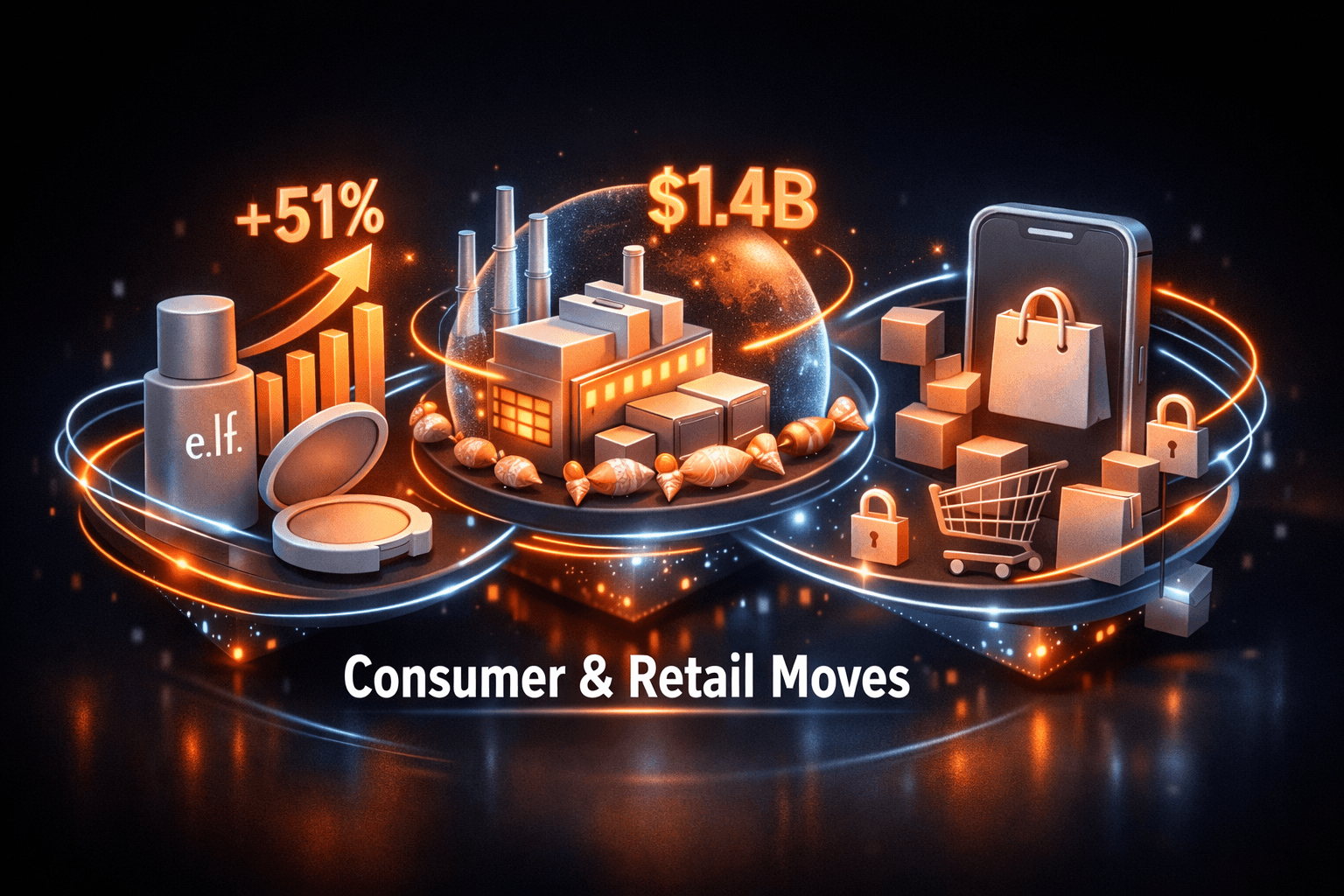
Beauty and snacking are taking center stage this morning, with e.l.f. Beauty reporting a 51% year over year sales increase and Mars announcing a $1.4 billion U.S. investment for 2027. Those moves point to strength in personal care and large-scale consumer staples spending on capacity and distribution.
At the same time, retailers are upgrading omnichannel playbooks and in-store experiences while managing cost and operational shifts, from plant closures to leadership turnover. What does that mean for you as a retail investor? It suggests pockets of momentum, but also the need to watch execution and risk around cyber and labor issues.
Market Highlights
Quick facts and notable metrics to start your trading day.
- e.l.f. Beauty ($ELF): Net sales rose 51% in fiscal Q2 2027 to $520.8 million, and management raised full-year guidance for a second straight quarter.
- Mars: Plans to invest $1.4 billion in U.S. manufacturing and operations in 2027, its largest annual domestic investment to date following the $36 billion acquisition of Kellanova assets.
- Mattel ($MAT): Launching a branded storefront on TikTok Shop to pursue live-commerce growth and direct-to-consumer reach.
- Ferrara: Will close a Chicago plant and lay off more than 150 workers, with the closure expected in April 2027, as the company reassesses market conditions.
- Industry ops and design: The Next Gen Store Awards highlighted brands including Anthropologie and Diptyque for experiential formats, underscoring in-store creativity as a growth lever.
Key Developments
e.l.f. Beauty posts a breakout quarter
e.l.f. reported a 51% increase in net sales to $520.8 million for fiscal Q2 2027, driven by European expansion at Sephora and stronger unit sales for its core brand. Management raised its full-year outlook, reflecting improved distribution and platform momentum. For you, that means the beauty segment is showing scalable demand where digital and retail placement combine, and analysts note this could pressure peers to show clearer international growth plans.
Mars doubles down on U.S. capacity after M&A
Mars' $1.4 billion commitment for 2027 is the largest domestic investment the company has announced in a single year, aimed at scaling its snacking portfolio after acquiring Kellanova assets. This kind of capital expenditure signals confidence in long-term consumer snacking trends and points to potential supply chain upgrades. It also raises the bar for competitors that may need to expand manufacturing or logistics to keep pace.
Omnichannel and operations: from TikTok to plant closures
Mattel's ($MAT) branded storefront on TikTok Shop shows how legacy toy brands are leaning into live commerce to reach younger buyers. Meanwhile, Lidl US continues store growth with a ninth 2026 opening planned in Baltimore, reflecting steady brick and mortar expansion. Counterbalancing those openings, Ferrara's planned Chicago plant closure and layoffs show companies are still adjusting manufacturing footprints to cost and innovation plans. Can brands keep this momentum while managing costs and labor? Execution will tell.
What to Watch
Forward-looking catalysts and risk areas to monitor for your positions.
- e.l.f. guidance and comp trends: Watch management commentary for margin trajectory and international sell-through, and track early reactions to the raised outlook.
- Capex deployment by Mars: Monitor announcements about where the $1.4 billion will be allocated, and whether that spurs supplier demand or local hiring that affects regional retailers.
- Wholesale versus DTC mix: Recent quarterly reports flagged surprises between DTC and wholesale channels. You should track SKU-level performance and wholesale orders, since shifts can quickly change margin profiles.
- Retail cybersecurity risk: The U.S. advisory on refrigeration system attacks means grocers and cold-chain operators may incur new security costs, and outages could cause episodic sales disruption. Keep an eye on industry guidance and any mandated compliance timelines.
- Leadership and restructuring: General Mills (GIS) reorganized into three operating segments amid a CEO change. Watch execution milestones and any guidance updates tied to the new structure. Ethan Allen ($ETH) replacing its long-time CEO adds governance and strategy risk for that chain.
Bottom Line
- Sector momentum is concentrated: beauty and snacking posted the biggest headlines, led by $ELF's 51% sales gain and Mars' large U.S. investment.
- Omnichannel innovation keeps accelerating, with Mattel moving into TikTok Shop and brands investing in in-store experience to differentiate.
- Operational adjustments persist, from Ferrara's plant closure to retailer leadership changes, so execution risk remains elevated.
- Cybersecurity for grocery refrigeration is a rising operational risk that could affect supply continuity and incremental costs across grocers.
- This briefing is informational only. Analysts note data suggests selective opportunities, but you should monitor execution, margins, and regulatory or security developments before drawing conclusions.
FAQ Section
Q: How did e.l.f. achieve 51% sales growth? A: e.l.f. cited stronger unit sales for its core brand and distribution gains, including the Rhode launch at Sephora in Europe, which helped drive the lift.
Q: Will Mars' $1.4B investment change competition in snacks? A: The investment signals capacity and distribution expansion, and it may pressure peers to match scale or accelerate their own capex plans to protect shelf presence.
Q: What should retailers do about the refrigeration cybersecurity advisory? A: Retailers should assess internet-connected systems, prioritize patching and network segmentation, and be ready to disclose any material incidents if they affect operations.