The Big Picture
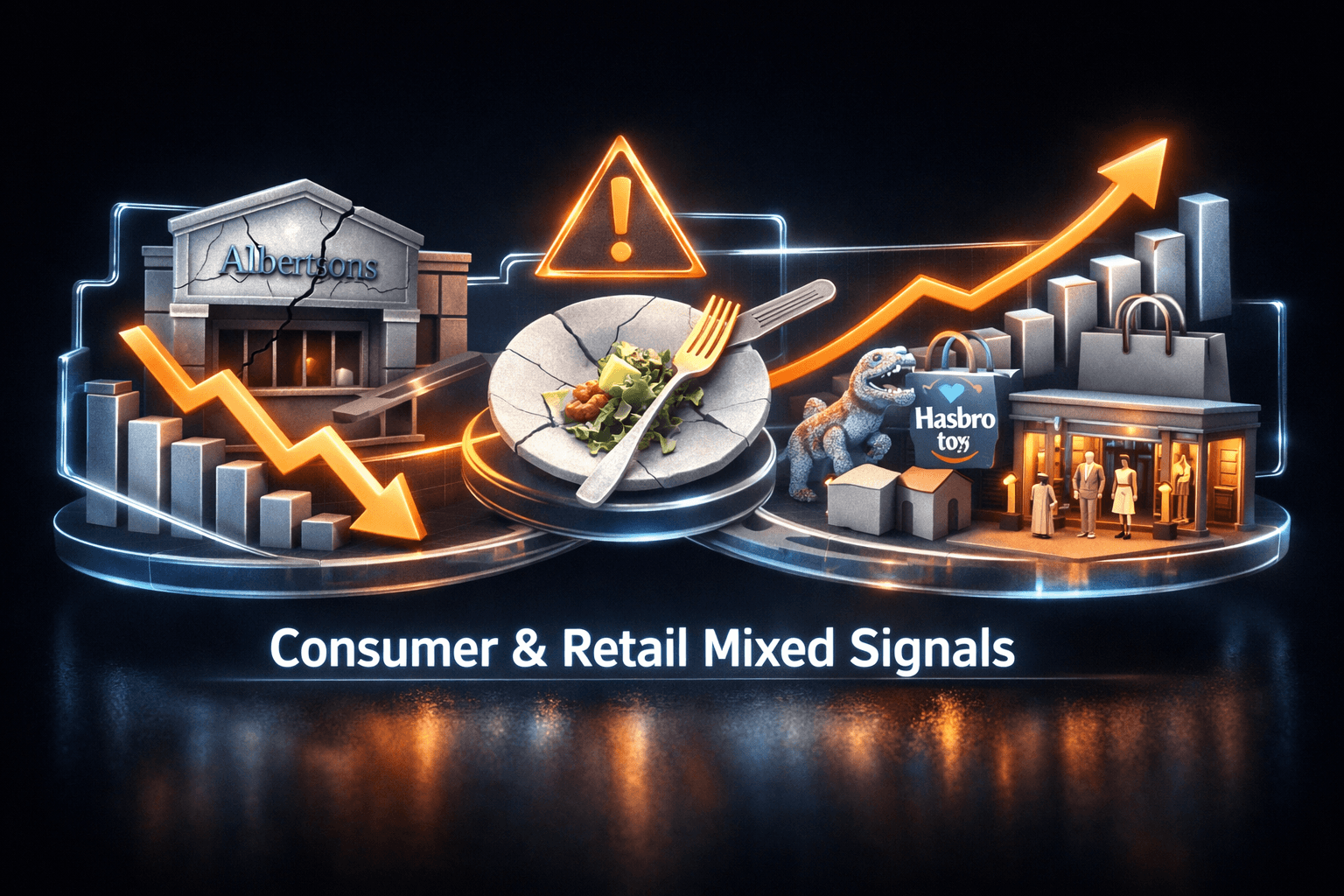
Today’s most impactful development was renewed pressure in the grocery aisle, as Albertsons signaled deeper cost cuts after reporting another quarter of falling identical-store sales. At the same time, a Gallup finding that U.S. consumer trust in food safety hit a record low adds a broader demand risk for grocers and food makers.
Those headwinds were balanced by product, content and experience moves across the rest of retail. You saw Hasbro expand into original Dungeons & Dragons content, Nordstrom revamp holiday offerings and several brands say they’re doubling down on physical stores even as AI reshapes back-office operations. That mix leaves the sector sending mixed signals to you, investors and analysts.
Market Highlights
Quick snapshots to keep you informed as markets trade today.
- Albertsons, $ACI, flagged additional cost cutting and the possibility of layoffs and store closures after reporting a third straight quarter of declining identical sales.
- Albertsons filed a lawsuit seeking about $8 billion from Kroger, $KR, claiming a lost merger premium after Kroger prioritized its own interests over regulatory pursuit.
- Hasbro, $HAS, opened a new Wizards of the Coast studio in Montréal to develop Dungeons & Dragons content, signaling more direct-to-consumer IP investment.
- Nordstrom, $JWN, rolled out expanded FAO Schwarz assortments and same-day beauty delivery in select markets, plus new holiday app features aimed at conversion during peak season.
- Broader trends: Gallup reports record-low consumer trust in food safety, while several brands and chains, including Crocs, Kohl’s and others, say they’re investing in stores despite AI-driven changes online.
Key Developments
Grocery pressure: Albertsons' cost drive and the Kroger dispute
Albertsons’ management told investors it’s accelerating cost reductions after another quarter of falling identical sales. The company explicitly said layoffs and market-specific store closures are options, which raises near-term margin relief concerns along with execution risk for the turnaround.
Separately, Albertsons filed a pretrial brief seeking roughly $8 billion from Kroger, $KR, over a failed merger that it says deprived shareholders of a merger premium. The legal fight creates added uncertainty for both companies, and it’s something you’ll want to watch as pretrial filings and schedules move forward.
Consumer confidence in food safety slips, behavioral consequences
Gallup’s new data showing trust in food safety at record lows comes after high-profile recalls and a Cyclospora outbreak. That erosion of trust can shift buying patterns toward smaller, perceived-safer brands, private label, or away from categories with recent incidents.
For you this means demand for some staples could be vulnerable, and food makers and grocers may face higher marketing and quality assurance costs to rebuild confidence. Analysts note this is a multi-quarter risk to volume and price mix in packaged foods and perishables.
Product, IP and stores: where retailers are placing bets
Not all news was negative. Hasbro, $HAS, opening a dedicated Wizards of the Coast studio in Montréal underscores the push into owned content and franchise monetization. Licensing and IP collaborations like the ACOTAR craze continue to drive marketing tie-ins and differentiated assortments for apparel and lifestyle brands.
Nordstrom, $JWN, is beefing up holiday convenience with new same-day services and expanded FAO Schwarz assortments, aiming to capture gift-buying demand. Meanwhile, executives across brands from Crocs, $CROX, to Kohl’s, $KSS, are saying they’ll invest in physical stores even as they layer in AI. That suggests a selective bullish case for experiential retail heading into the holidays.
What to Watch
Here are the catalysts and risks that could move the sector next.
- Legal timetable between Albertsons and Kroger, including discovery and any pretrial rulings, which could alter near-term risk pricing for both companies.
- Upcoming retailer and packaged-food earnings, where you should watch comparable-store sales, promotion cadence, and commentary on food safety and supply chain costs.
- Holiday season execution, including adoption rates for same-day and app-driven features. Will you see conversion lift from Nordstrom’s changes, and can others replicate quick-delivery offerings profitably?
- Consumer confidence metrics and any further foodborne illness reports or recalls, which could depress demand in vulnerable categories over the next few months.
- Licensing and IP partnerships, plus content investments, which could drive incremental sales and margin premium for owners of popular franchises.
Bottom Line
- Sector sentiment remains mixed, with grocery and food-safety headwinds offset by content, experiential and store investment initiatives.
- Watch legal developments around the Albertsons-Kroger dispute, they could be a major swing factor for grocery valuations.
- Monitor consumer-trust trends and recall headlines closely, since they can change category demand quickly and create margin pressure.
- Don’t discount investments in stores and IP, they may deliver durable gains for select retailers heading into the holiday season.
- Keep a selective approach, and follow upcoming earnings and holiday metrics for clarity on who’s gaining share.
FAQ
Q: How serious is Albertsons’ situation for the grocery sector? A: Albertsons’ sequence of falling identical sales and a move toward deeper cost cutting signals material company-specific stress, and analysts note the Kroger suit adds legal uncertainty that could ripple through sector sentiment.
Q: Should you worry about food safety headlines hurting demand? A: Yes, reduced consumer trust can translate into lower category volumes and higher remediation costs, so you should monitor recall frequency and Gallup or other consumer confidence updates.
Q: Are store investments still a good signal for retailers? A: Store investment is not a universal green light, but many brands say experiential and fulfillment-related store upgrades are boosting conversion, so you should look for measurable ROI signals in same-store sales and margins.