The Big Picture
A wave of tech-first moves and targeted M&A set the tone for the Consumer & Retail sector this morning. DoorDash is pushing deeper into marketplace retail, commerce platforms are rolling out AI tools to prepare catalogs for discovery, and Hormel is expanding protein capacity with a $1 billion acquisition.
These developments matter because they sharpen two durable themes you should be watching: platforms and data-driven merchandising, and scale-driven consolidation in food and consumer packaged goods. Taken together, the news suggests momentum for companies that can blend distribution, AI-enabled product discovery, and supply-chain scale.
Market Highlights
Quick facts and numbers to note from overnight and recent filings.
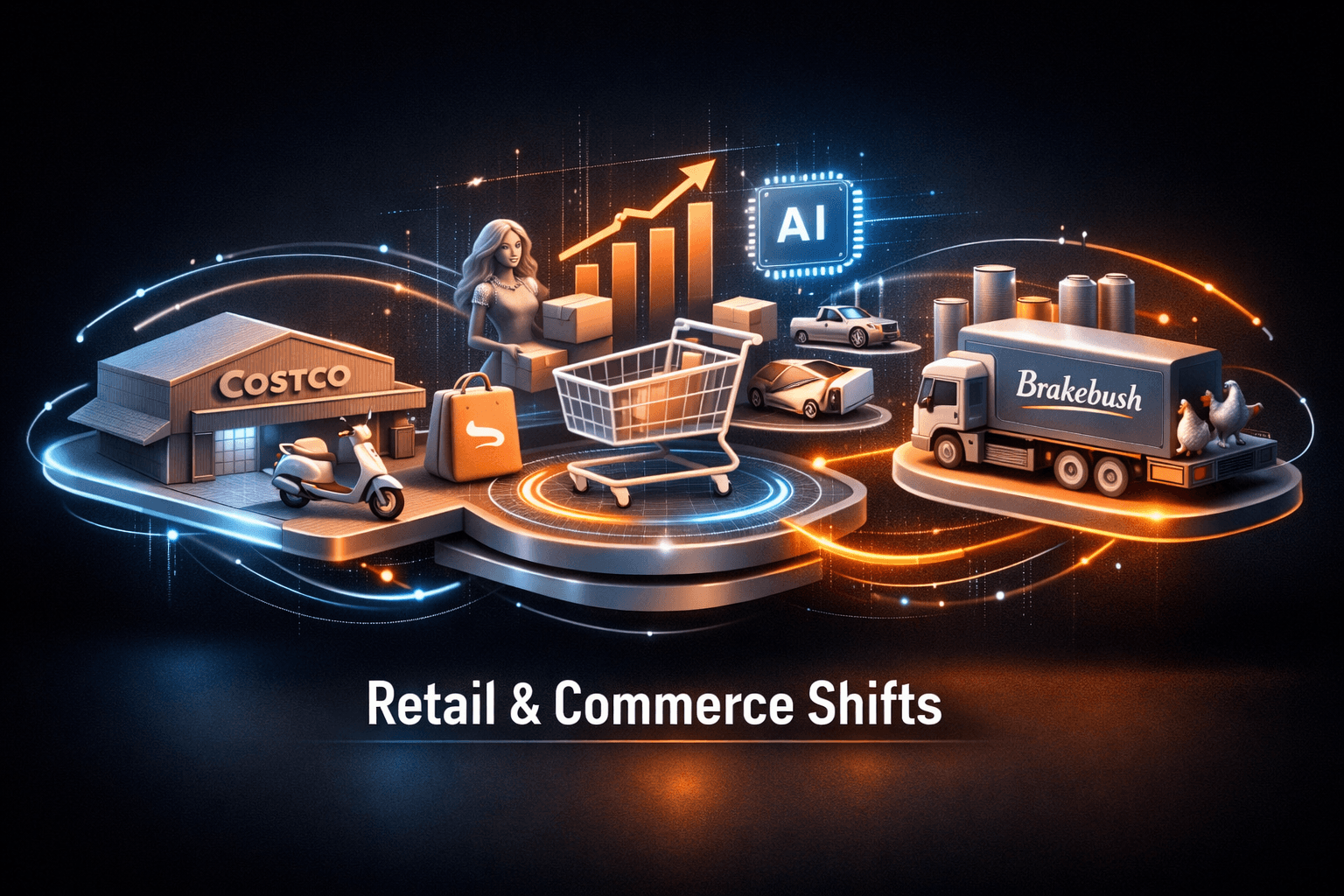
- DoorDash ($DASH) expanded its retail partnerships to include Costco ($COST) and introduced features such as Text DoorDash and Dasher Returns to build a one-stop marketplace.
- Commerce and related brands launched two AI tools, Feedonomics Enrichment and BigCommerce Catalog Enrichment, aimed at making catalogs ready for AI discovery and improving merchant searchability.
- Hormel ($HRL) agreed to buy chicken processor Brakebush Brothers for about $1.0 billion to strengthen its value-added chicken and foodservice footprint.
- 1-800-Flowers ($FLWS) is selling PersonalizationMall.com and Things Remembered for $45 million, a sharp decline from the roughly $245 million paid six years ago.
- Mattel ($MAT) named Roger Lynch, formerly CEO of Condé Nast, as its new chief executive as Ynon Kreiz steps down.
Key Developments
DoorDash expands retail reach and shopping features
DoorDash is moving beyond restaurant delivery toward a broader retail marketplace by adding partners including Costco, and by rolling out Text DoorDash alongside Dasher Returns. These product changes aim to shorten the path from discovery to purchase, and to improve post-sale flows for returns. For you, that means DoorDash is positioning itself as a utility for convenience shopping, which could pressure traditional grocers and third-party logistics providers.
Commerce and BigCommerce launch AI catalog tools
Commerce introduced Feedonomics Enrichment and BigCommerce Catalog Enrichment to help merchants ready product catalogs for AI discovery, serving B2B and B2C customers. The tools are designed to standardize feeds, enrich metadata, and make items more discoverable by AI agents. If you follow e-commerce platforms or merchants, expect AI-driven search and recommendation upgrades to become a competitive baseline rather than a novelty.
Hormel buys Brakebush, while 1-800-Flowers trims assets
Hormel’s $1 billion purchase of Brakebush Brothers adds scale in value-added chicken and a deeper foodservice footprint for the Spam maker. That deal underscores consolidation in protein and the premiumization of prepared foods. At the other end, 1-800-Flowers sold PersonalizationMall.com and Things Remembered for $45 million, down from a $245 million acquisition price about six years ago, highlighting how previously high-growth direct-to-consumer bets can come back to earth.
What to Watch
Expect several near-term catalysts and risks that could move stocks in this group. Earnings seasons, execution on integration, and adoption of AI tools will be focal points.
- Earnings and guidance: Watch upcoming quarterly reports for names like $DASH, $PEP, $HRL, and specialty retailers for revenue per order trends and margin impact from tech investments.
- AI adoption signals: Track merchant uptake of the new Feedonomics and BigCommerce enrichment tools and any case studies showing higher discovery or conversion rates. Will AI discovery lift average order values and reduce customer acquisition costs?
- M&A and restructuring: Monitor Hormel’s integration cadence and any commentary from $FLWS on how proceeds will be used after the asset sale. Trade-offs between portfolio focus and returns matter for long-term margins.
- Retail platform partnerships: See whether Costco integration with $DASH expands to inventory or pricing syncs, or whether this remains a limited SKU test. Your exposure to platform-led retail depends on rollout scale.
- Consumer trends and marketing: Creative partnerships and multicultural outreach are gaining emphasis. Brands that hand over the keys to creators and prioritize bilingual marketing may reach multicultural customers more effectively, but you should watch execution risk and measurement.
Bottom Line
- Platform expansion and AI tools are the main bullish themes today, as companies push to make discovery and fulfillment more seamless.
- Hormel’s $1 billion deal signals continued consolidation in food manufacturing and foodservice, which can support scale economics for acquirers.
- The $45 million sale by $FLWS highlights how earlier strategic bets can underperform, a reminder to watch capital allocation closely.
- Mattel’s leadership change to Roger Lynch is material for strategic direction, but execution and product roadmap will dictate investor reaction.
- For your portfolio exposure, focus on companies that demonstrate measurable AI adoption, scalable distribution, and disciplined M&A integration.
FAQ Section
Q: How might DoorDash’s new Costco partnership affect grocers? A: The Costco tie-up positions $DASH to capture more bulk and convenience orders, increasing competitive pressure on grocers that rely on in-store loyalty and pickup economics.
Q: Will the new AI catalog tools immediately boost sales for merchants? A: Data suggests these tools improve discoverability and feed quality, but measurable sales lifts typically follow technical integration and optimization over several quarters.
Q: What does Hormel’s acquisition mean for protein markets? A: The $1 billion purchase of Brakebush Brothers increases Hormel’s presence in value-added chicken and foodservice, which may improve scale and margin mix if integration runs smoothly.