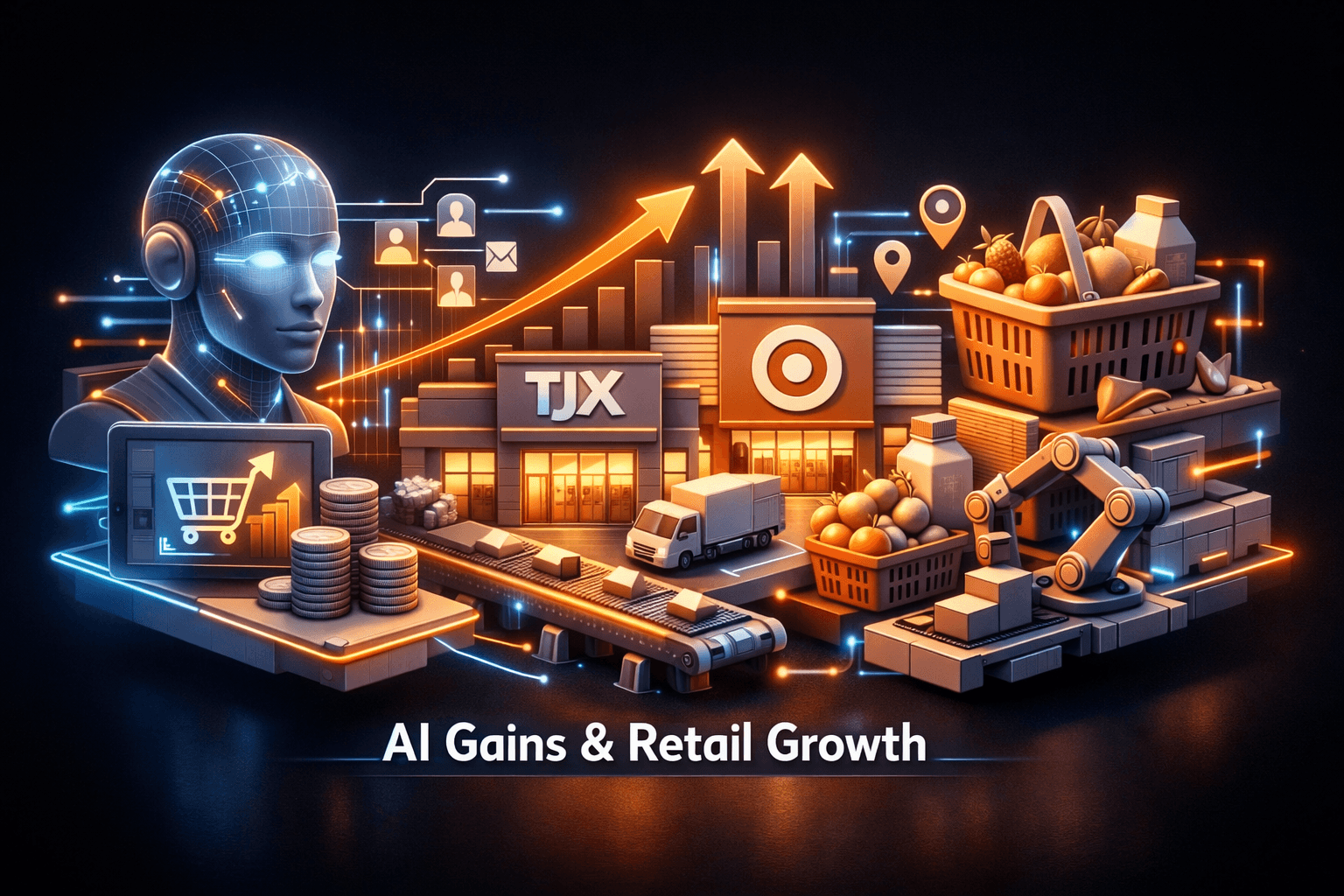
The Big Picture
Retailers and service providers are leaning into AI and operations upgrades, and the early results look tangible for revenue and efficiency. Adobe data shows AI-referral traffic generating 53 percent more revenue per visit, and several major retailers are translating strategic investments into traffic and sales gains.
That momentum comes as a mix of industry-specific headwinds persists, including $LOW trimming its outlook and an activist pushing $ZVIA toward a sale. For you as an investor, the picture suggests selective opportunity, with technology and off-price channels leading the way.
Market Highlights
Quick takeaways you can scan before the open.
- Adobe analytics finds AI referrals are converting better and spending more, generating 53 percent more revenue per visit than non-AI referrals, according to Digital Commerce 360.
- $TJX, parent of TJ Maxx, Marshalls and HomeGoods, plans to accelerate store openings after strong off-price performance.
- $TGT saw food and beverage sales rise 7.2 percent year over year in Q2, fueling single-digit net and comp sales growth.
- $LOW cut its outlook as DIY spending remains pressured, though Pro, home services and online sales helped deliver a 0.2 percent comp increase.
- $WMT is rolling out Symbotic fulfillment, with the SymMicro system expected to be operational in about six months to speed pickup and delivery.
Key Developments
AI is driving higher-value traffic, and brands are setting the rules
Adobe's July data points to a material lift from AI referrals, with shoppers from AI sources spending 53 percent more per visit. That suggests AI can improve the quality of traffic and conversion funnels for online retailers, data suggests.
At the same time, marketers are drawing lines around customer-facing AI use, according to Modern Retail. Many brands are using AI while restricting certain creative and messaging applications. What does that mean for you, the investor? It means adoption will likely be uneven, but where companies pair strong controls with AI-driven discovery and personalization, conversion gains could follow.
$TJX ramps expansion as off-price momentum builds
$TJX told Modern Retail it will accelerate store openings as off-price demand remains healthy. Off-price chains often benefit in late-cycle retail environments, and $TJX's move to expand suggests management sees room to gain share.
For investors, that expansion is a growth lever that could support comp-store trends and margin resilience, especially if the company keeps disciplined inventory sourcing.
Groceries, automation and defensive moves reshape retailer playbooks
$TGT's grocery sales rose 7.2 percent year over year, according to Grocery Dive, giving its turnaround tangible momentum. That grocery strength provided a shot in the arm for overall comps in Q2 and highlights how food and consumables can stabilize traffic.
$WMT is fitting a store with Symbotic's SymMicro fulfillment system to speed in-store pickup and delivery workflows. The system is expected to come to life in about six months, which could lift fulfillment efficiency and labor productivity where deployed.
Headwinds: $LOW outlook cut, Zevia activism, brand risk at Neutrogena
$LOW trimmed guidance as DIY spending remains pressured, even though Pro and online channels showed gains. A 0.2 percent comp increase underlines the uneven recovery in home improvement, and analysts note guidance revisions often weigh on short-term sentiment.
Separately, an activist investor urged $ZVIA to pursue a sale, arguing the company missed opportunities in the better-for-you soda category. And Modern Retail covered a Neutrogena controversy over an ambassador partnership that sparked online backlash, raising questions about brand trust and long-term loyalty. Can brand trust recover quickly after a public dispute? That will depend on response strategy and customer sentiment trends.
What to Watch
Focus on measurable catalysts and risks over the next weeks.
- AI metrics: Watch follow-on data from Adobe and retailers about conversion lifts, average order values and return rates for AI-driven referrals. If the 53 percent lift holds across more retailers, the case for technology-led revenue growth strengthens.
- Store openings and cadence: Track $TJX's rollout plans and potential store count guidance updates. New openings and market share gains can have outsized impact on mid-cycle comps.
- Fulfillment rollouts: Monitor $WMT's Symbotic deployment and any reported productivity metrics. Early operational improvements can be a leading indicator for broader adoption.
- Earnings and guidance updates: $LOW's revised outlook is a red flag for DIY exposure. Look for updates from home improvement peers and any investor commentary on consumer spending patterns.
- Brand risk and activism: Follow developments at $ZVIA and reporting on Neutrogena's brand sentiment. Social backlash and activist campaigns can rapidly affect sales and valuation if they alter customer behavior.
You'll want to keep an eye on weekly same-store sales, traffic trends, and any commentary about AI governance from major consumer brands. Are companies balancing AI performance gains with reputational risk? That's the question to track.
Bottom Line
- AI is translating into higher-quality traffic, with Adobe reporting a 53 percent revenue lift per AI referral, which could reshape digital marketing ROI.
- $TJX and $TGT show operational momentum through store expansion and grocery strength, offering selective growth stories within the sector.
- $WMT's Symbotic deployment is a near-term efficiency catalyst to watch, expected to be operational in about six months.
- Not all news is positive, as $LOW's outlook cut and activist pressure at $ZVIA highlight exposure to headwinds and governance risks.
- For you, the path forward is selective. Focus on companies showing measurable AI uplift or operational leverage, while monitoring brand risk and discretionary demand trends.
FAQ
Q: How significant is the Adobe finding that AI referrals generate 53 percent more revenue per visit? A: It's a notable early indicator that AI-driven referrals can lift average revenue per visit, but you'll want to see broader replication across retailers and sustained conversion improvements before calling it a structural shift.
Q: Should I be worried about $LOW's outlook cut? A: The cut points to continued pressure in DIY spending, but $LOW's growth in Pro, services and online partially offsets weakness. Watch next quarter's guidance and comps for clarity.
Q: What does the Neutrogena controversy mean for brand-focused retailers? A: Brand disputes can dent loyalty, especially in beauty and CPG categories. Analysts note that recovery depends on response speed, transparency, and whether the issue affects core customers' purchase behavior.
Investment disclaimer: This briefing presents market analysis and reported facts for informational purposes only. It does not recommend buying, selling, or holding any security, and it does not provide personalized investment advice.