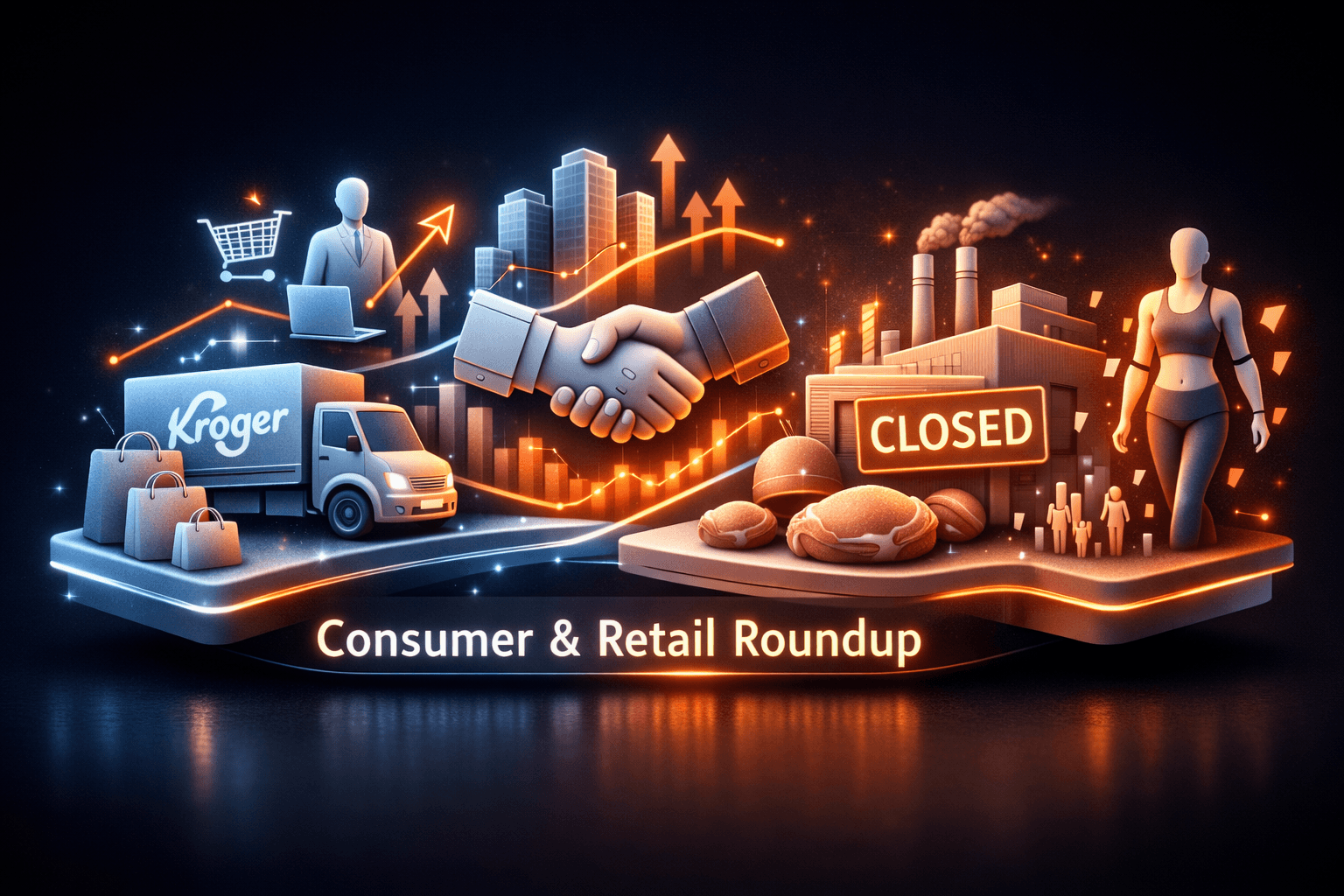
The Big Picture
Headline moves in the consumer and retail sector over the past 24 hours send mixed signals to investors. Strategic hires and deal activity show companies pushing to scale digital reach and better-for-you assortment, while closures, layoffs and executive turnover underscore persistent operational headwinds.
Markets were closed Saturday, so all price references and investor positioning are referenced as of Friday, August 14, heading into the long weekend. If you follow grocery, home improvement or apparel, you should pay attention to how these stories influence sentiment when markets reopen on Monday.
Market Highlights
Key facts and quick takes to scan before the next session.
- Kroger announced Nate Faust as EVP and chief ecommerce officer, effective Sept. 1, signaling renewed focus on online grocery execution. The move puts $KR squarely in focus among grocery peers.
- Tyson Foods said it will close or divest three beef plants and lay off at least 2,500 workers as it contends with a cattle supply shortage and heavy losses, a material operational shift for $TSN.
- Home Depot-owned SRS Distribution agreed to buy Lohmiller & Company, adding four HVAC locations in Colorado, expanding $HD's indirect reach into contractor distribution.
- Ferrero continued its consolidation in cereals and better-for-you breakfast with the purchase of Purely Elizabeth, following its $3.1 billion acquisition of WK Kellogg in 2025.
- Michaels rolled out a new store format at three locations with upgraded personalization services and a rewards-member self-checkout queue, a test that could influence $MIK's omnichannel plan.
- Executive churn drew attention at $LULU as the company’s AI chief, who’d been in the role less than a year, exited ahead of leadership changes and raised flags for analysts.
Key Developments
Kroger names new ecommerce chief, bets on simpler online execution
Nate Faust will take over Kroger’s ecommerce operations on Sept. 1, bringing experience from Walmart and Jet.com. Analysts and industry outlets note Faust’s founder energy and outsider perspective could simplify Kroger’s complex digital stack, but operational fixes will take time and capital.
What should you watch? Kroger’s ability to streamline fulfillment, cut costs and improve user experience will determine whether this hire moves the needle for margins and market share in a fiercely competitive grocery sector.
Tyson plant closures highlight supply-chain pressure across protein
Tyson’s decision to close or sell three beef facilities and cut at least 2,500 jobs underscores a supply-driven profit squeeze. The company cited a cattle shortage and mounting losses, and this restructuring will likely compress short-term volumes and change regional supply flows.
This matters for packer margins and for retailers that rely on steady beef supply. Do higher wholesale costs or tighter availability show up in consumer prices? Keep an eye on pricing and inventory updates from grocers and wholesalers next week.
Deals and format tests: Ferrero, SRS, Michaels and private equity lessons
M&A and format innovation are shaping shelf and channel strategies. Ferrero’s acquisition of Purely Elizabeth expands its better-for-you breakfast portfolio, fitting into a broader push after the WK Kellogg deal. Home improvement distribution is consolidating as SRS buys Lohmiller to beef up HVAC reach in Colorado.
Retailers are also experimenting with stores. $MIK is testing revamped layouts and member-only checkout lanes. On the DTC front, the Modern Retail podcast’s Tubby Todd case study showed how private equity can accelerate shelf entry into partners like Target, but it also raises tradeoffs around brand control and margin pressure.
What to Watch
Here are the catalysts and risks to track into next week and beyond.
- Earnings and commentary:Watch grocery and protein suppliers for commentary on supply chains and pricing. Any updated guidance from $KR, $TSN or wholesalers could move sentiment.
- Operational milestones:Kroger’s new ecommerce leader starts Sept. 1, so early execution moves and roadmap details will matter for digital margins. Michaels’ store tests may roll out further if initial performance is solid.
- Regulation and labeling:The FDA delay on defining ultraprocessed foods has opened the door for legislative action. If Congress acts, product reformulation or label changes could be required for many packaged-food players.
- Labor and capacity risks:Tyson’s closures and layoffs could ripple across suppliers and retailers, affecting availability and pricing seasonally. Monitor inventory and freight indicators.
- Leadership stability:Executive turnover at $LULU raises questions about how quickly strategy and AI initiatives will be implemented. Who stays and who goes matters for tech-enabled retail moves.
Bottom Line
- Mixed signals dominate: strategic hires and acquisitions point to growth initiatives, while closures and churn show real operational risk.
- If you follow grocery or CPG, watch supply and pricing commentary closely when markets reopen, because protein constraints and labeling debates could affect margins.
- Retailers testing store formats and personalization are trying to separate the wheat from the chaff in omnichannel playbooks, and early pilots will signal who scales next.
- Analysts note that private equity can accelerate distribution gains but may introduce tradeoffs in brand control and margins; evaluate those deals case by case.
- This summary is for informational purposes only and not investment advice. It reflects news through Friday, August 14, and forthcoming newsflow should guide your view.
FAQ Section
Q: How will Kroger’s new ecommerce chief affect online grocery competition? A: Expect a renewed focus on simplifying operations and fulfillment; changes will be gradual and dependent on execution and capital allocation.
Q: Should I be worried about protein supply after Tyson’s announcement? A: The closures highlight regional supply stress, which could lead to tighter availability and potential near-term price pressure, but broader market impacts depend on redeployment of capacity.
Q: Will regulatory moves on ultraprocessed foods change product portfolios? A: Possibly, yes. If Congress or the FDA establishes firm definitions, many manufacturers could face labeling, reformulation or marketing changes that affect costs and shelf placement.