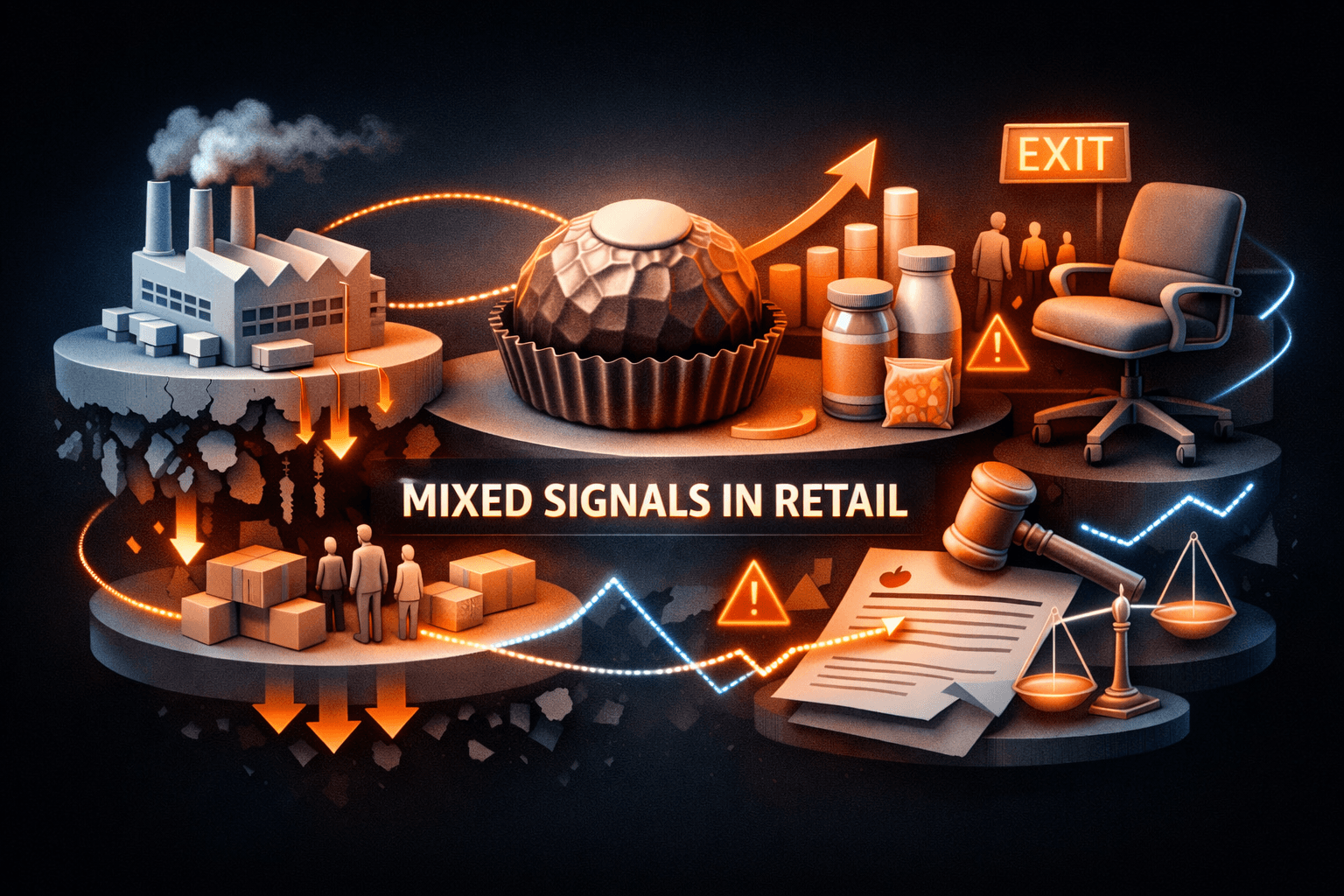
The Big Picture
Today the Consumer & Retail sector served up a mixed bag of growth initiatives and cost-cutting moves that matter to shareholders and workers alike. Strategic expansion by food and lifestyle brands sat beside plant closures, executive departures and one notable bankruptcy, leaving investors with both opportunities and risks to weigh.
If you follow this sector you saw deals and distribution wins that point to longer term growth, but you also saw operational pain and governance questions that could pressure margins and sentiment in the near term.
Market Highlights
Below are the most market-relevant headlines and the concrete figures that moved the story today.
- Ferrero expands its better-for-you portfolio with the acquisition of Purely Elizabeth, building on Ferrero's earlier $3.1 billion purchase of WK Kellogg in 2025.
- Kroger names Nate Faust to lead e-commerce, a move aimed at simplifying a business critics call overly complex. The hire signals a push to improve $KR's online execution.
- Michaels ($MIK) rolled out a new store format at three locations, adding personalization services and a rewards-member self-checkout lane to lift in-store conversion.
- Lululemon ($LULU) saw another senior-tech exit as AI chief Ranju Das leaves less than a year into the role, intensifying analyst concern about turnover ahead of incoming CEO Heidi O'Neill's start.
- Tyson Foods ($TSN) will close or sell three beef plants and lay off at least 2,500 workers amid a cattle shortage and heavy losses, a major operational setback for the meat sector.
- PepsiCo ($PEP) will cease warehouse operations at an Oklahoma production site, affecting more than 180 warehouse employees though production will continue.
- Mud Jeans filed for bankruptcy, underlining pressures on debt-laden niche apparel players as broader retail divergence continues.
- Brands including H&M, Chobani and UrbanStems outlined refined partnership strategies aimed at audience alignment and cultural relevance, a distribution and marketing playbook for growth.
- Non-alcoholic beer brand Bero expanded into major retailers including Walmart, Kroger and Publix and built an internal B2B portal to support wholesale scale-up.
Key Developments
Ferrero keeps buying in the better-for-you aisle
Ferrero's purchase of Purely Elizabeth adds another clean-label breakfast brand to its portfolio, following the 2025 $3.1 billion acquisition of WK Kellogg. The deal reinforces the global push into faster-growing, premium grocery niches, and it shows consolidation remains an active play in packaged foods.
For you as an observer, this signals continued appetite among large CPG players for portfolio diversification and shelf-stable brands that can command higher margins.
Operational and workforce pressure at big food companies
Tyson's announcement to close or sell three beef plants and lay off at least 2,500 workers is the most disruptive operational story today. The company cites a cattle shortage and financial strain. Similarly, PepsiCo will wind down warehouse operations at an Oklahoma site, affecting about 180 workers while keeping production running.
These moves highlight supply chain fragility and margin pressure in commodity-linked categories. Data suggests processing capacity and labor dynamics remain key risk factors into earnings season.
Retail strategy and talent shakeups: Michaels, Kroger and Lululemon
Michaels' test of a new store format aims to broaden in-store appeal with personalization and rewards-driven checkout perks. This is a push to convert foot traffic into higher basket values, and it may offer a playbook for other experiential retailers.
Kroger's $KR e-commerce appointment of Nate Faust signals a recognition that its digital business needs simplification. But can an outsider's founder energy untangle legacy systems and partnerships quickly enough to move the needle? Meanwhile, Lululemon's $LULU talent churn, with the exit of its AI chief Ranju Das, has analysts increasingly concerned about leadership continuity ahead of a CEO transition.
What to Watch
Look ahead to catalysts that could shift sentiment in the coming days and weeks. You'll want to track several items closely.
- Earnings and guidance: Watch upcoming quarterly reports for $TSN, $PEP, $KR and other majors, where margin commentary will reflect plant closures and e-commerce investment decisions.
- Labor and capacity updates: Monitor communications from Tyson and other processors on capacity shuffle timelines. Worker impacts may prompt regional supply disruptions and cost swings.
- Executive stability: Keep an eye on $LULU board commentary and appointments as Heidi O'Neill's start approaches. Leadership continuity matters for AI and digital strategy execution.
- Regulatory rules and labeling: The FDA delay on defining ultraprocessed foods has pushed lawmakers into the fray, so follow any state or federal legislative moves that could affect product labeling and reformulation costs.
- Retail tests and rollouts: If Michaels' new format expands beyond three stores, that will indicate its potential ROI. You should watch pilot metrics for traffic, basket size and rewards adoption.
Bottom Line
- Sector sentiment is neutral, balancing strategic M&A and distribution wins against plant closures, layoffs and executive churn.
- Ferrero's acquisition trend points to continued consolidation in better-for-you and shelf-stable categories, which could reshape competitive dynamics.
- Operational risks at Tyson and localized closures at PepsiCo underscore supply and labor pressures that may show up in near-term margins.
- Leadership moves at Kroger and Lululemon will be pivotal for e-commerce and AI execution, so monitor follow-up hires and strategy updates.
- Regulatory uncertainty over ultraprocessed foods adds another variable for food makers, particularly around labeling and reformulation costs.
FAQ Section
Q: How does Ferrero's Purely Elizabeth buy affect the grocery landscape? A: The acquisition reinforces consolidation in better-for-you categories and signals continued interest from large multinationals in premium, growth-oriented brands.
Q: What should you expect from Kroger's new e-commerce chief? A: Nate Faust brings startup experience and an outsider perspective, which may accelerate simplification and platform consolidation, but results will depend on execution timelines and legacy integration challenges.
Q: Will Tyson and PepsiCo closures affect product availability? A: Plant and warehouse changes can cause regional disruptions, especially in beef supply chains, so you should watch company updates and retailer inventory communications for local impacts.