The Big Picture
Retail and consumer brands woke up to a fresh wave of practical innovation today, as AI agents, automation in food and beverage distribution, and product reformulation with natural ingredients all moved from concept toward deployment. That matters because these shifts affect how customers find products, how stores operate, and how brands protect margins and trust.
If you follow retail closely, you're seeing companies test real-world use cases rather than just pilot ideas. From Best Buy's AI-focused store layouts to Schnucks' health-tracking assistant, the sector is placing bets that could change sales discovery and operational efficiency ahead of the next holiday cycle.
Market Highlights
Key developments to watch this morning include retailer experimentation with AI agents, marketing platforms reworking audience strategies for Black Friday and Cyber Monday, and CPGs leaning into natural ingredient reformulations.
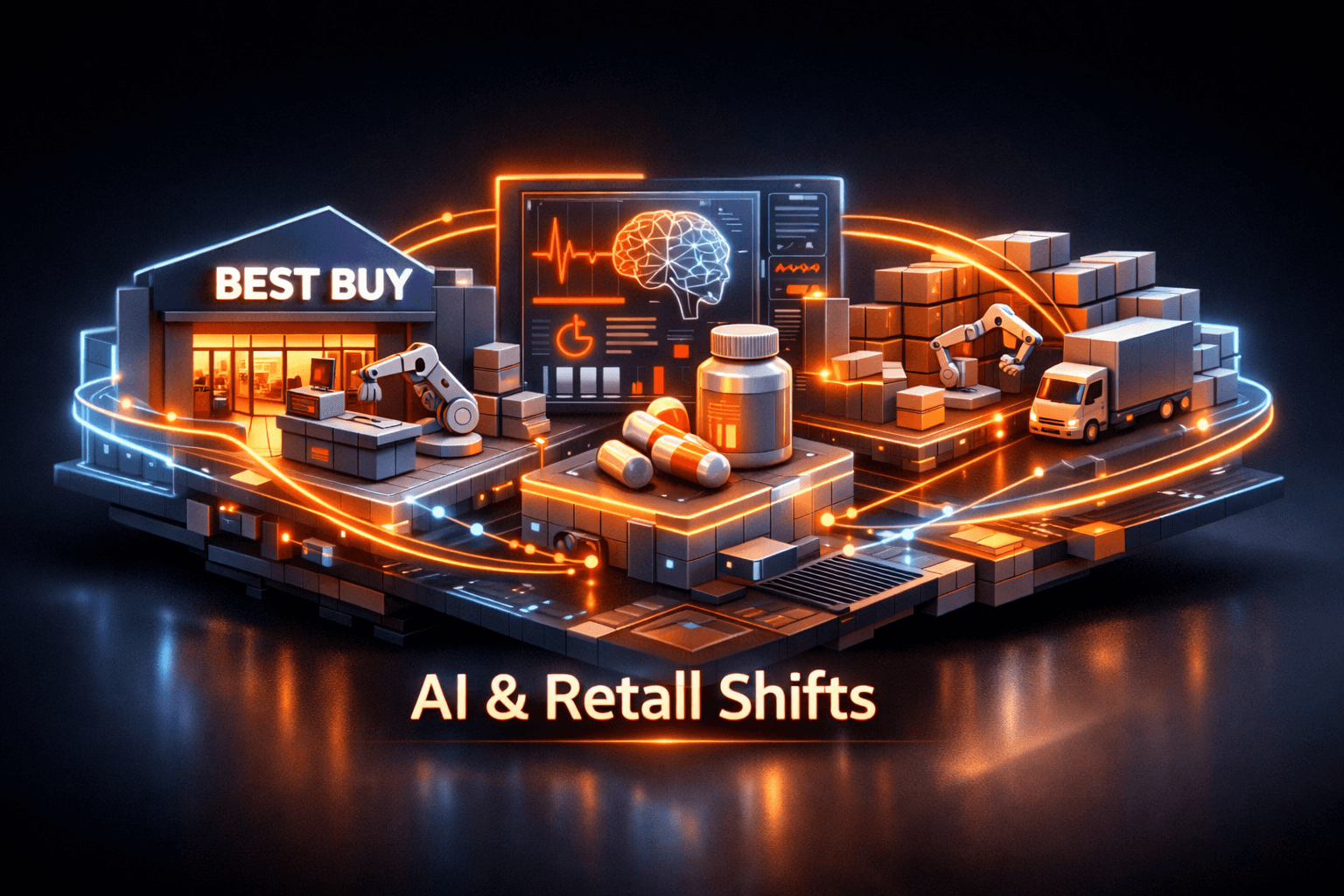
- Best Buy, $BBY, is rethinking store footprints to showcase AI products such as Ray-Ban Meta glasses and to give shoppers a hands-on experience.
- Meta, $META, is tied to retail experiments through its Ray-Ban collaboration as retailers create shop-in-shops and trained staff to demonstrate mixed reality hardware.
- Regional grocer Schnucks launched a health-tracking AI assistant intended to guide shopping and nutrition, positioning the chain as a model for personalized in-store tech.
Key Developments
In-store AI and the shopper assistant test cases
Schnucks rolled out a health-tracking AI assistant that aims to help consumers choose healthier options and streamline the shopping journey. Best Buy is converting parts of its footprint into AI playgrounds for devices like Ray-Ban Meta glasses, and it's training staff to sell use cases not just devices.
For you as an investor, these pilots matter because they test monetizable services and higher-margin categories, while giving chains new ways to increase basket size and customer loyalty.
Marketing strategy, discoverability and AI-driven decisions
Two sponsored Retail Dive pieces flagged a shared challenge: marketers must audience-proof campaigns and ensure brands are structured to be found by AI purchasing systems. The guidance is practical, urging simulation of audience reactions before holiday campaigns and rethinking SEO and product data for algorithmic discovery.
That suggests brands that invest in data hygiene and simulation tools might avoid wasted ad spend, and that marketing effectiveness could decouple from traditional tactics as AI platforms take a larger role in purchase decisions.
CPG reformulation and automated supply chains
Food Dive covered two related themes. First, CPGs reformulating with natural ingredients must protect shelf life and quality to maintain consumer trust. Second, automation is being used across food and beverage distribution to boost speed and accuracy.
These moves could reduce waste and improve margins if execution is sound, but they also require capital and rigorous testing. Data suggests companies that get both product science and distribution automation right may gain share in a crowded CPG market.
What to Watch
Expect three near-term focus points that should determine whether today's pilots scale or remain experiments.
- Holiday readiness and BFCM simulations. Are brands running audience simulations to defend their Black Friday and Cyber Monday campaigns, and are those tests surfacing actionable changes to product feeds and creative?
- Retail rollouts and shopper engagement metrics. Track customer conversion, time spent with demos, and attach rates for AI devices at $BBY shop-in-shops and Schnucks pilot locations. Will trials convert into repeat behavior?
- Supply chain and reformulation outcomes. Watch shelf-life test results, recall rates, and fulfillment accuracy as automation projects expand. Any improvement in on-shelf availability or reduced waste will show up in margins over time.
Don't forget regulatory and execution risks. AI assistants raise privacy questions, and reformulated products can disappoint consumers if taste or stability suffers. How will you judge success? Look for measurable KPIs such as conversion lift, average order value, and waste reduction percentages.
Bottom Line
- Retailers are moving beyond proof of concept on AI and automation, and today's developments indicate practical deployment rather than theory.
- Brands that invest in data hygiene, discovery optimization, and pre-holiday audience simulation may avoid wasted marketing spend and improve conversion.
- CPG reformulation with natural ingredients is a growth vector, but shelf-life and quality testing will be decisive for consumer trust and margins.
- Operational automation in food and beverage distribution offers both speed and accuracy gains, which could improve on-shelf availability and reduce costs over time.
- Analysts note that adoption, not just intent, will separate winners from laggards, so watch pilot KPIs and rollout cadence closely.
FAQ Section
Q: How soon will AI assistants change everyday shopping? A: Many pilots are moving to limited rollouts now, but broad behavioral change will depend on demonstrated conversion lifts and user trust, which may take several quarters.
Q: Should you expect immediate margin improvement from automation and reformulation? A: Data suggests efficiency gains are possible, but margin benefits depend on deployment scale, upfront investment, and successful product testing.
Q: What metrics should you track to evaluate these initiatives? A: Focus on conversion rates, average order value, attach rates for new devices, shelf-life stability results, and fulfillment accuracy as primary indicators.