The Big Picture
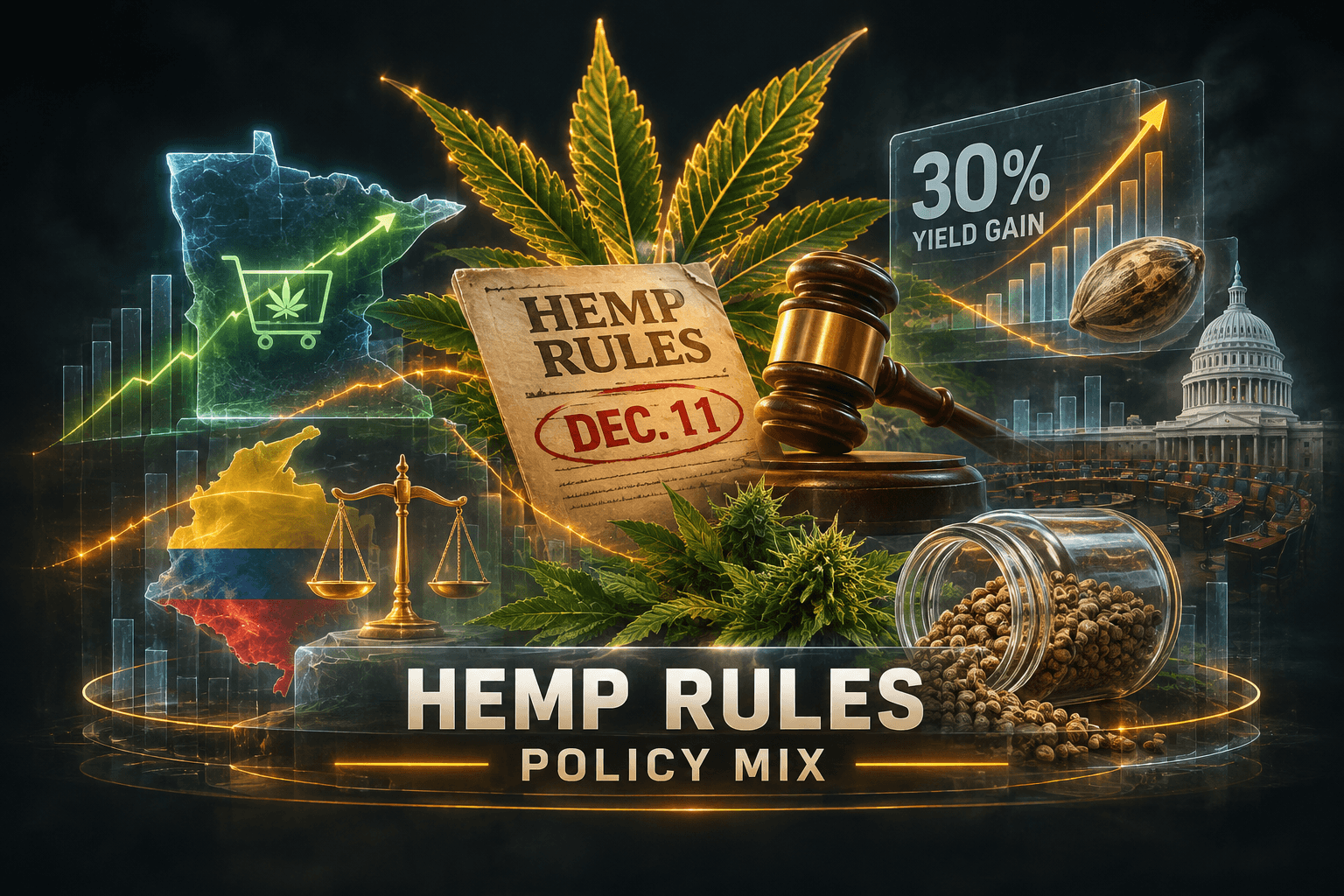
Federal hemp rules set to change on Dec. 11 are putting product availability and cannabis seed access at the center of the sector’s weekend news. Minnesota’s top cannabis official says the state will allow continued hemp THC product sales even if the federal ban takes effect, while some Republican senators are discussing narrower exceptions for veterans and seniors.
Those signals don’t settle how businesses will respond or how federal rules will be applied. Cultivation innovation and a Colombian court ruling offer positive developments, but the near-term picture is mixed. U.S. stock markets are closed Sunday, Nov. 29, and will next open Monday, Nov. 30. No company share-price moves were provided in these reports.
Market Highlights
The most immediate policy date is Dec. 11, when a stricter federal definition of hemp is scheduled to take effect. A cannabis breeder warns that viable seeds from high-THC plants could lose their hemp exemption, potentially affecting access to genetics as well as seed sales. The precise commercial impact remains uncertain.
Minnesota’s position could give businesses and consumers in the state a different near-term outlook, but it doesn’t eliminate the federal compliance questions. Separately, senators have floated carveouts for certain groups, a proposal rather than an enacted change. What could that mean for operators? For now, the practical answer depends on how the rules develop and how businesses assess their legal and operating risks.
- BeLeaf Medical’s cultivation director says under-canopy lighting has added about 30% to yields at the operation. This is a reported result from one grower, not an industry-wide benchmark.
- Far-red light may affect flower aroma, according to the report. After harvest, XRpure uses X-rays to kill mold and bacteria.
- Colombia’s Constitutional Court backed a Rastafari congregation’s right to use cannabis as a sacrament under conditions and urged Congress to regulate the practice.
- The reports contain no U.S. cannabis stock price or percentage-change data. Friday, Nov. 27, was the last trading day before the weekend.
Key Developments
Federal hemp rules put products and seeds in focus
The Dec. 11 change could reach beyond intoxicating hemp products. The breeder cited by High Times argues that removing the hemp exemption for viable seeds from high-THC plants may limit access to genetics and influence which strains can be developed in the future. That is a concern raised by an industry participant, not a confirmed forecast of the rule’s eventual effects.
For companies, the open questions include which products and materials will be affected, what compliance steps will be needed, and whether enforcement or further federal action changes the outlook. If you follow businesses with exposure to hemp-derived THC, distinguish between proposals, state-level positions, and rules that have actually taken effect.
Minnesota and senators signal possible limits to a broad ban
Minnesota’s top cannabis official says the state will allow continued hemp THC product sales even if a federal ban takes effect. That statement may offer some local businesses a measure of continuity, but it doesn’t guarantee that every product or operator will face the same risk. The report also notes that owners are weighing what level of risk they are willing to tolerate.
Sen. Pete Ricketts and other Republican senators have floated carveouts that could preserve legal access for veterans and seniors. The discussion comes as the White House is asking Congress to include cannabinoid-related provisions in an end-of-year funding bill. The carveouts remain a possible compromise, not settled policy, so investors will want to track legislative language and timing rather than assume an exemption is assured.
Operational innovation and legal decisions add counterpoints
BeLeaf Medical’s reported 30% yield improvement from under-canopy lighting points to a potential cultivation efficiency gain. The same report says far-red light could influence flower smell and describes XRpure’s use of X-rays to kill mold and bacteria after harvest. These are specific company and technology claims; the reports don’t provide independent verification or cost data to show how broadly the approach could scale.
In Colombia, the Constitutional Court ordered the government to recognize a Rastafari congregation as a religious entity and supported sacramental cannabis use under conditions. The court also urged Congress to regulate the practice. This is a notable legal development, but it concerns Colombia and shouldn’t be read as a change in U.S. cannabis law. A separate trademark dispute involving Terps USA and the University of Maryland also highlights the importance of brand clearance and intellectual-property risk for cannabis companies.
What to Watch
First, monitor developments ahead of the Dec. 11 federal hemp-rule change, including any final guidance, enforcement details, or congressional action. Watch whether the proposed carveouts advance in the end-of-year funding process and how Minnesota’s position translates into practical guidance for businesses. Neither a proposal nor a state official’s statement alone resolves the full compliance picture.
For Monday, Nov. 30, keep an eye on how cannabis-related securities respond when U.S. trading resumes, while remembering that the weekend reports don’t include stock-specific price data. Sector names frequently tracked by investors include the AdvisorShares Pure US Cannabis ETF, AdvisorShares Pure US Cannabis ETF (MSOS), and companies Trulieve Cannabis (TCNNF), Green Thumb Industries (GTBIF), Curaleaf Holdings (CURLF), and Tilray Brands (TLRY). Consider how each company’s reported business exposure relates to hemp products, state cannabis markets, cultivation costs, and regulatory risk. You’ll also want to watch for company disclosures that clarify product mix or the financial significance of these issues.
Beyond policy, look for evidence that cultivation technologies can deliver repeatable yields and quality improvements at commercially reasonable costs. The seed debate, product rules, and brand disputes all point to a broader theme: access, compliance, and intellectual property can shape the sector alongside demand and operating performance.
Bottom Line
- The Dec. 11 hemp-rule change is the clearest near-term catalyst, with possible implications for hemp THC products and high-THC cannabis seeds.
- Minnesota’s stated approach and proposed Senate carveouts may soften the impact for some users or businesses, but neither is a complete resolution.
- BeLeaf Medical’s reported 30% yield gain is a cultivation signal to follow, not proof of sector-wide results or profitability.
- Colombia’s court decision is significant in its jurisdiction, while U.S. investors should keep domestic policy and company disclosures in focus.
FAQ
Q: When are the federal hemp-rule changes scheduled to take effect? A: The reports say the stricter federal definition is scheduled to take effect on Dec. 11, 2026.
Q: Could the changes affect cannabis seeds as well as hemp THC products? A: A breeder warns that viable seeds from high-THC plants could lose their hemp exemption, potentially affecting seed access and genetics. The full impact remains uncertain.
Q: Are U.S. cannabis stocks trading on Sunday, Nov. 29? A: No. U.S. stock markets are closed Sunday and are scheduled to reopen Monday, Nov. 30. The reports provide no stock-specific price changes.