The Big Picture
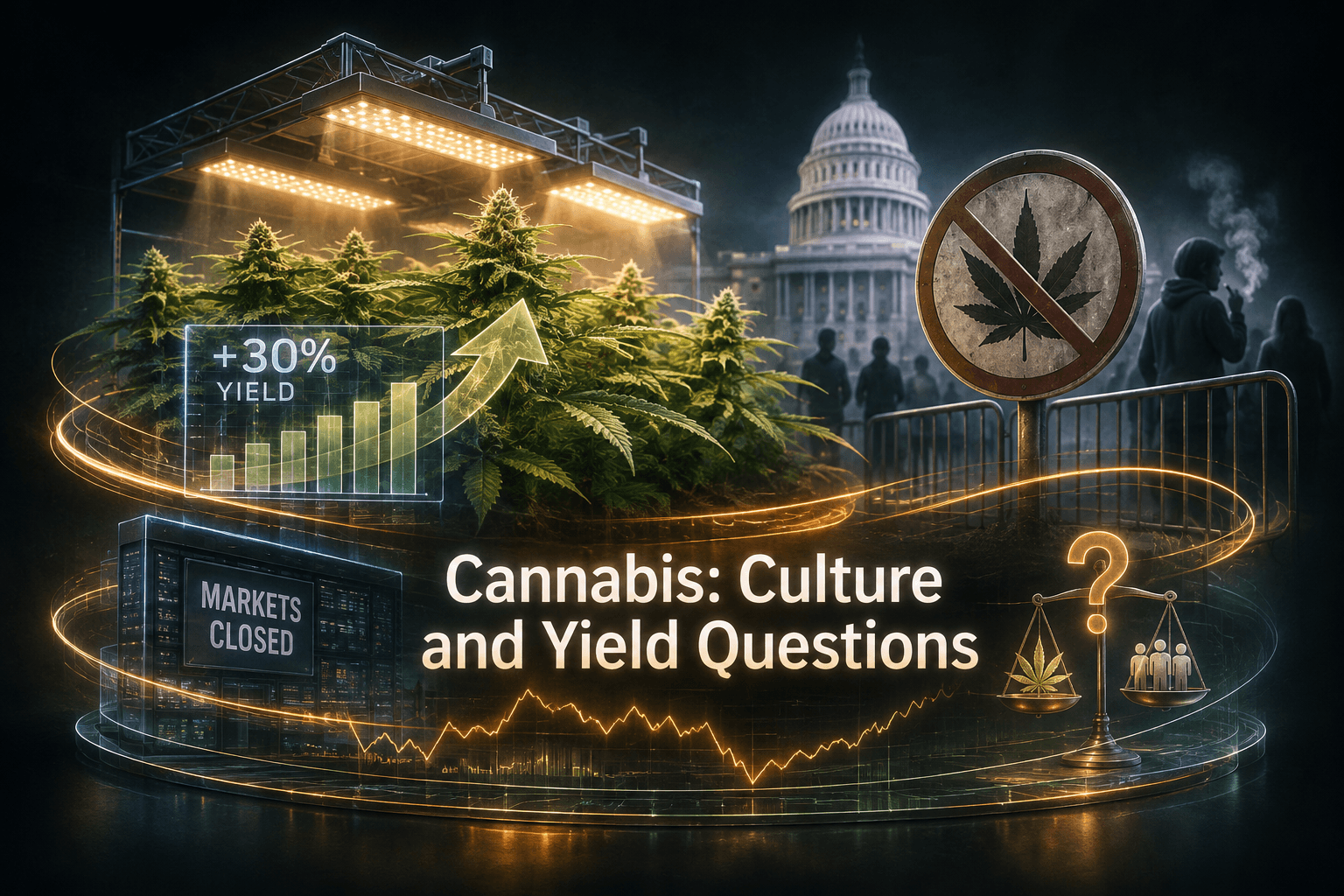
A grower’s reported 30% yield improvement offers a notable cultivation claim, but Sunday’s cannabis news also underscores that legalization hasn’t necessarily made cannabis easier to consume in public. Together, the stories highlight two distinct issues for the industry: improving production economics and building a durable consumer market.
The yield figure comes from BeLeaf Medical’s cultivation director and concerns under-canopy lighting, rather than a broad industry study. Meanwhile, a High Times cultural report examines the loss of public events and neighborhood dispensaries, as well as the difficulty of finding legal places to smoke. U.S. stock markets were closed Sunday, so there was no cannabis equity trading today; the next session is Monday, November 30.
Market Highlights
These reports are useful context for investors, but neither includes company financial results, new policy announcements, or a reported share-price reaction. No percentage changes or closing prices were provided, so the sector’s listed companies’ performance should be assessed using Friday, November 27, market data rather than inferred from Sunday’s headlines.
- BeLeaf Medical’s cultivation director says under-canopy lighting has added about 30% to yields. The claim is attributed to one operator and isn’t presented as an industry-wide result.
- The report also discusses far-red light as a possible influence on flower aroma, and XRpure’s use of X-rays to kill mold and bacteria after harvest.
- High Times describes continuing challenges around public consumption, the disappearance of some neighborhood dispensaries, and the decline of Hippie Hill’s 4/20 smokeout.
- For sector context, investors commonly track the AdvisorShares Pure US Cannabis ETF, AdvisorShares Pure US Cannabis ETF (MSOS), and companies including Trulieve Cannabis (TCNNF), Green Thumb Industries (GTBIF), Curaleaf Holdings (CURLF), and Tilray Brands (TLRY). No current price moves are available from these stories.
Why do these separate headlines matter together? Cultivation gains could help individual operators manage production costs, while consumer access and retail availability shape whether demand can translate into sales. Neither factor alone establishes the direction of sector earnings, but both can inform how you evaluate cannabis businesses.
Key Developments
Under-canopy lighting raises an efficiency question
BeLeaf Medical’s cultivation director says lighting plants from below has boosted yields by about 30%. The approach may be relevant to growers looking for more output from existing facilities, where changes in production efficiency can matter to unit costs and capacity. However, the report doesn’t provide independent verification, a comparison of operating costs, or details about how broadly the result applies.
The story also raises two post-harvest and product-quality questions. Far-red light may change how flower smells, according to the report, while XRpure uses X-rays to kill mold and bacteria after harvest. For investors, these are reported techniques to monitor, not proof of commercial adoption, regulatory approval, improved margins, or a measurable change in consumer demand.
Legalization has not settled where consumption happens
The High Times feature takes a cultural view of legalization, asking what has changed for people who advocated for cannabis access. It points to the end of Hippie Hill’s 4/20 smokeout, fewer neighborhood dispensaries, and the search for legal places to consume. These observations draw attention to a gap between legal sales and the practical experience of using cannabis in public.
That gap could matter to retailers and brands if limited consumption options affect customer engagement or the visibility of cannabis culture. Still, the article doesn’t quantify sales effects, report a change in dispensary counts, or identify a new policy outcome. You’ll want to distinguish these cultural concerns from measured company performance and local market data.
Two sides of the industry’s execution challenge
One story focuses on making cultivation more productive; the other questions whether consumers have enough places and community settings to use products. Together, they show why operational innovation and market access are separate parts of the sector’s business picture. Efficiency improvements may support production economics, but they don’t resolve restrictions on where consumption is permitted or guarantee stronger demand.
What to Watch
When trading resumes Monday, November 30, the stories themselves don’t supply a specific event or catalyst expected to move cannabis shares. Instead, watch for company disclosures that can test the cultivation claim, including whether operators report repeatable yield gains, the costs of lighting and processing changes, and any effects on product quality. Also monitor local rules and retail developments that could clarify whether legal consumption venues or dispensary access are changing.
For sector benchmarks and company-specific context, keep $MSOS, $TCNNF, $GTBIF, $CURLF, and $TLRY on your watchlist. Their performance can differ because of business models, market exposure, and company-specific conditions, so a sector headline shouldn’t be treated as a signal about any one ticker. Compare Monday’s trading with Friday, November 27, and look for fresh company or policy information before drawing conclusions.
Key risks include treating a single grower’s reported yield result as broadly repeatable, assuming post-harvest technology will improve profits without cost data, and reading cultural commentary as a quantified demand indicator. If you’re following the sector, separate documented financial or policy updates from early-stage claims and broader commentary.
Bottom Line
- U.S. markets were closed Sunday; the next trading session is Monday, November 30.
- BeLeaf Medical’s cultivation director reports about 30% higher yields with under-canopy lighting, but the claim is based on one operator’s account.
- Far-red lighting and X-ray treatment are additional techniques discussed, with no reported sector-wide adoption or financial impact.
- The cultural report highlights unresolved public-consumption and retail-access challenges, but doesn’t quantify their effect on sales.
- Use company filings, market data, and policy updates to assess these developments; this summary is for informational purposes, not personalized investment advice.
FAQ
Q: Did cannabis stocks trade on Sunday, November 29? A: No. U.S. stock markets were closed Sunday, and the next trading session is Monday, November 30.
Q: What yield improvement did the grower report? A: BeLeaf Medical’s cultivation director said under-canopy lighting added about 30% to yields. The report doesn’t establish that other growers will see the same result.
Q: Does the cultural report show that cannabis demand is falling? A: No. It describes challenges around public consumption and neighborhood access, but provides no sales or demand data.