The Big Picture
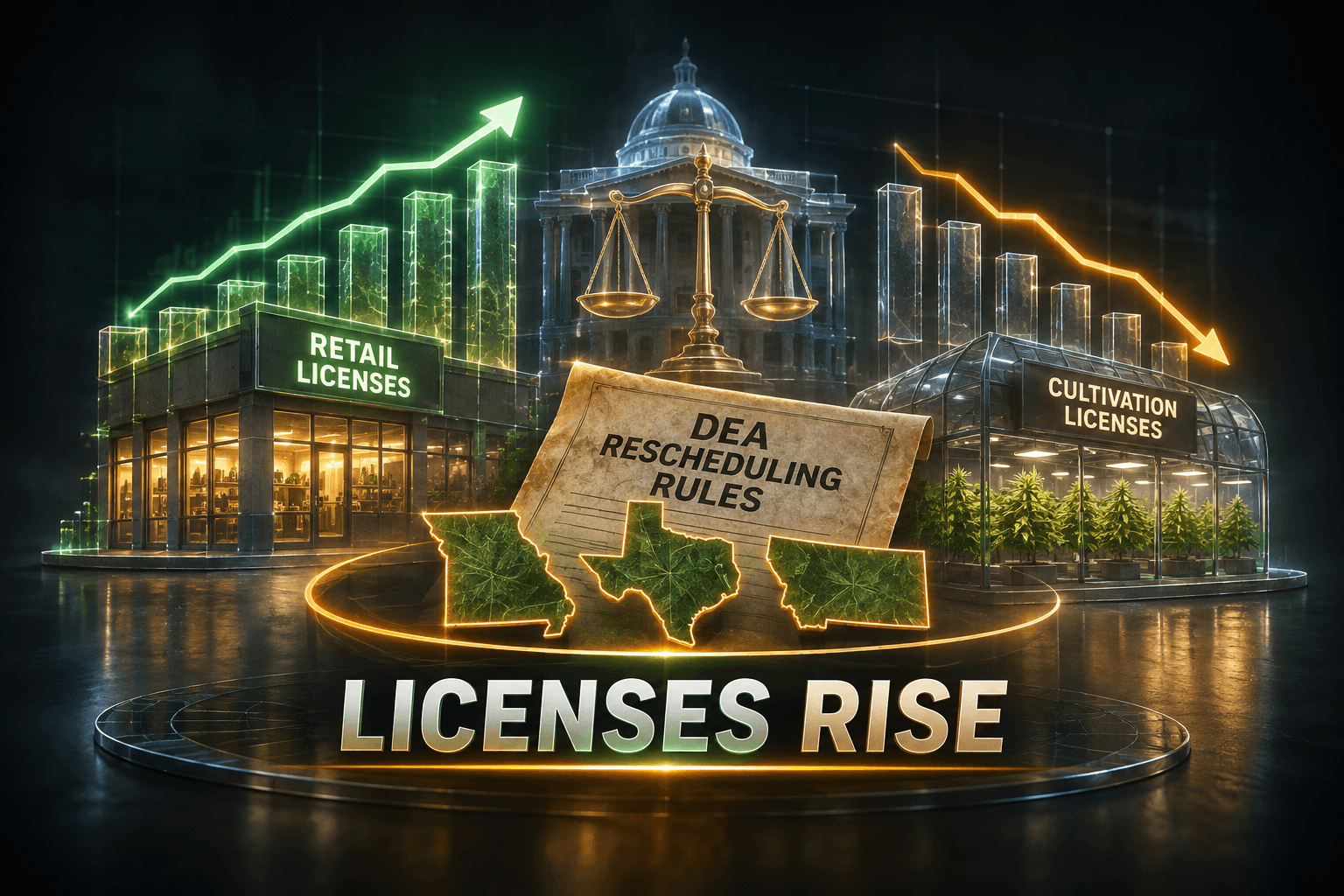
U.S. cannabis retail licenses grew by 205 in the third quarter, the largest quarterly increase in two years, even as cultivation lost 322 active licenses. The figures suggest a shift in the industry's footprint toward retail and a slower overall contraction, but they don't establish that sales or company profits are rising.
At the same time, three Republican-led states have joined a federal court challenge arguing that restrictive Drug Enforcement Administration rules tied to rescheduling could harm medical marijuana businesses, state programs and patients. For you, the morning's two developments point to a sector with signs of operating stabilization alongside unresolved federal policy questions.
Market Highlights
The license data offers a useful snapshot of the industry's changing business base, but license counts are not a direct measure of operating performance. A growing number of retail authorizations may indicate expanding access or market participation; the report does not say whether each license represents an open store, how much it sells, or whether it is profitable.
Key reported figures from the third quarter include:
- Retail added 205 active cannabis licenses, its largest quarterly gain in two years.
- Cultivation shed 322 active licenses, indicating continued contraction in that part of the market.
- Total active licenses declined 0.4%, the smallest quarterly drop in eight quarters.
- The DEA rules dispute concerns medical marijuana operators and the effects of federal rescheduling implementation.
The stories were published overnight ahead of Wednesday's regular U.S. trading session. Neither report included cannabis company share-price moves, earnings results or new company guidance, so the news alone doesn't establish a market direction for today's trading.
Key Developments
Retail licensing shows relative resilience
Retail's gain stands out against cultivation's losses. The contrast may reflect a rebalancing of the licensed business base, but the available figures don't explain the causes of the changes or identify which states drove them. A license increase can be encouraging as an industry activity measure, yet it doesn't guarantee that new outlets will open or generate meaningful revenue.
The narrow 0.4% decline in total active licenses is also notable because it was the smallest drop in eight quarters. That points to a slower rate of contraction in the reported license count, not necessarily a broad recovery. You may want to compare future license updates with company disclosures on store openings, same-store sales and cash flow before drawing conclusions about individual operators.
States challenge DEA restrictions linked to rescheduling
Three Republican-led states filed a brief in federal court opposing restrictions the DEA is placing on medical marijuana operators in connection with the Trump administration's rescheduling move. Their argument is that the restrictions could harm state programs, businesses and patients. The filing puts implementation details, rather than the broad direction of rescheduling alone, in focus.
The challenge introduces a legal and regulatory variable for medical cannabis operators. The report does not specify a ruling, a timeline for a decision, or the eventual effect on individual companies. Until the court process and federal approach become clearer, the filing is a reason to track policy developments carefully, not evidence that the rules have been changed or that a particular outcome is assured.
Together, the stories describe two different parts of the investment picture: a potentially stabilizing business footprint and continued uncertainty over federal oversight. How much either matters to a company's outlook depends on its market exposure, licensing position and ability to convert operations into sales, details not provided in these reports.
What to Watch
During today's session, watch for company or agency statements that add detail to either story. On licensing, future updates can help establish whether retail growth continues and whether the industry's total license count stabilizes. On rescheduling, the next meaningful information may come from court proceedings or further clarification of the DEA's requirements for medical operators.
For sector context, investors commonly track the AdvisorShares Pure US Cannabis ETF, AdvisorShares Pure US Cannabis ETF (MSOS), along with Trulieve Cannabis (TCNNF), Green Thumb Industries (GTBIF), Curaleaf Holdings (CURLF) and Tilray Brands (TLRY). These tickers represent different exposures, and the two reports do not provide specific news about their share prices or business results. If you're monitoring them today, separate broad policy headlines from company-specific disclosures and reported trading data.
Risks include continued cultivation contraction, a gap between licenses and commercial activity, and uncertainty over how federal rules will be applied. What would make the retail-license figures more consequential? Evidence that openings are translating into sustained revenue and improved operating performance would provide additional context, but that evidence isn't included in today's reports.
Bottom Line
- Retail added 205 active licenses in Q3, its largest quarterly increase in two years.
- Cultivation lost 322 licenses, while total active licenses fell just 0.4%.
- Three Republican-led states are challenging DEA restrictions associated with rescheduling; no outcome is reported.
- Read license growth as an industry indicator, not proof of higher sales or profitability.
- Use company filings, policy updates and verified market data to assess developments. This summary is informational and not personalized investment advice.
FAQ Section
Q: What does the Q3 license data say about cannabis retail? A: Retail added 205 active licenses, its largest quarterly gain in two years, while the overall license count declined 0.4%.
Q: What are the states challenging? A: Three Republican-led states argue in federal court that DEA restrictions tied to rescheduling could harm medical marijuana operators, state programs and patients.
Q: Does retail license growth confirm a cannabis sales recovery? A: No. License counts show changes in active authorizations, but the report provides no sales, profitability or company-level performance figures.