The Big Picture
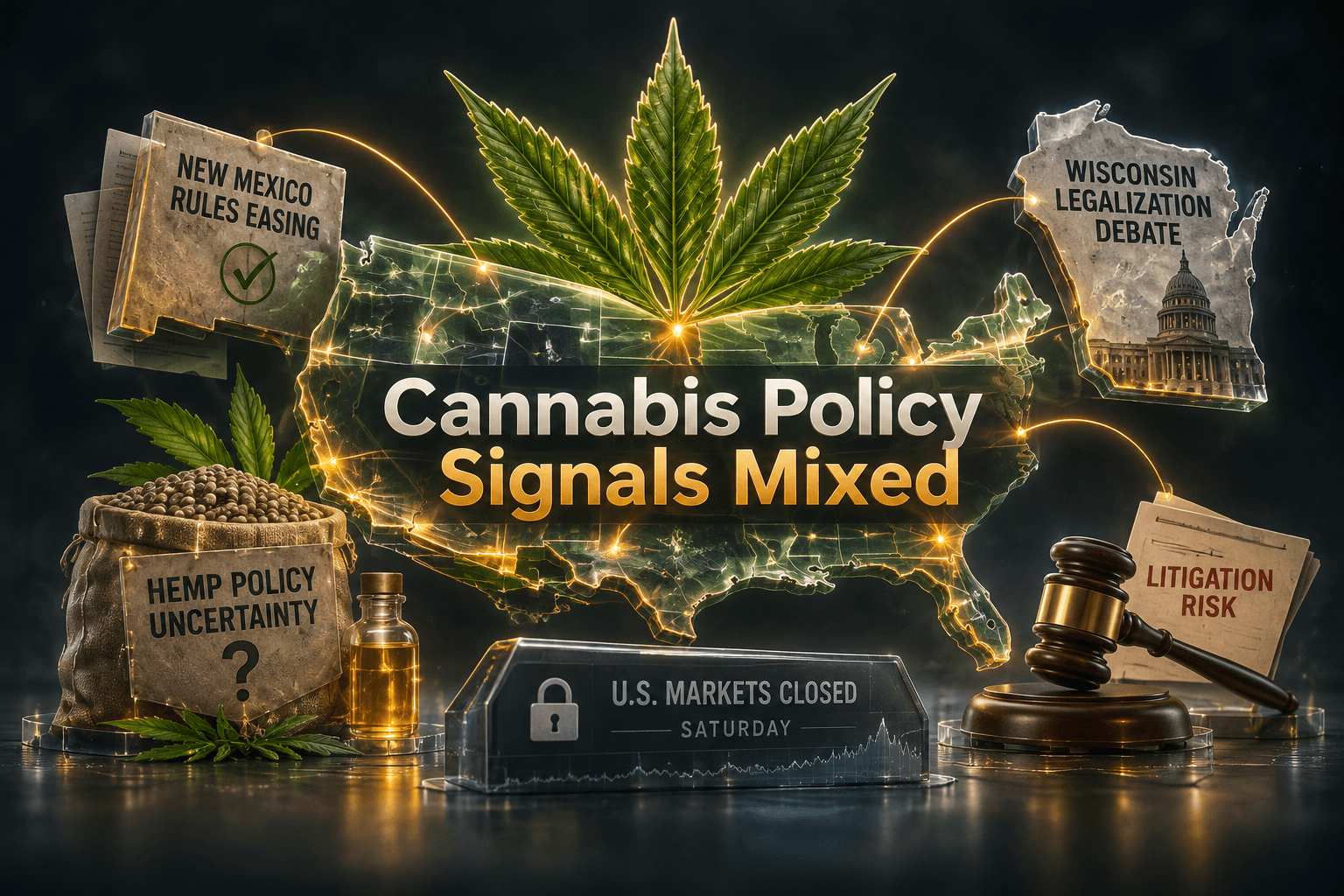
Policy uncertainty remains the defining thread in cannabis news this weekend, even as advocates and lawmakers press for changes in several states. New Mexico plans to remove two provisions from proposed medical psilocybin rules after pushback, while Wisconsin lawmakers say marijuana legalization could help protect hemp businesses from federal policy changes.
Those developments offer signs of debate and adjustment, not settled outcomes. U.S. stock markets were closed Saturday, so there was no trading reaction to these headlines; for context, the last session was Friday, November 20, and the next is Monday, November 23.
Market Highlights
The headlines were a mix of possible policy openings and commercial and legal risks. For cannabis companies, changes in state access rules could matter, but the stories do not establish new revenue, earnings or a timeline for implementation.
- New Mexico health officials plan to strip two controversial provisions from proposed medical psilocybin rules after advocates and lawmakers objected.
- Wisconsin lawmakers renewed arguments for marijuana legalization, saying it could help hemp businesses facing federal policy changes.
- A class-action lawsuit over alleged odors from cannabis cultivation in Santa Barbara County is set to go to trial next month.
- U.S. equities were closed Saturday. No Saturday stock prices or percentage moves are available from these headlines.
Other coverage focused on consumer experiences and industry branding. High Times reported on cannabis coaching around intentional use, including the risks of high-dose THC, and introduced five strains developed with Sensi Seeds. These are notable business and culture stories, but the reports provide no sales figures or company guidance to quantify their financial impact.
Key Developments
Rule changes and state access debates remain unsettled
In New Mexico, the Department of Health's planned revisions follow pushback from grassroots psychedelic advocates and state lawmakers. The change concerns medical psilocybin, not cannabis, so it is not a direct cannabis-market development. Still, it shows how public feedback can shape emerging regulated-drug frameworks, a relevant point for operators tracking future policy design.
Wisconsin's debate is more directly tied to cannabis and hemp businesses. Lawmakers argue that legalizing marijuana could help preserve legal businesses as federal hemp policy changes. That is an argument for legislation, not a finalized law or a guarantee that hemp-derived products will remain available. If you follow operators with exposure to multiple product categories, the eventual scope and timing of federal and state rules will matter.
South Carolina adds another layer of uncertainty. Republican Sen. Tom Davis says state health officials are violating state law by not taking steps to provide medical marijuana access following federal rescheduling. That is the senator's interpretation; the report does not establish that officials or a court have accepted it. For investors, the distinction between a political claim, a legal obligation and an operating program is important.
Hemp restrictions and litigation pose business risks
A separate MJBizDaily report warns that a federal hemp ban could affect hemp-derived CBD products marketed for pets. The story highlights a potential product-access and consumer-safety issue, but does not provide a final implementation timetable or quantify the market at risk. Companies connected to hemp-derived products may face added uncertainty around permitted products, compliance and customer access.
In California, hundreds of Santa Barbara County residents are involved in a class-action case alleging odor impacts from cannabis cultivation. The case is due to go to trial next month. Its outcome could matter to the cultivator involved and may draw attention to local operating conditions, but the available report does not establish liability or the likely financial consequences.
Together, these stories underline that regulation is not the only source of risk. Community relations, local permitting and the ability to meet product rules can all shape operating costs and market access. You’ll want to distinguish a scheduled legal proceeding from a judgment, just as you would distinguish a proposed ban from a rule already in effect.
Brand activity offers limited financial visibility
High Times' first five strains, bred by Sensi Seeds, connect the brand's Cannabis Cup history with a new genetics offering. Meanwhile, a sponsored profile described Cannabiz Seed's presence across North America, Australia and Europe, and an H-Bar promotional story featured vapes and beverages. These items indicate ongoing product and brand activity, but they do not disclose audited sales, margins or market share.
Industry events are also approaching: Fat Nugs Magazine and partners plan programming at MJBizCon from December 1 to 4 in Las Vegas. The event may provide a venue for networking and business announcements, although no specific financial catalyst was reported. Cannabis coaching coverage, meanwhile, is a reminder that high-dose THC use carries risks and that consumer education is part of the wider market conversation.
What to Watch
For Monday, November 23, the first reference point will be how cannabis-related equities respond after the weekend, not an assumed move from Saturday. No price targets, company results or analyst actions were included in the supplied headlines, so the news alone offers no basis for predicting percentage changes. Keep attention on follow-up reporting about New Mexico's rule revisions, Wisconsin's legislative path and the scope or timing of federal hemp changes.
Legal and regulatory milestones deserve particular attention: the California odor case is scheduled for trial next month, and South Carolina's dispute over medical access could clarify how state law interacts with the federal rescheduling issue. At MJBizCon, watch for concrete business updates rather than treating event participation itself as evidence of growth. For sector context, commonly tracked names include the ETF AdvisorShares Pure US Cannabis ETF (MSOS) and companies Trulieve Cannabis (TCNNF), Green Thumb Industries (GTBIF), Curaleaf Holdings (CURLF) and Tilray Brands (TLRY). Their exposure and results differ, and none of the stories here reports a company-specific market move.
What would turn these policy debates into a clearer business signal? A definitive rule, enacted legislation, court decision or company disclosure would provide more information than advocacy statements or promotional announcements. Until then, a selective approach to interpreting headlines can help you separate potential catalysts from unresolved risks.
Bottom Line
- Saturday's U.S. market closure means there was no trading response to the news; the next session is Monday, November 23.
- New Mexico's planned psilocybin rule revisions show policy responsiveness, but they do not directly change cannabis access.
- Wisconsin legalization advocacy may matter to hemp businesses, but no legislation has been finalized in the reports.
- Federal hemp uncertainty and the California odor lawsuit highlight regulatory and operating risks.
- Brand launches and MJBizCon activity are worth monitoring, but the headlines provide no financial results to measure their impact.
FAQ
Q: Did cannabis stocks trade on Saturday, November 21? A: No. U.S. stock markets were closed Saturday; the last trading session was Friday, November 20, and the next is Monday, November 23.
Q: Does New Mexico's rule change directly affect cannabis businesses? A: The proposed revisions concern medical psilocybin rules, not cannabis, though the process may interest observers of regulated-drug policy.
Q: What are the main risks highlighted in this news roundup? A: Federal hemp-policy uncertainty, unresolved state medical-access questions and the upcoming California cultivation odor trial are the clearest risks.