The Big Picture
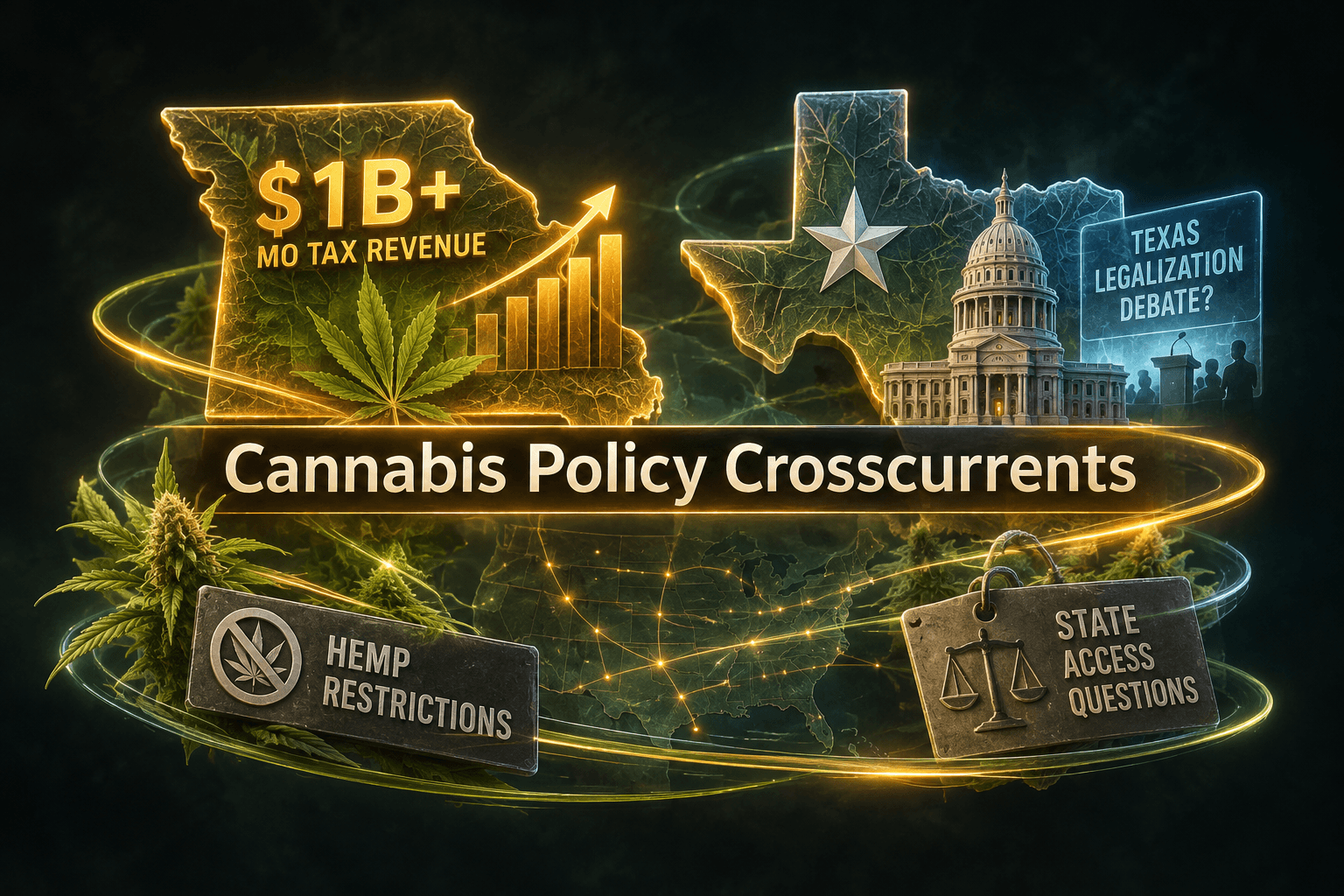
Cannabis policy offered investors a split screen Friday: Missouri's cannabis-derived tax revenue has surpassed $1 billion, but new restrictions on hemp-derived THC and CBD are raising questions about access and business models. Texas's governor-elect also said voters deserve a chance to decide on legalization, a notable political signal that has yet to become a ballot measure or law.
These developments point to continued demand and political debate, but also show how much the sector depends on state and federal rules. What should you take from a day with both growth indicators and regulatory friction? For now, the stories support a selective, wait-for-clarity view rather than a single clear direction.
Market Highlights
Missouri's cumulative cannabis tax revenue passed $1 billion, according to figures shared by trade group MoCannTrade. The total includes regular local and state sales taxes as well as additional taxes on medical and adult-use purchases, with $265.47 million generated in the past 12 months.
- Missouri: More than $1 billion in total cannabis-derived tax revenue; $265.47 million came in over the latest 12 months reported.
- Illinois: A federal judge declined to pause state rules restricting hemp-derived THC sales to licensed dispensaries. The underlying lawsuit remains part of the dispute.
- Texas: Governor-elect Gina Hinojosa said voters should have a chance to decide on marijuana legalization and pledged to rescind her predecessor's executive order restricting hemp THC products.
The supplied reports don't provide Friday share-price changes for cannabis companies or funds, so they don't establish how the market reacted during the session. For sector context, investors commonly track the MSOS ETF and companies including Trulieve Cannabis, Green Thumb Industries, Curaleaf, and Tilray through AdvisorShares Pure US Cannabis ETF (MSOS), Trulieve Cannabis (TCNNF), Green Thumb Industries (GTBIF), Curaleaf Holdings (CURLF), and Tilray Brands (TLRY).
Key Developments
Hemp restrictions create uncertainty for products and retailers
Two stories highlight pressure on the hemp-derived cannabinoid market. MJBizDaily warned that a federal hemp ban could remove popular CBD products used for pets, while an Illinois judge rejected the hemp industry's request to temporarily pause state rules that channel hemp-derived THC sales to licensed dispensaries.
The Illinois decision is not a final resolution of the lawsuit, but it leaves the challenged restrictions in place for now. For companies tied to hemp products, the practical issues include which products can be sold, through what channels, and under what rules. You may want to distinguish those regulatory exposures from licensed cannabis businesses, while recognizing that policy changes can affect both markets.
State-level political signals are encouraging, but not settled
In Texas, governor-elect Hinojosa's comments put legalization and hemp THC restrictions on the incoming administration's agenda. Her stated support for a voter decision is not itself a guarantee that a ballot question will qualify, pass, or lead to a particular regulatory framework. Her pledge on the prior administration's executive order also awaits action after she takes office.
In South Carolina, Republican Sen. Tom Davis accused health officials of violating state law by not moving toward medical marijuana access following federal rescheduling. That is the senator's interpretation, and the report does not describe a settled legal ruling or an operating medical market. The disagreement underscores that federal changes may not translate automatically into state-level access.
Revenue data and industry activity offer context, not a forecast
Missouri's tax milestone is a concrete indicator of the scale of its regulated market, although tax receipts alone don't reveal company profitability, prices, or the split between operators. A separate Marijuana Moment opinion article cited the failure of Massachusetts Question 8, saying more than 75% of voters opposed a measure to ban adult-use sales, and argued that law enforcement is turning against prohibition. That is an opinion piece's framing, not a nationwide poll result.
Other items were more promotional or feature-oriented than market-moving: seed brand Cannabiz Seed described its international reach, H-Bar promoted a holiday product lineup, and a story covered a Portuguese island listed for sale. Industry events may provide networking and visibility, including MJBizCon in Las Vegas from December 1 to 4, but these announcements don't establish financial performance.
What to Watch
Near term, track how Illinois' lawsuit proceeds and whether the court or state officials change the timing or scope of enforcement. Federal hemp policy is also important, particularly the potential consequences for pet CBD and other consumer products. The reports identify risks and disputes, but don't provide a final outcome on the federal ban or its implementation.
In Texas, watch for formal actions after the new administration takes office: any steps on the executive order, legislative proposals, or ballot process would be more concrete than campaign statements. In South Carolina, monitor whether state officials respond to Sen. Davis's claim and whether the rescheduling dispute produces a legal or administrative decision. Missouri's tax figures provide a useful baseline for future revenue comparisons, though they aren't a substitute for company-level results.
For sector monitoring, keep $MSOS, $TCNNF, $GTBIF, $CURLF, and $TLRY on your watchlist as commonly followed ETF and company tickers. Compare future price action with reported filings, operating results, and policy developments rather than assuming today's headlines caused a particular move. The supplied news includes no earnings releases or analyst rating changes.
Bottom Line
- Missouri's more than $1 billion in cumulative cannabis tax revenue is a significant market-scale datapoint, but it doesn't by itself indicate operator margins or future growth.
- Illinois restrictions and the threatened federal hemp ban keep product access and sales channels in focus, including for pet CBD.
- Texas's governor-elect has signaled support for a voter decision on legalization, but no ballot or policy change is confirmed in the report.
- South Carolina's medical access dispute remains unresolved; the senator's allegation is not a court finding.
- Use a selective approach: follow legal developments and company disclosures, and don't infer daily trading performance from headlines when price data wasn't provided.
FAQ
Q: What does Missouri's $1 billion cannabis tax milestone include? A: The reported total includes regular state and local sales taxes plus additional taxes on medical and adult-use cannabis purchases.
Q: Has Texas legalized marijuana or scheduled a legalization vote? A: No such change is reported. Governor-elect Gina Hinojosa said voters should get a chance to decide, but a ballot measure or law is not confirmed.
Q: Does the Illinois court ruling end the hemp industry's challenge? A: No. The judge denied a request to pause the restrictions, while the lawsuit challenging them remains unresolved.