The Big Picture
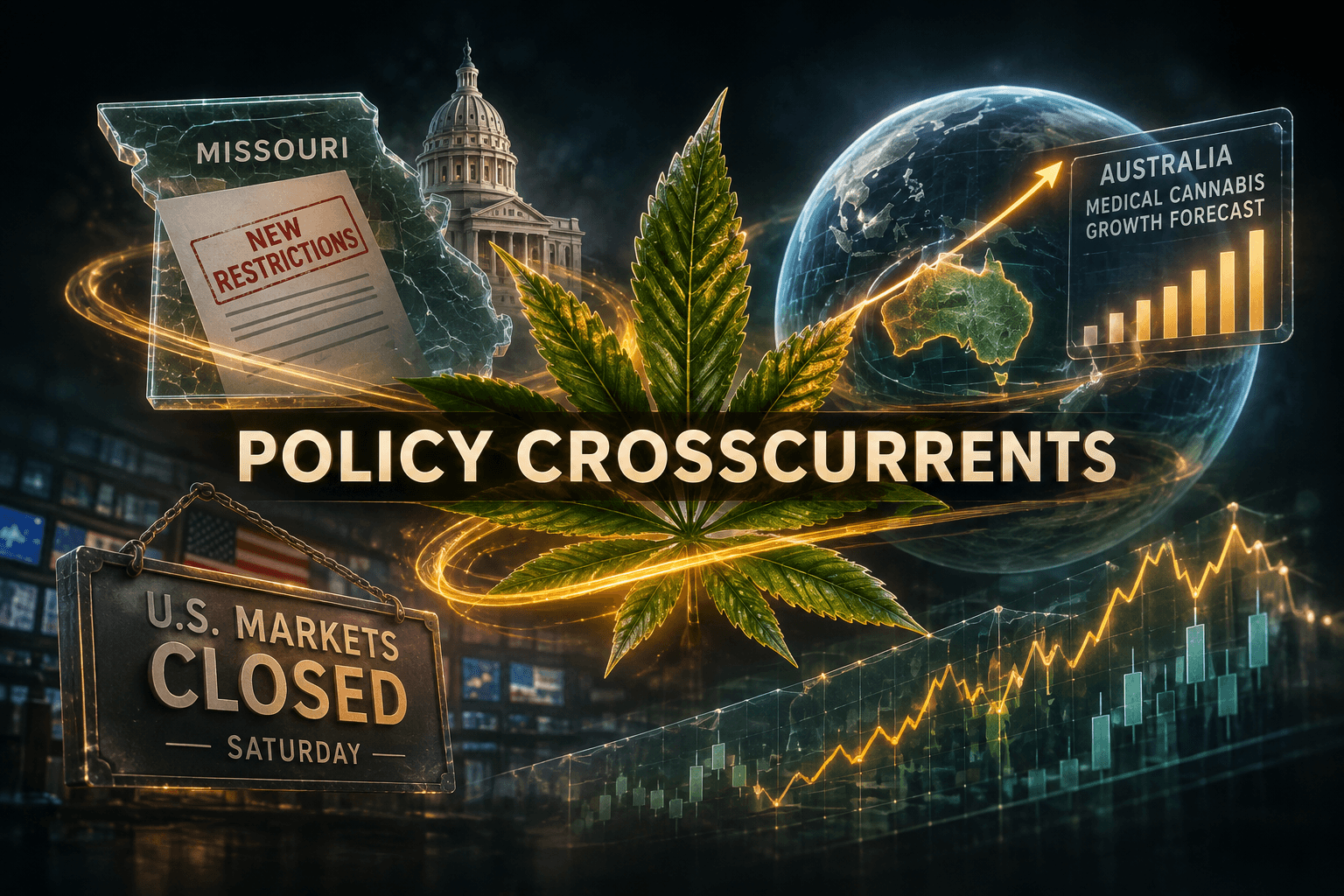
Regulation is the clearest common thread in Saturday’s cannabis news, with Missouri’s hemp-derived THC restrictions taking effect and other states weighing how to manage licensing, retail compliance and product disclosures. These developments matter because rules can affect what businesses sell, how they operate and what customers can access.
The signals are mixed, not a clear sector-wide catalyst. Australia’s medical cannabis market is forecast to expand, while U.S. headlines highlight compliance burdens and legal uncertainty. U.S. stock markets were closed Saturday, November 14, so there was no trading today; the next session is Monday, November 16. What should you take from the headlines? For now, distinguish longer-term market projections from regulatory changes that could affect operators more immediately.
Market Highlights
No cannabis share-price movements or percentage changes were provided in the reported stories. With U.S. markets closed Saturday, there is no basis here to characterize equities as having moved today. Investors can use the weekend to review Friday’s market data and consider whether these developments change their view of individual companies or the broader sector.
- Missouri’s new law restricting hemp-derived THC sales took effect, with a temporary exemption for beverages. Retailers reportedly discounted or cleared other products ahead of the change.
- A report cited an estimated $781.6 million value for Australia’s medical cannabis market in 2025 and projects it could exceed $2.67 billion by 2035, a 13.1% compound annual growth rate.
- Massachusetts may require labels for cannabis treated with radiation, while a federal change described in a report could alter the legal status of some cannabis seeds starting December 11.
For a sector watchlist, investors commonly track the AdvisorShares Pure US Cannabis ETF, AdvisorShares Pure US Cannabis ETF (MSOS), and cannabis companies including Trulieve Cannabis (TCNNF), Green Thumb Industries (GTBIF), Curaleaf Holdings (CURLF) and Tilray Brands (TLRY). The supplied news includes no new price targets, ratings or company-specific trading data for these tickers, so the stories should not be read as evidence of a particular stock’s performance.
Key Developments
Missouri restrictions put hemp retailers under pressure
Missouri’s hemp THC restrictions took effect Saturday, with beverages temporarily exempted. The report described retailers cutting prices, clearing shelves and giving away products as the effective date approached. One retailer’s account of lost income underscores how a regulatory change can reach beyond product availability to workers and businesses that rely on these sales.
For investors, the immediate question is how the restriction is implemented and whether the temporary beverage exemption changes over time. The story concerns hemp-derived products, so it should not automatically be treated as a direct update on licensed marijuana operators. Still, it illustrates how quickly state rules can reshape adjacent markets and create uncertainty for businesses with exposure to them.
States weigh market design, retail discipline and labeling
In North Carolina, the Cannabis Commission heard advice from an Oklahoma official about market structure and enforcement. The official cited unintended consequences from Oklahoma’s experience. That is a cautionary perspective, not evidence that North Carolina has adopted a particular policy. The discussion may nevertheless inform how the state balances access, oversight and enforcement as it considers its market framework.
Other state-level stories point to day-to-day operating risks. An MJBizDaily report described New York’s list of cannabis defaulters as a warning for retailers to order more carefully. In Massachusetts, regulators may require disclosure when cannabis has been remediated with radiation, a practice that has drawn objections from some consumers and operators. If you follow companies with retail or wholesale exposure, inventory management and labeling rules are worth monitoring alongside expansion plans.
Federal uncertainty meets international growth projections
A High Times report says a federal change scheduled for December 11 could make some cannabis seeds contraband based on the THC level of the plants they came from. The article says seed banks are shifting some U.S. orders offshore and breeders are considering alternatives such as clones and tissue culture. This is a reported legal risk with potential implications for seed sellers and home growers, but the supplied information does not quantify its effect on publicly traded businesses.
Elsewhere, a Market.us Media report projects Australia’s medical cannabis market could grow from an estimated $781.6 million in 2025 to more than $2.67 billion by 2035. Such a forecast suggests potential demand growth, but it is a projection, not a guarantee of revenue for any specific company. A separate report on a $4.9 million federal award for ibogaine PTSD research concerns psychedelics, not cannabis, and should be viewed as broader policy context rather than a direct cannabis-sector catalyst. Pennsylvania’s legalization debate also featured an op-ed arguing for a framework that gives smaller businesses a chance to compete, not an enacted legalization measure.
What to Watch
Heading into Monday, November 16, check for company disclosures or market commentary addressing Friday’s close and any relevant exposure to state hemp or cannabis rules. The provided reports contain no upcoming cannabis earnings dates or company-specific catalysts, so avoid assuming a scheduled corporate event is driving the next session.
Near-term policy dates deserve attention: the December 11 federal seed change described in the news, the status of Missouri’s beverage exemption, and any movement toward radiation-remediation labeling in Massachusetts. North Carolina’s discussions may offer clues about regulatory design, while New York retailers’ inventory choices could signal how operators adapt to compliance pressure. The IgniteIt Capital & Policy Summit returns to Washington on Wednesday, November 18, offering an industry forum for policy discussion, though the report does not identify a specific regulatory decision expected there.
For your watchlist, $MSOS, $TCNNF, $GTBIF, $CURLF and $TLRY remain sector names to monitor. Compare each company’s disclosed market exposure and financial results with the policy headlines; sector-level news may not affect every operator in the same way.
Bottom Line
- U.S. markets were closed Saturday; the next trading session is Monday, November 16.
- Missouri’s hemp THC restrictions are now in effect, with a temporary exemption for beverages.
- Potential labeling, retail compliance and seed-rule changes keep regulatory risk in focus.
- Australia’s market forecast is a long-term projection, not a near-term guarantee for listed companies.
- Use a selective approach: separate confirmed policy changes from proposals, commentary and forecasts.
FAQ Section
Q: Did cannabis stocks move on Saturday, November 14? A: U.S. stock markets were closed, and the supplied news includes no Saturday price changes. The next session is Monday, November 16.
Q: What is the main immediate regulatory development? A: Missouri’s restrictions on hemp-derived THC products took effect, with a temporary exemption for beverages.
Q: What are the key upcoming dates to monitor? A: The reported federal seed-rule change is scheduled for December 11, and IgniteIt’s Capital & Policy Summit is set for November 18. Massachusetts labeling discussions and Missouri’s beverage exemption also warrant follow-up.