The Big Picture
Missouri's new rule classifying hemp-derived THC products, including delta-8 and THCA, as marijuana takes effect Thursday, immediately narrowing retail distribution to state-licensed marijuana facilities. That's the most consequential overnight development for the sector, because it changes where a broad set of products can be sold and may affect supply chains and revenue for multi-state and hemp-focused operators.
At the same time, local-level wins in Michigan and a small-scale labor change in Illinois paint a mixed picture for the industry. If you're watching the space, you'll want to weigh how local market expansions and workforce shifts interact with tightening state rules to shape near-term demand and margins.
Market Highlights
Overnight headlines were regulatory and municipal rather than earnings or large corporate moves. No major price gaps were reported in the news wire overnight, but several names remain focal points for investors tracking sector exposure.
- AdvisorShares Pure US Cannabis ETF (MSOS), the broad cannabis ETF, remains the go-to gauge for sector flows and policy sensitivity.
- Trulieve Cannabis (TCNNF) and Green Thumb Industries (GTBIF) are commonly watched by investors tracking large multi-state operators and Canadian-linked exposure.
- Curaleaf Holdings (CURLF) and Tilray Brands (TLRY) are on watch lists for retail and product distribution exposure as licensing and retail access change.
Key Developments
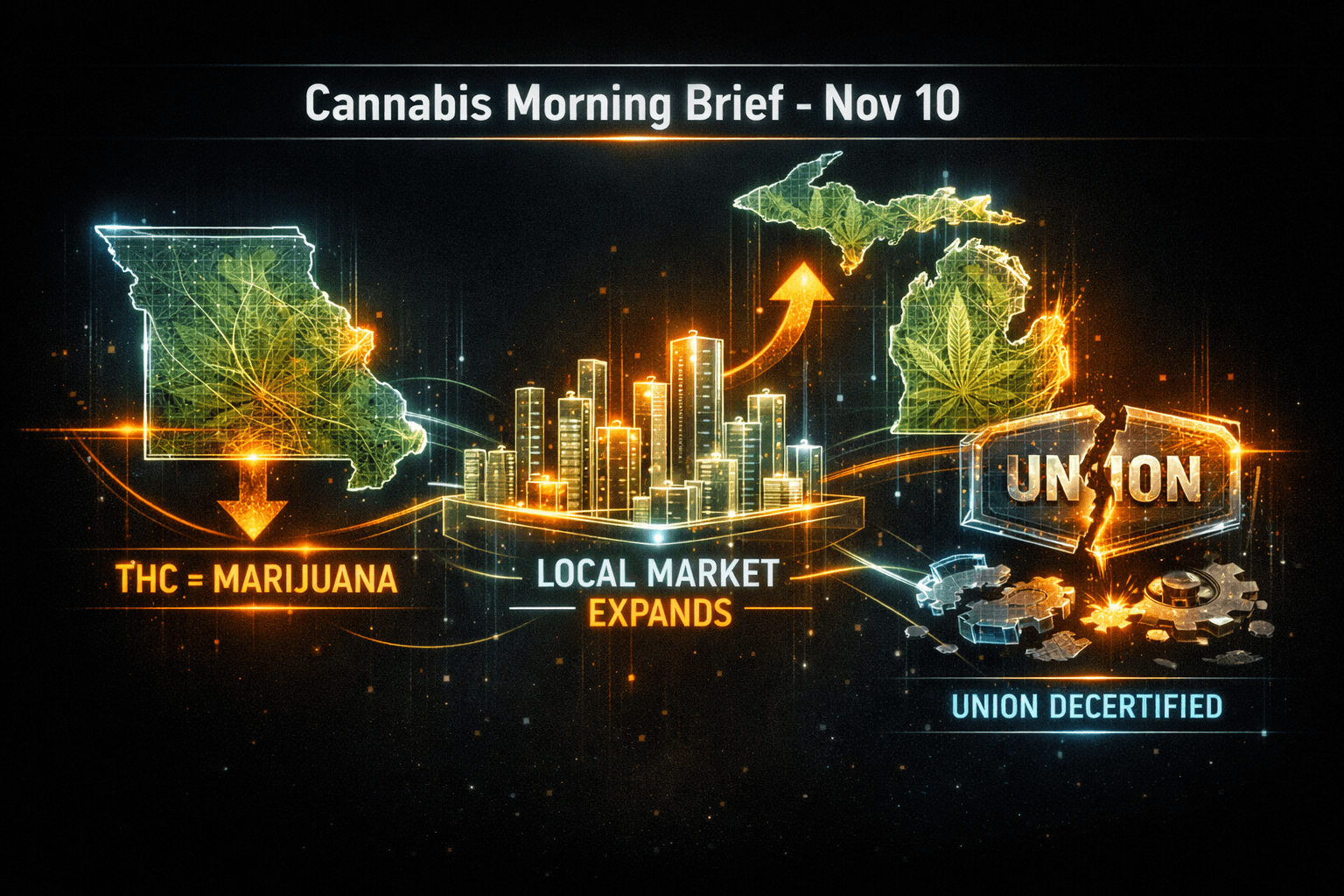
Missouri reclassifies hemp-derived THC as marijuana
State regulators in Missouri adopted rules that will treat hemp-derived THC products, including delta-8 and THCA, as marijuana. The rule, effective Thursday, limits legal sales to retailers holding state marijuana facility licenses, rather than general hemp retailers.
Implications are immediate and practical. Retailers that previously sold hemp-derived THC may need new licenses or to stop selling those SKUs. Distributors and producers will face a narrower purchaser base and new compliance requirements. That could tighten supply in unlicensed channels while shifting volume into licensed dispensaries.
Michigan voters expand local cannabis operations in multiple communities
On Election Day several Michigan communities voted on local cannabis rules, with four approving expansions or new allowing measures and one reducing licenses. Bad Axe repealed its ban on cannabis businesses by a 664-537 margin, enabling up to new local operations.
These local wins create incremental addressable markets and suggest continued consumer demand at the municipal level. For companies with operational flexibility or local licensing pipelines, this is positive for market penetration and future revenue opportunities.
Zen Leaf Highland Park workers decertify union
Employees at the Zen Leaf dispensary in Highland Park, Illinois voted to decertify from UFCW Local 881, with the NLRB approving the change earlier this month. The vote was 10-1 in favor of decertification.
For operators, this is a micro-level labor development that may affect store-level costs and flexibility. It doesn't change sector-wide labor dynamics overnight, but it's a reminder that labor relations can vary significantly across sites and may affect local operating economics.
What to Watch
Missouri enforcement starts Thursday, so monitor state guidance, retailer compliance notices, and any short-term supply disruptions. If you're tracking companies with hemp-derived product lines or broad retail footprints, watch their statements and inventory moves carefully.
Which local markets could move the needle for revenue? Keep an eye on rollout timelines in Michigan communities that approved expansions, and on licensing queues. You should track municipal permit processes because local approvals determine when new stores actually open.
Key tickers to watch for exposure and company commentary include $MSOS, $TCNNF, $GTBIF, $CURLF, and $TLRY. Check corporate press releases and 8-K filings for any mention of strategic responses to Missouri's rule or Michigan market entries. Also monitor consumer demand metrics and pricing data, because shifts in where products can be sold could pressure street pricing in some channels.
Risk factors to monitor include sudden enforcement actions, delays in retail licensing, inventory destocking at non-licensed outlets, and potential litigation or clarifying guidance from Missouri regulators. Labor developments, like the Zen Leaf vote, can pop up unexpectedly, so you should watch store-level news if you hold exposure to single-state operators.
Bottom Line
- Missouri's reclassification is a near-term regulatory headwind for hemp-derived THC retail access and could shift sales to licensed dispensaries.
- Michigan municipal votes expand addressable markets in several communities, supporting longer-term demand growth at the local level.
- The Zen Leaf decertification is a localized labor change, highlighting variance in workforce dynamics across stores.
- Watch $MSOS, $TCNNF, $GTBIF, $CURLF, and $TLRY for corporate responses and exposure to state-level shifts.
- Data suggests the sector is a mixed bag today, so remain selective and track licensing and compliance updates closely.
FAQ Section
Q: How will Missouri's rule affect where hemp-derived THC can be sold? A: The rule reclassifies many hemp-derived THC products as marijuana, limiting legal sales to retailers that hold state-issued marijuana facility licenses.
Q: Do Michigan local votes mean new stores will open immediately? A: No, local approval allows licensing and permitting, but actual store openings depend on municipal processes, license issuance, and build-out timelines.
Q: Should I expect widespread labor changes after the Zen Leaf vote? A: The decertification was specific to one Highland Park store and doesn't indicate a sector-wide trend, though it underscores that labor outcomes vary by site and operator.