The Big Picture
A federal hearing on cannabis rescheduling was paused this week, injecting fresh uncertainty into a market that is otherwise showing strong state-level commercial momentum. That pause coincides with headline milestones and fresh policy moves from New York, Florida and international markets, so you should be watching both growth and regulatory risk closely.
Markets are closed Saturday, Oct 3; the last US trading day was Friday, Oct 2 and the next trading day is Monday, Oct 5. These stories matter because federal clarity would affect banking, research and cross-border deals, while state and international reforms are shaping near-term sales and supply dynamics.
Market Highlights
Quick facts and numbers you can use as a one-stop update.
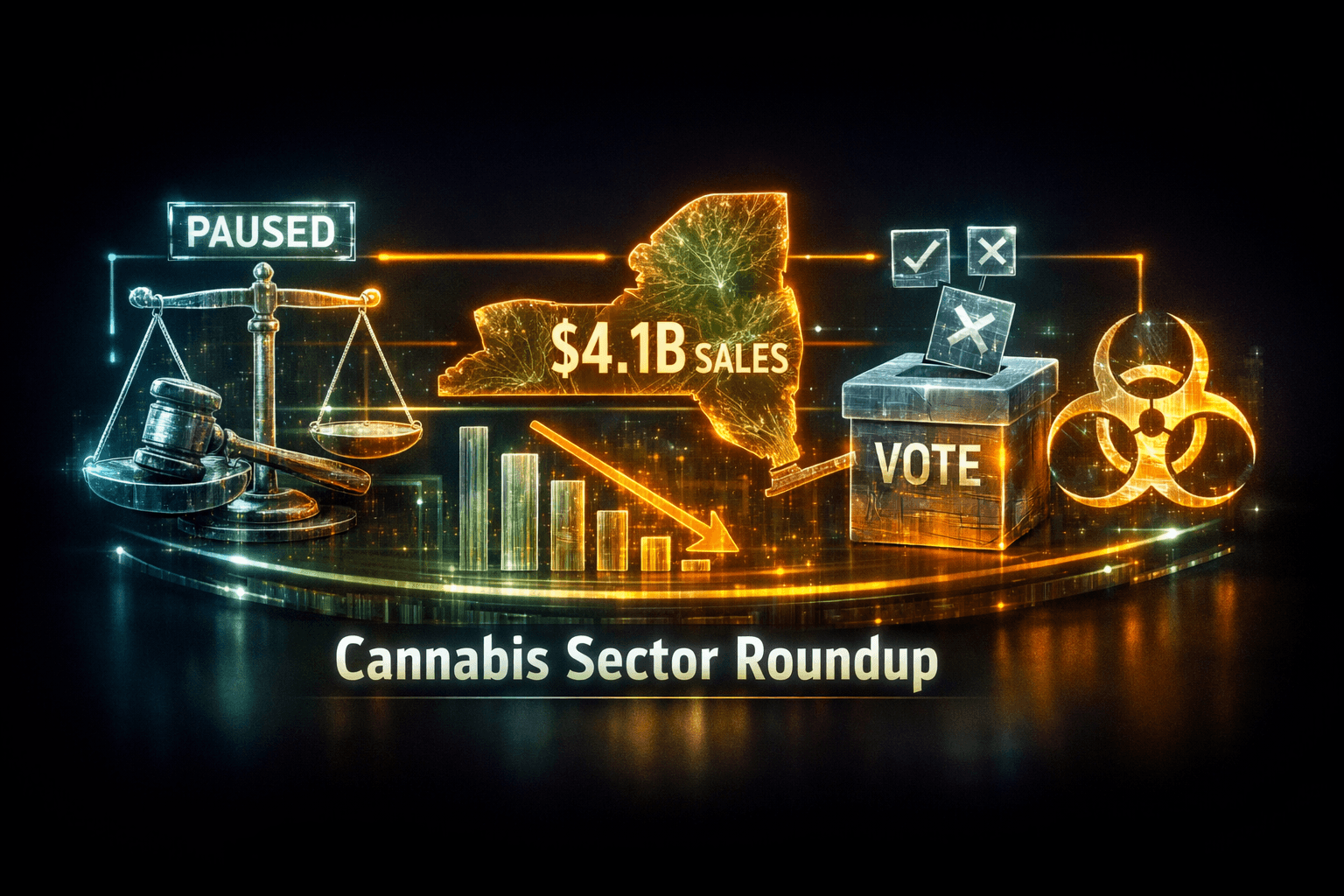
- Federal pause: A DEA administrative law judge paused the federal cannabis rescheduling hearing to consider adding a new GAO report that criticizes DEA and FDA procedures, delaying a process investors have been watching closely.
- New York sales: State officials told regulators that dispensaries have now sold about $4.1 billion in recreational cannabis since late 2022, and current monthly sales remain on pace to set an annual record even as some indicators point to a slowdown.
- Product safety: Colorado regulators reported health problems tied to Maui Wowie and Grape Gorilla vapes after labs detected methylene chloride, prompting recalls and heightened scrutiny of supply chains.
- Policy and expansion: Two Florida legalization ballot measures were filed proposing adult-use legalization with possession limits including up to two ounces and five grams of concentrate. Jamaica introduced transitional permits to bring small growers into the regulated market.
- Political risk: Four GOP senators asked for an investigation into alleged Chinese criminal ties to U.S. cannabis and hemp businesses, raising enforcement and compliance questions for firms with global supply chains.
- Names and ETFs to track: Keep an eye on $MSOS, $TCNNF, $GTBIF, $CURLF, $TLRY for sector exposure and as proxies for overall market sentiment.
Key Developments
DEA rescheduling hearing paused after GAO report
The DEA chief administrative law judge halted the rescheduling hearing to review a Government Accountability Office report that found procedural gaps at DEA and FDA. That pause means federal policy timing is unclear and any expectation that rescheduling would bring rapid changes to banking and research is likely premature.
For you that means a continued patchwork of state-by-state rules will drive business outcomes in the near term, while federal reform remains uncertain.
New York posts $4.1 billion in recreational sales, but growth shows signs of stalling
New York dispensaries have sold roughly $4.1 billion since the market opened in late 2022, and sales this year are on pace to set another record. Still, some metrics indicate a slowdown from early bullish forecasts, suggesting supply, pricing, and demand dynamics may be rebalancing.
Investors should note that big state markets can both buoy revenue growth and mask localized margin pressure, especially as competition and regulatory costs rise.
Product safety and political probes raise compliance risk
Colorado vape recalls tied to methylene chloride have triggered health reports, underscoring how product safety issues can hit brands and retailers quickly. At the same time, a bipartisan group of GOP senators requested a probe into alleged Chinese criminal ties to parts of the U.S. cannabis and hemp supply chain.
Both developments may increase regulatory scrutiny and compliance costs, and they could affect consumer trust in certain product categories.
What to Watch
Practical catalysts and risks you should monitor heading into next week.
- Federal timeline: Watch for updates from the DEA administrative law judge and any formal inclusion of the GAO report. If you follow federal policy, you'll want to know how this reshapes timing for potential rescheduling or other actions.
- State sales trends: Monitor New York monthly sales releases for signs of sustained demand or further slowing. Are retailers seeing seasonal demand or permanent market shifts?
- Florida ballot process: Track signature validation deadlines and polling for the two newly filed measures. A successful ballot in a large market would be a major long-term catalyst, but timing and legal challenges can be drawn out.
- Product safety fallout: Watch which brands and retailers are impacted by the Colorado recall, and whether state regulators widen testing or enforcement. That could affect margins for vape-heavy product lines.
- Regulatory and enforcement risk: Follow responses to the Senate letter about alleged Chinese criminal ties and any DOJ or Treasury interest. Compliance and supply chain vetting could become more expensive.
- ETFs and names to follow: Use $MSOS, $TCNNF, $GTBIF, $CURLF, $TLRY as barometers of sentiment. If you track the sector, these tickers will tell you whether retail and institutional flows are shifting.
Which of these matters most to you will depend on your time horizon. Are you focused on near-term sales or longer-term federal reform? A wait and see approach is often wise until regulatory signals clear up.
Bottom Line
- Federal pause creates uncertainty, so policy-driven upside looks pushed out for now.
- State-level growth remains real, with New York hitting $4.1 billion in recreational sales, though some momentum has softened.
- Product safety recalls and probes into foreign criminal ties raise compliance costs and reputational risk for operators and suppliers.
- Florida ballot filings and Jamaica reforms show expansion opportunities, but timelines and execution risk vary by jurisdiction.
- Watch $MSOS, $TCNNF, $GTBIF, $CURLF, $TLRY for market sentiment as you evaluate exposure heading into next week.
FAQ Section
Q: How does the DEA hearing pause affect federal rescheduling timing? A: The judge's pause to review a GAO report introduces delay and uncertainty, meaning any federal rescheduling timetable is likely extended beyond previous expectations.
Q: Will New York sales momentum offset federal uncertainty? A: State revenue growth, including New York's $4.1 billion milestone, supports earnings for operators active in that market, but state gains do not remove federal risks such as banking and interstate commerce rules.
Q: What should I monitor about product recalls and compliance? A: Track recall scopes, lab testing results, and state regulator responses, because broader testing or enforcement changes can pressure supply chains and increase costs for companies you follow.