The Big Picture
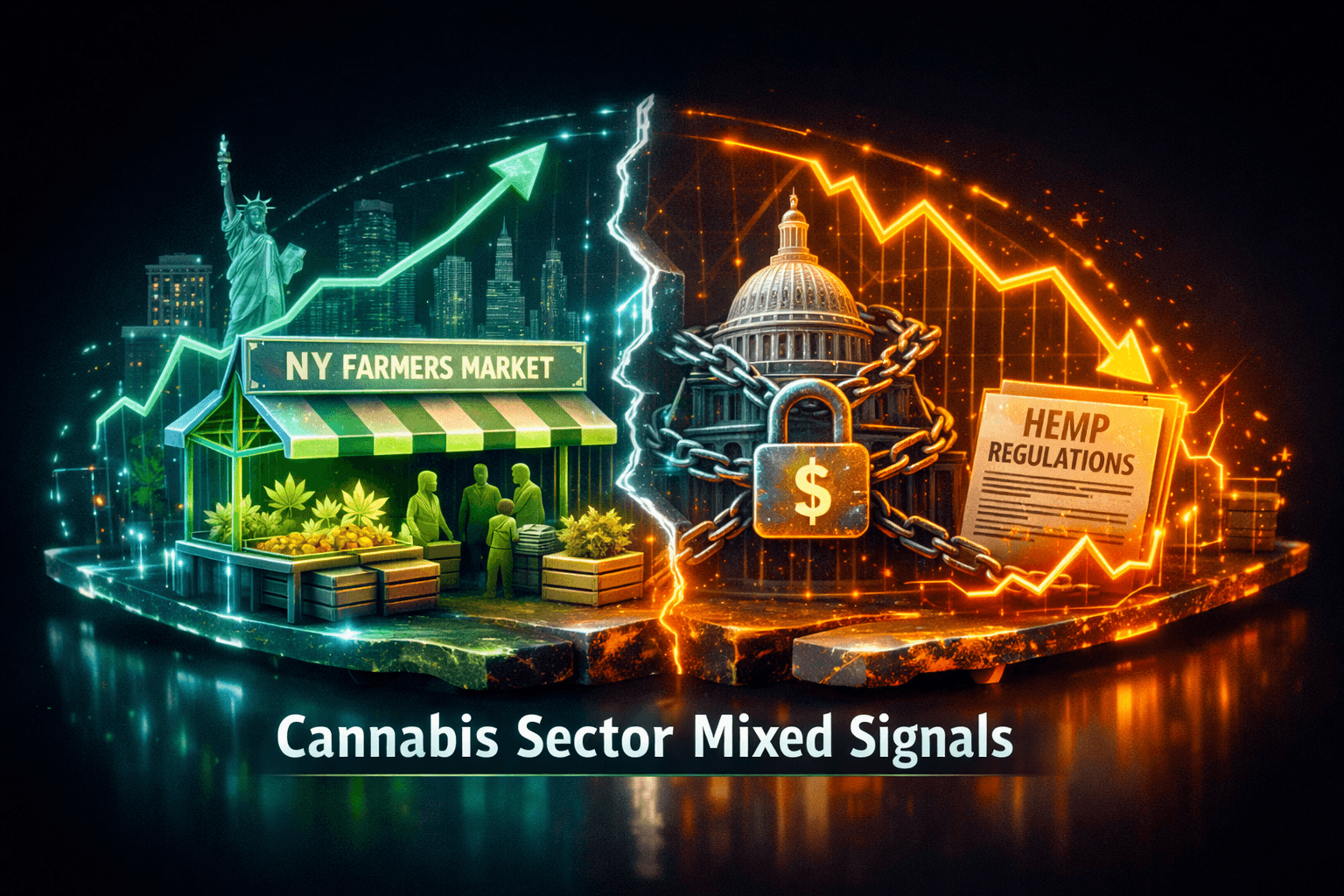
Today delivered mixed signals for the cannabis sector, leaving you with both clear expansion wins and growing policy risks to weigh. New York's move to allow licensed microbusinesses to sell at farmers' markets and Delaware's strong first-year sales figures pointed to steady retail demand and market normalization.
At the same time, new developments around a likely federal hemp restriction and payments platform rules created fresh uncertainty for CBD and hemp merchants. That split sets up a cautious, selective trading environment heading into next week, and it raises immediate questions about which market segments will keep momentum and which will face pressure.
Market Highlights
Quick facts and movers from today's headlines and sector themes.
- Massachusetts judgment: A judge ordered a Massachusetts city to pay more than $2 million to three cannabis stores after misallocating municipal funds.
- New retail access: New York regulators cleared licensed microbusinesses to sell at farmers' markets and pop-up events, expanding licensed retail channels.
- Delaware sales: First-year adult-use retail sales in Delaware topped $53.4 million, with month-over-month growth and a July record for monthly sales.
- Hemp and payments: Square, operating as $SQ, told merchants to stop selling hemp and CBD products on its platform, citing an upcoming federal change. That affects point-of-sale accessibility for many small sellers.
- Names to watch: The broader sector ETFs and names investors track include $MSOS, $TCNNF, $GTBIF, $CURLF, and $TLRY as you follow trading and policy developments.
Key Developments
Legal win in Massachusetts underscores regulatory redress
A court ruling ordered a Massachusetts municipality to repay more than $2 million to three cannabis licensees after officials used community host agreement funds for unrelated projects. The decision reinforces that local governments can be held to financial commitments tied to cannabis licensing.
For you that means enforcement and legal recourse can protect licensed operators when local authorities stray, and it may encourage investors to favor operators in markets with clearer municipal oversight.
Retail expansion: New York pop-ups and Delaware demand
New York's authorization for licensed microbusinesses to sell at farmers' markets and pop-up venues opens a lower-cost customer acquisition channel for small producers and micro-retailers. This move could boost foot-traffic sales and brand discovery, especially for craft and local producers.
Delaware's $53.4 million in first-year adult-use sales, with steady monthly gains, provides another data point that regulated markets can scale quickly once retail networks mature. Are these trends a bellwether for other states? They suggest consumer adoption remains robust where retail access expands.
Hemp and payments face immediate pressure
Square's directive to merchants to stop selling hemp and CBD products, tied to an expected federal legal change, creates a practical bottleneck for hemp commerce. Even as some officials, including CMS head Dr. Mehmet Oz, urge delay to preserve senior access to CBD, payment processors are acting now to limit risk exposure.
The implication for you is straightforward, if unwelcome: CBD and hemp brands may face restricted payment rails and reduced retail distribution before policy clarity arrives. That pressure could compress margins or push sellers to third-party processors and higher costs.
What to Watch
Where you should focus as the market absorbs today's mixed news.
- Federal hemp legislation: Watch the Senate timeline and any amendments that could delay or alter a ban. Dr. Oz's public plea to senators to delay the ban for Medicare coverage is a development to monitor closely.
- Payments policy moves: Follow statements from $SQ and other major processors on CBD policy. Changes in payment access will directly affect small merchants and could change competitive dynamics.
- State rollouts and retail expansions: Expect more guidance from New York regulators on pop-up licensing requirements and enforcement. Other states may take cues from Delaware's sales trajectory when shaping expansion plans.
- Earnings and licensing updates: Look for operator commentary on margins, delivery and direct-shipping growth, and effects of local rulings. Data releases on monthly retail sales for other states could confirm whether the Delaware pattern repeats elsewhere.
- Legal and enforcement trends: Incidents like the Wisconsin case where police used surveillance tech to track out-of-state purchases show enforcement risks remain in prohibition states. That will be important if you hold exposure in multi-state operators with interstate activity.
Bottom Line
- Mixed signals dominate today's flow, with clear retail demand gains balanced by real policy and payments risks.
- New York and Delaware headlines point to organic consumer growth where retail access expands, which analysts note supports longer-term legalization momentum.
- Square's payment restriction and a possible federal hemp ban are immediate operational threats for CBD and hemp merchants, creating short-term uncertainty.
- If you follow sector ETFs like $MSOS or names such as $TLRY, $TCNNF and $CURLF, expect volatility tied to policy headlines more than fundamental shifts this week.
- Stay selective, watch federal and payment developments, and track state retail data for clearer signals next week.
FAQ
Q: Will New York's farmers market rule let any seller operate? A: No, only licensed cannabis microbusinesses approved by state regulators can sell at farmers markets and pop-up events under the new guidance.
Q: Does Square's notice mean CBD is illegal now? A: Not yet, but $SQ's action reflects private-sector risk management ahead of an expected federal change that could criminalize many hemp-derived products.
Q: How should you monitor hemp ban developments? A: Track Senate actions, statements from CMS and key committees, and payment processor policy updates, because those factors will drive market access and merchant costs.