
Share this article
Spread the word on social media
Avicanna put out a press release this morning & on paper it's the most boring kind there is: a date. $AVCN on the TSX ($AVCNF over the counter in the U.S.) reports Q3 2026 on Thursday, November 12, before the open. Founder & CEO Aras Azadian & CFO Nick Hilborn get on a webcast at 8:30 a.m. ET, walk through the numbers, talk about QUIX & the MyMedi.ca program, & take questions. That's the whole release. You can probably guess why we're spending fourteen hundred words on a calendar notice.
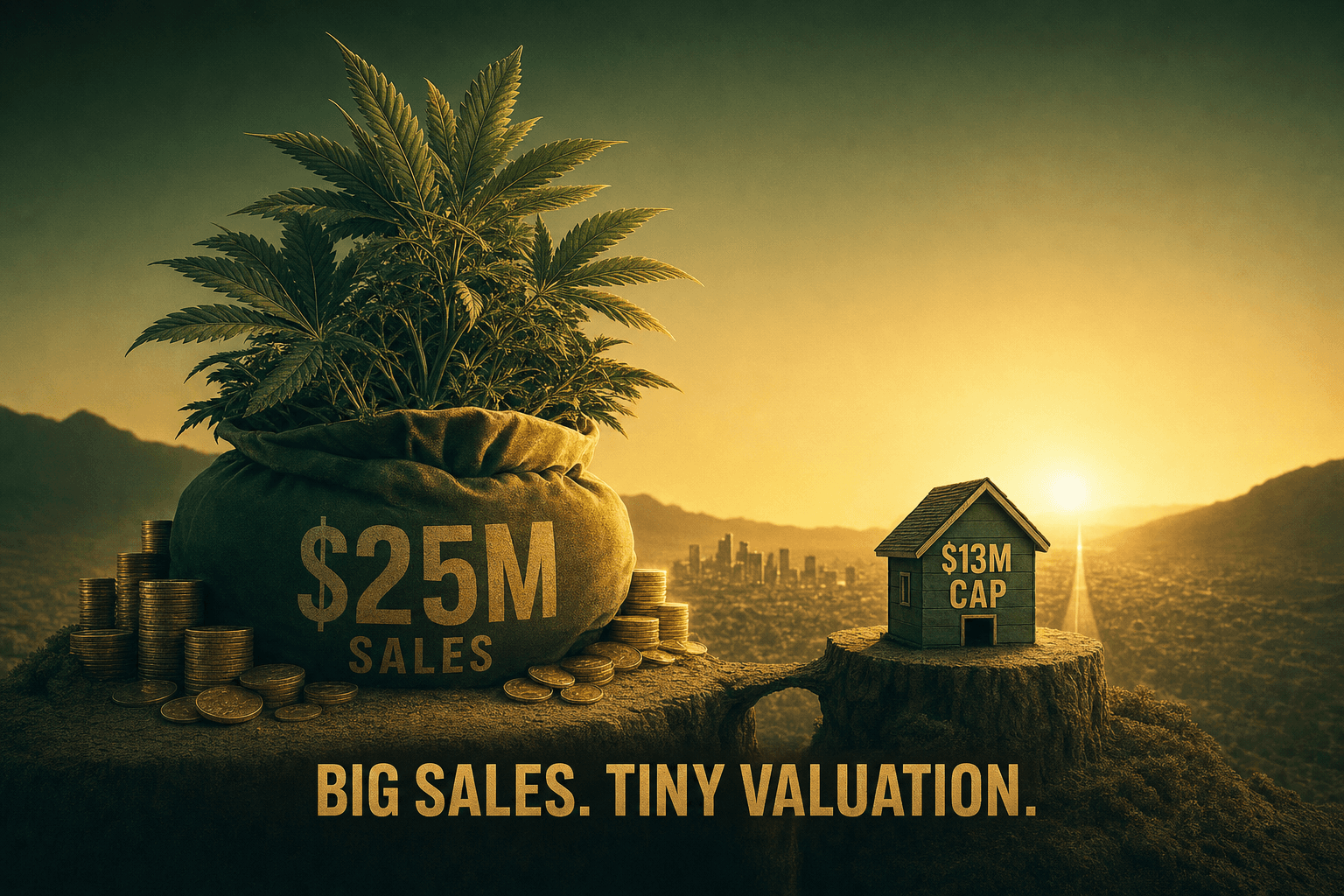
Here's the short version of a company most of you have never looked at. It did C$25.5 million of revenue in 2025. Gross margin went from 51% to 57% in a year. It printed a positive adjusted EBITDA quarter in Q4 2025 & a record C$6.68 million revenue quarter in Q1 2026 at a 58% margin. It sells more than fifty finished products, ships into about two dozen countries, holds U.S. patents, runs a Phase II trial in osteoarthritis pain & controls its own hemp supply in Colombia. And it trades at a dime on the TSX, with a market cap around C$13 million. That's half a turn of sales for a business with pharma margins. That's not a valuation. That's a shrug.
We don't think the shrug survives a company that starts talking. So let's do the talking first.
Who they actually are
Strip away the ticker & Avicanna is a Toronto pharma company that happens to work in cannabinoids. Azadian founded it in 2016 & took it public on the TSX in 2019. Then he spent six years doing the unglamorous thing: building formulations, running studies, filing patents & getting doctors comfortable. The chart since the IPO is a ski slope & we're not going to pretend otherwise. What got built underneath that chart is the part nobody priced.
There are four businesses in here, & they feed each other.
RHO Phyto is the formulary: oils, sublinguals, topicals & transdermals in set cannabinoid ratios, sold nationwide across Canada's medical & adult-use channels. Fifty-six SKUs & 172 listings at last count, with listings up 27% year over year. It's the part of the company that looks like a consumer brand but behaves like a drug portfolio, because every product comes with dosing guidance & data behind it.
MyMedi.ca is the care platform. Pharmacist-led, bilingual, built to walk a patient from a doctor's authorization through dosing, follow-up & insurance. It serves veterans, works with public & private payers on reimbursement, & it's where the branded products sell best. Before this spring it had strung together four straight quarters of growth.
The pharma pipeline is the long game: cannabinoid candidates aimed at dermatology, chronic pain & neurology, backed by real-world evidence from the platform, a Phase I THC dose-finding study with the University of Calgary & that Phase II osteoarthritis pain study. Avicanna also hosts a clinical symposium on cannabinoid therapeutics every year at MaRS in Toronto. It ran the sixth one in June, as a two-day event. Companies that are just selling gummies don't do that.
And then there's Santa Marta Golden Hemp in Colombia, the majority-owned subsidiary that grows & refines the CBD, CBG & THC that go into everything above. It also ships Aureus-branded API to partners in markets from Denmark to Singapore to Australia. That's the part that makes the model asset-light: organic-certified inputs from the equator, finished products & science in Canada, exports wherever the paperwork allows.
Four pillars, one tiny cap, a decade of grinding.
The grinding started to pay
2024 was a record revenue year. 2025 did C$25.5 million, took gross margin to 53%, cut the net loss by 41% to C$2.7 million & closed the year with a positive adjusted EBITDA quarter. By then the footprint was 24 international markets & there was no debt on the balance sheet. Management was openly talking about scaling abroad & exploring a U.S. senior exchange listing. Q1 of this year was a record: C$6.68 million of revenue at a 58% gross margin & an adjusted EBITDA loss of only C$150,000.
Then Ottawa changed the math. On April 1, Veterans Affairs Canada cut the maximum rate it reimburses for medical cannabis by about 30%. Veterans are a core patient group on MyMedi.ca, so that wasn't a rounding error, it was a hole in the hull. Average patient cart size fell 11.3%. MyMedi.ca posted its first sequential revenue decline. Q2 revenue came in at C$5.64 million, down 8% from a year earlier, & the stock did what stocks do when the growth story stalls: it slid from a 52-week high near C$0.28 to a dime.
Now read the rest of that Q2 release, because the market didn't. Active patients went up. Orders went up. Unit sales of Avicanna's own branded products jumped 48% quarter over quarter & 33% year over year. Gross margin held at 57% straight through the reimbursement cut, because the mix kept shifting toward the products the company makes itself. The adjusted EBITDA loss was C$360,000. That's a bruise, not a wound. The working capital deficit shrank from C$1.28 million at year-end to C$280,000. And management put a sentence in the release we'd circle in red: they expect positive adjusted EBITDA in the second half of 2026. Write it down. November 12 gets graded against it.
What changed since the market stopped looking
Three things, & none of them were in the Q2 numbers.
QUIX launched. It's Avicanna's self-emulsifying delivery technology: it breaks cannabinoids into nano-sized droplets so they absorb faster & more consistently, which is the whole problem with oral cannabis. In the company's reported study work the formulation showed 74% higher bioavailability & peak levels arriving 63% faster than the comparator. The first products, rapid-onset capsules & soft chews, reached Canadian medical channels in the third quarter with more than 35 commercial listings lined up before launch. Q3 is the first quarter with QUIX on the shelf, which means the 12th is the first look at it.
MyMedi.ca went institutional. In September the company launched an Integrated Healthcare Program that pushes the platform into hospitals, specialty clinics, insurers & care networks. It was built off a pilot at Sunnybrook's Odette Cancer Centre. The number that matters in that release came from Health Canada: only 18% of Canadians using cannabis for medical reasons do it with a medical document. The other 82% are buying somewhere else & dosing themselves, with no treatment plan, no follow-up & no reimbursement support. That's the gap MyMedi.ca is aimed at, & it's a far bigger pond than the veterans channel.
Smart money showed up. In August, Michael Porter, a pharma executive & life-sciences investor who's led more than 25 life-sciences deals, bought C$500,000 of units at 15 cents with warrants at 20. Last Thursday the company closed C$2 million of one-year debentures at 13% with 4 million warrants, also struck at 20 cents. The money is earmarked for working capital, production & clinical development. Thirteen percent isn't cheap money & we won't pretend it is. But look where everyone writing a check keeps setting the warrant strike: twenty cents, double the tape. The people closest to this thing are pricing the upside above where the market sits.
And the company decided to talk. The Q2 print went out at 6:30 on a Friday night in August & didn't even mention a call. This one lands Thursday morning before the open, with the founder & the CFO on a mic & a Q&A at the end. Somebody in Toronto decided it's time to sell the story instead of filing it. In a dime stock that posture change matters more than people think, because a stock can't re-rate on numbers nobody hears.
The U.S. kicker
We've spent most of this year writing about Washington's slow-motion Schedule III saga, & you can catch up on where it stands here. Avicanna's angle on it is simple. The company welcomed the first federal steps toward rescheduling in its Q2 release, & the reason is obvious. If cannabinoid medicine gets a real pharmaceutical lane in the U.S., a U.S. partner will go shopping. A Canadian company with a decade of formulations, real-world evidence, U.S. patents & clinical programs is exactly what it shops for. It already has a toe in the door: its patented CBD topicals sell stateside through the re+PLAY wellness brand founded by NBA veteran Al Harrington. Nobody's paying for that optionality at a dime. That's the point.
What we'd like to see on the 12th
Revenue climbs back toward last year's C$6.40 million. A print above C$6 million with the full VAC cut in the base tells us the worst of the reimbursement hit is behind them. Another mid-fives quarter says QUIX needs more time, & the stock keeps its dime.
Gross margin holds 57% or better. Last year's Q3 margin got clipped to 49% by one-time costs & the Canada Post strike, so the comp is easy. The real question is whether the branded mix keeps carrying the margin.
Adjusted EBITDA turns positive, or management explains exactly how Q4 does. They put the second-half call in writing. A positive Q3 validates it & gives the stock a reason to leave the dime. A small loss with a dated Q4 path is fine. A bigger loss than Q2 isn't.
QUIX gets numbers, not adjectives. Units, listings, reorders, sell-through. "Strong early reception" tells us nothing.
Cash gets a straight answer. With C$2 million of 13% paper on the books, we want the runway in months & a clear statement that a positive-EBITDA second half means the 15-cent placements stop.
How we see it
Our house rule in this sector hasn't changed: assume the news doesn't happen & trade around a core. At a dime the core costs almost nothing to hold, & the risk isn't the quarter, it's paying for the whole recovery before the call. If the numbers land, a C$13 million market cap on C$25 million of sales doesn't stay a shrug for long. If they don't, you've got a well-run small pharma that buys itself more time & keeps building, which is what it's done for ten years. Either way, on November 12 Avicanna stops being quiet. Quiet was the one thing this stock couldn't afford.
Subscribe to StockAlpha for the November 12 recap & the rest of the Avicanna story arc.
Disclosure
Jefferson Equity Derivatives & Intelligence LLC, the publisher of StockAlpha.ai, has been compensated for the promotion of Avicanna Inc. (TSX: AVCN), which engaged it as a paid investor relations consultant. Avicanna Inc. paid fifteen thousand dollars ($15,000) USD for this engagement (November 1, 2026 through December 15, 2026). As a result, our opinion is neither unbiased nor independent. The publishers hold no securities of the Company and have agreed not to trade in Avicanna securities during the engagement. This marketing may increase investor awareness, trading volume, and share price, which may be temporary. This article was built from public disclosures only. It's commentary, not investment advice. Do your own work.