 Sector Insights
Listen to this Recap
22:47
Sector Signals Split Between AI and Energy Investment, Credit and Demand Risks
Podcast • Loading audio...
Share this article
Spread the word on social media
Key Takeaways
- •Sector performance figures were unavailable, so the groupings reflect headline tone and catalysts rather than measured daily returns.
- •Materials, healthcare and energy reported notable project, regulatory or production milestones, but execution and policy risks remain.
- •Housing affordability is a clear pressure point: builder confidence fell to a 14-year low and 68% of builders offered incentives.
- •AI and clean-energy growth are increasingly linked to grid capacity, storage, cybersecurity and the reliability of physical infrastructure.
- •Crypto adoption signals persisted alongside Bitcoin near $64,000, weaker crypto-linked shares and pressure on spot ETF flows.
Executive Summary
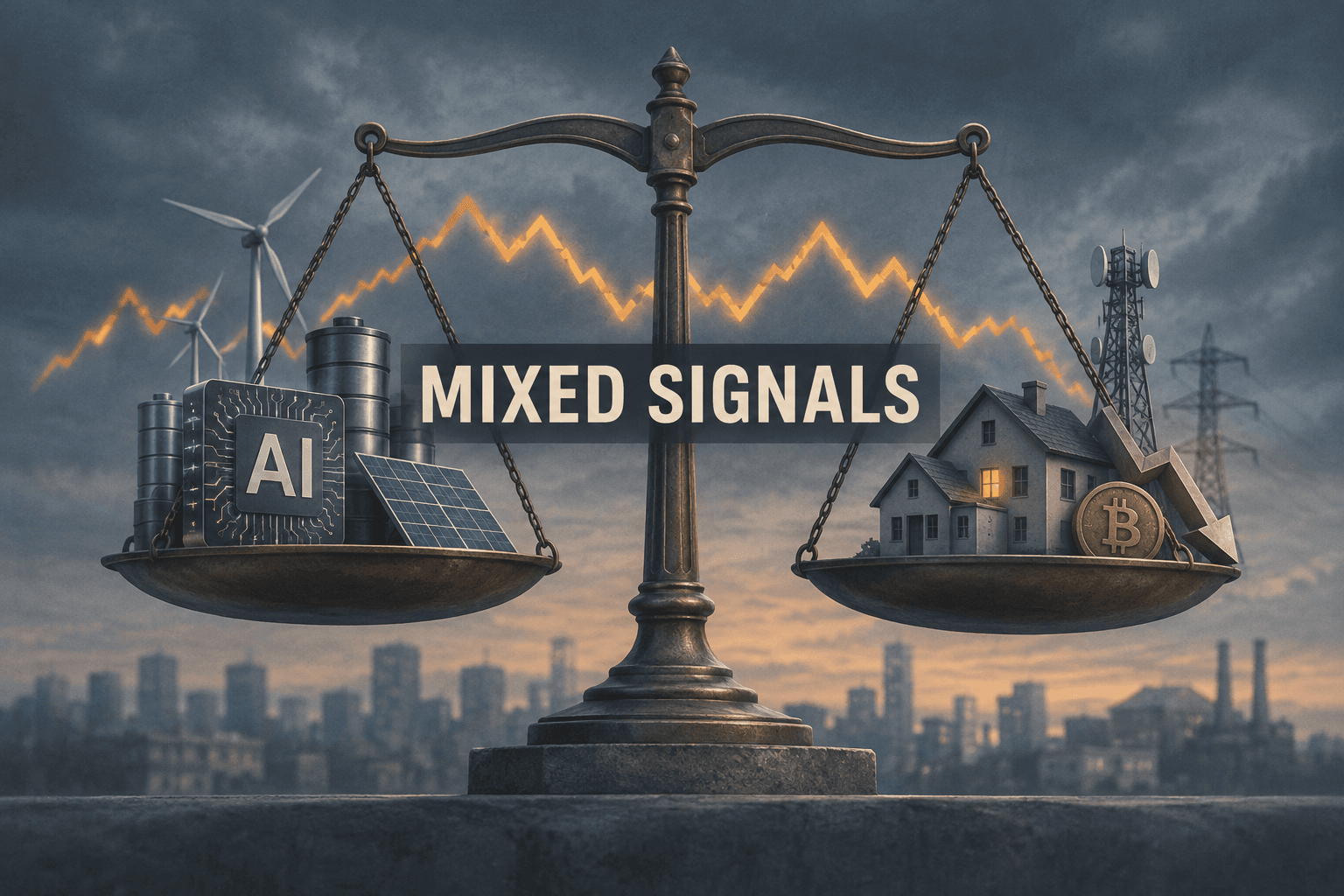
The Nov. 17 sector picture is a study in conflicting signals. Investment and expansion continued in areas including artificial intelligence, energy infrastructure, mining projects and selected property transactions. But those longer-term growth narratives ran alongside near-term pressure: Bitcoin hovered near $64,000 as crypto-linked shares weakened, U.S. homebuilder confidence fell to a 14-year low, a major cable operator delayed an interest payment, and drought pushed Southwest hydropower to a record low.
There is no reliable sector-performance ranking in the information provided. Every sector summary lists performance as unavailable, and none supplies daily percentage returns or a complete set of ticker-level moves. The groupings below therefore describe the tone and substance of the day’s headlines—not which sectors actually rose or fell in the market. Company announcements, policy developments and project milestones can be consequential, but they do not by themselves establish a sector’s price performance.
A recurring theme is the gap between investment potential and execution. AI infrastructure plans and automation projects point to continued spending, but questions about financing, energy supply, regulation and returns remain. Clean-energy storage capacity is expanding, while drought, grid constraints and cyber incidents expose reliability challenges. In consumer-facing industries, product launches and new services offer growth avenues, but affordability and online economics are weighing on demand and margins.
Constructive Catalyst Set: Materials, Healthcare and Energy
Materials: Project progress meets execution risk
Mining and materials news carried a notably active project-development thread. Permits for two gold projects in Guinea, a $675 million Tanzania contract and Rio Tinto’s Tiwai Point restart were among the day’s prominent developments. Separate updates described a full project stake, fresh drilling and a completed geophysical study. Together, the news points to continued efforts to advance exploration and production, including in regions where permitting, infrastructure and local operating conditions can shape project timelines.
The headline value of a contract or a project milestone should not be confused with realized revenue or returns. Projects still depend on execution, financing, labor availability and access to essential inputs. The summaries specifically flag water access, industrial capability, labor, recycling and critical-mineral alliances as issues to watch. Water is particularly relevant: it can constrain both extraction and processing, while competition for supplies may create additional operational and community considerations.
For sector watchers, the useful distinction is between development progress and operating delivery. Permits and studies can reduce some uncertainty, but they do not remove construction, cost or commodity-price risk. The day’s material-sector news was constructive in activity, with the qualification that the practical test is whether projects advance on schedule and within expected costs.
Healthcare: Positive clinical and regulatory milestones, but uneven outcomes
Healthcare produced several potentially meaningful developments across medicines, research and biotechnology financing. Roche received approval for a breast cancer pill, and a separate update reported success in a bladder-cancer trial. A major financing for an AI-focused biotech also underscored continued interest in applying computational tools to drug development.
Those positive headlines were balanced by an FDA setback for Summit Therapeutics, ongoing regulatory debate and other research updates. The contrast illustrates why healthcare cannot be read as a single directional story: results can vary substantially by treatment, trial design, regulatory decision and stage of development. An approval or successful trial is a milestone, but the summaries do not provide the commercial forecasts, detailed clinical data or market reaction needed to assess its financial significance.
The AI-financing news connects healthcare to the broader technology investment cycle. It signals interest in tools intended to improve research and development, while leaving open questions about development timelines, validation and the eventual translation of research into approved products. For observers, the most informative follow-up will be detailed evidence and regulatory disclosures, rather than the headline alone.
Energy: Supply, grid reliability and transition investment
Energy offered a mix of traditional supply developments and low-carbon investment. A $1.8 billion Canadian energy deal and the start of production at Guyana’s Uaru project point to continued activity in oil and gas. Poland’s 1.81-gigawatt solar auction and solar-technology announcements, meanwhile, highlight the expansion of renewable capacity. Together, these stories reflect an energy system investing across multiple sources rather than moving in a single direction.
Reliability and security were central counterweights. Security discussions around the Strait of Hormuz put shipping and geopolitical exposure on the watchlist. A reported U.S. grid-capacity gap raises questions about whether infrastructure can keep pace with new electricity demand. Refinery strike risks and a cyberattack-related outage affecting a renewable asset further illustrate how energy supply can be disrupted by labor, network and security issues—not just by fuel availability.
The practical takeaway is that energy transition is also an infrastructure and resilience story. New generation capacity matters, but so do transmission, storage, cybersecurity and dependable fuel supply. The day’s project announcements point to investment; the risks show that getting energy to customers consistently remains a separate challenge.
Caution-Heavy Headlines: Real Estate, Crypto and Communications
Real estate: Affordability weighs on housing, while selected deals continue
The clearest broad demand warning came from housing. Homebuilder confidence fell to a 14-year low as affordability pressures kept prospective buyers on the sidelines, and 68% of builders were offering incentives. Incentives may help attract customers, but their prevalence also signals the effort required to make purchases workable in a strained affordability environment.
That weakness contrasts with continued activity in selected commercial property markets. Data-center, multifamily and office transactions were reported, including a $100 million Hudson Yards development-site sale. The deal demonstrates that capital continues to move in specific locations and property types; it does not establish that real estate demand is uniformly strong. Property values and operating prospects can differ considerably by asset, tenant demand, financing conditions and local supply.
The sector also faces risks that are not captured by transaction volume alone. Mortgage-related AI oversight and cyber resilience were flagged as issues, as property and financing businesses depend on increasingly complex data systems. For a balanced reading, housing affordability is the clearest negative signal, while commercial transactions offer selective evidence of ongoing activity rather than a broad-based recovery.
Crypto: Bitcoin weakness alongside continuing institutional interest
Bitcoin traded near $64,000 in the summaries, with one report describing a decline and another saying the asset was holding around that level as technology stocks slid. Crypto-linked shares weakened, and spot ETF flows remained under pressure. The available information does not include a precise daily return, so the magnitude of the move cannot be quantified here.
There were countervailing adoption signals. Goldman Sachs’ exposure to an Ether exchange-traded fund, Tether’s investment in Brazil and a planned stablecoin payments test point to continued interest in regulated investment products and payment applications. But adoption headlines do not erase price volatility, security alerts or legal uncertainty. The combination of institutional participation and falling prices is a reminder that use cases and asset valuations can move on different timelines.
The reported relationship between crypto and technology stocks is also worth monitoring, though one day’s co-movement does not establish a durable correlation. If risk appetite in growth-oriented assets weakens, crypto-related shares may face pressure alongside technology companies; policy, flows and crypto-specific events can still produce a different path.
Communications: Credit and labor concerns against selective growth
Communications news was mixed, with a cautionary operational and credit story offset by some company and content developments. Cable One’s delayed interest payment put financial risk in focus, while labor tension at an AT&T fiber venture raised questions about execution and operating continuity. These are more direct risk signals than announcements of future content or connectivity projects, although the summaries do not provide enough detail to assess the eventual financial impact.
Tencent Music reported revenue growth of 5.6% and secured early-release rights for selected K-pop titles. Production investment, live events and connectivity initiatives offered brighter notes across the wider group. Still, many of these announcements have yet to show measurable financial results. The sector therefore calls for selectivity in analysis: distinguish demonstrated revenue growth from projects whose contribution remains prospective, and keep credit and labor developments in view.
Mixed and Cross-Cutting Sectors: Utilities, Technology, Industrials and Consumers
Utilities: Storage growth faces drought and grid constraints
U.S. energy storage capacity passed 200 gigawatt-hours, a substantial milestone that reflects the buildout of infrastructure to store electricity. A new solar factory and off-grid tracker controls added to evidence of clean-energy expansion. Renewable financing and grid capacity also remain active topics, while a December decision concerning Consumers Energy’s dams is a future regulatory point to monitor.
Against this progress, Southwest hydropower fell 19% to a record low amid drought. The contrast captures a central utility challenge: the mix of available generation can change sharply with weather, while electricity demand and infrastructure needs continue. Uncertainty around data-center investment complicates planning as well. If large computing projects proceed, they may increase demand; if plans change, forecasts for new capacity and grid investment may need to adjust.
The 200-GWh storage milestone is evidence of scale, not proof that all reliability needs are solved. Storage, generation, transmission and demand forecasts must work together. Utilities face the task of planning for both rapid technological demand and climate-related variability in water and power resources.
Technology and industrials: AI ambition meets regulation and capacity limits
AI remained a major growth narrative across technology and manufacturing. Product rollouts and large startup-financing discussions featured alongside Anthropic’s reported infrastructure plan, which emphasizes the scale of computing investment under consideration. In industrials, AI, robotics and data tools appeared in manufacturing updates, while expanded air capacity pointed to changes in logistics and supply chains. A cybersecurity startup’s reported billion-dollar valuation added another marker of investor interest in technology businesses.
Yet the investment story comes with uncertainty about cost, capacity and rules. Nvidia faced leadership uncertainty, and a proposed legal risk for chip customers added to questions around the semiconductor ecosystem. New semiconductor export controls could affect industrial operations and supply chains. Restrictions involving Waymo and Kalshi illustrated the regulatory exposure facing technology businesses in fields such as automated driving and prediction markets.
The connection to utilities is direct: data centers require power, and uncertainty over their timing makes grid planning more difficult. The connection to industrials is equally important: automation can support productivity, but companies still need suitable systems, workers and energy. Severe-weather preparation and workforce challenges were cited as operational risks, alongside energy costs. AI investment is therefore a source of potential demand and a test of infrastructure, governance and execution.
Consumer and retail: New formats cannot eliminate affordability pressure
Retailers and brands continued to experiment with ways to attract customers, including AI-powered shopping tools, delivery expansion, and fragrance and footwear launches. Leadership changes and production expansion were also reported. Dillard’s modest sales growth exceeded expectations, offering a limited positive data point in a mixed consumer backdrop.
The counterweights are meaningful. Grocery inflation and possible changes to the Supplemental Nutrition Assistance Program (SNAP) could affect household budgets and food retailers. Legal exposure adds another company-level risk, while pressure on the economics of online grocery operations raises questions about whether convenience can be delivered profitably. Nike’s stated lengthy path back to growth further underscores that brand recovery can take time, even when a company has significant scale.
The stories suggest a consumer sector adapting its products, delivery and customer interface while contending with price sensitivity. New shopping tools and product launches may support engagement, but the summaries do not establish that they are generating durable sales or improved margins. Household affordability remains the broader variable to watch.
Policy-Sensitive and Smaller-Signal Areas
Cannabis: Market potential depends on policy and implementation
Cannabis coverage was dominated by regulation and market development rather than reported financial results. Virginia’s first adult-use market analysis estimated annual sales of $1.05 billion ahead of a planned 2027 launch. That estimate points to potential demand, but it is a forecast, not current revenue, and the market’s eventual size will depend on implementation and competitive conditions.
Elsewhere, North Carolina was weighing THC-regulation options, Massachusetts was considering testing rules, and a Los Angeles labor dispute added an operating issue. Congress was also set to examine psychedelic therapy for veterans—a related policy discussion, but not evidence of a change in cannabis rules. Taken together, the headlines show how regulation, product oversight and labor conditions can shape an industry whose commercial prospects remain closely tied to policy decisions.
Finance: Operational resilience and uneven company signals
Finance and banking headlines were mixed. JPMorgan Chase restored service after a disruption, bringing operational resilience into focus. Bitcoin and spot ETF flows remained under pressure, connecting financial-market activity to the crypto weakness described above. Bank filings and upcoming earnings were identified as near-term sources of information, but the summaries do not include enough detail to characterize the sector’s overall financial results.
AECOM’s results and record backlog offered a positive company-specific signal, tempered by softer revenue and uneven guidance. Amazon’s clean-energy plans added a corporate investment angle, while hedge-fund filings and rate-sensitive sector calls provided context on positioning and interest-rate exposure. These items should not be read as a unified signal for banks or financial firms: they span different businesses and do not establish a common earnings trend.
Cross-Sector Themes Investors Are Monitoring
1. Infrastructure is the bridge between growth stories and real-world constraints
Data centers, AI, electrification, renewables and manufacturing automation all depend on physical infrastructure. Utilities are building storage, energy companies are pursuing new generation, and technology firms are discussing major computing investments. At the same time, grid-capacity concerns, drought, cyber incidents and uncertainty over data-center plans show that infrastructure availability can limit or delay commercial ambitions.
2. Affordability and financing shape demand
The housing confidence decline and builder incentives show how affordability can restrain a major purchase. Grocery inflation and possible SNAP changes bring similar pressure to everyday consumption. In communications, a delayed interest payment adds a credit lens, while real-estate activity and renewable investment remain sensitive to capital availability. Across these sectors, announcements of expansion need to be assessed alongside the cost of financing and the ability of customers to pay.
3. Regulation and policy can alter timelines
Cannabis market estimates depend on future rules and launch schedules. Semiconductor export controls may affect industrial supply chains. Healthcare trial outcomes and FDA decisions influence the path from research to commercialization, while technology restrictions can constrain how products are deployed. Policy is not merely background context in these industries; it can determine which projects proceed and when.
4. Resilience is an increasingly common operating issue
Labor tensions, severe-weather preparations, cyber resilience, hydropower shortages and security concerns around energy routes all point to a broader focus on continuity. A company’s growth plan can be disrupted by events well beyond customer demand, from weather and infrastructure failures to workforce disputes and cyberattacks. This makes operational readiness an important complement to revenue and growth forecasts.
Investor Watchlist: What the Headlines Do—and Do Not—Show
The day’s reports support monitoring several measurable follow-ups: whether builders’ incentives persist and housing confidence stabilizes; how drought affects hydropower and utility planning; whether data-center projects translate into firm demand forecasts; and whether mining and energy projects move from permits or announcements to production. In healthcare, trial details and regulatory documentation matter more than a brief description of a positive or negative result. In crypto, price, ETF-flow and security data can help distinguish a short-term move from a broader change in demand.
It is equally important to separate company-specific events from sector-wide evidence. A single delayed payment does not establish the condition of every communications business, just as a large property sale does not demonstrate a broad real-estate rebound. A financing announcement signals available capital for a particular venture, not necessarily commercial success. The summaries offer a useful agenda for further research, but not a substitute for complete financial statements, price data or company disclosures.
Forward-Looking Perspective
The next phase of the market narrative will likely turn on whether investment plans can meet practical tests: financing, regulation, power availability, labor and customer demand. AI and clean-energy spending remain prominent, but infrastructure constraints and uncertainty over project economics may determine how quickly those ambitions become operating results. Housing and consumer affordability will provide an important read on demand, while commodity projects and energy-security developments will keep supply reliability in focus.
With no sector-return data supplied for Nov. 17, a performance-based conclusion would be unsupported. The day instead points to a neutral, highly differentiated landscape: constructive milestones in materials, healthcare and energy coexist with clear pressures in housing, crypto and parts of communications. Analysts and market participants will have a clearer basis for comparison when full price moves, company disclosures and subsequent operating data become available. This recap is informational and does not constitute personalized investment advice or a recommendation regarding any security.
Sources
+ 14 more sources
Use these insights — enter this week's contest.
Free practice contests — earn Alpha CoinsExplore More Content
Disclaimer: StockAlpha.ai content is for informational and educational purposes only. It is not personalized investment advice. Sentiment ratings and market analysis reflect data-driven observations, not buy, sell, or hold recommendations. Always consult a qualified financial advisor before making investment decisions. Past performance does not guarantee future results.
Spotted something wrong? Report an error.