 Sector Insights
Listen to this Recap
16:41
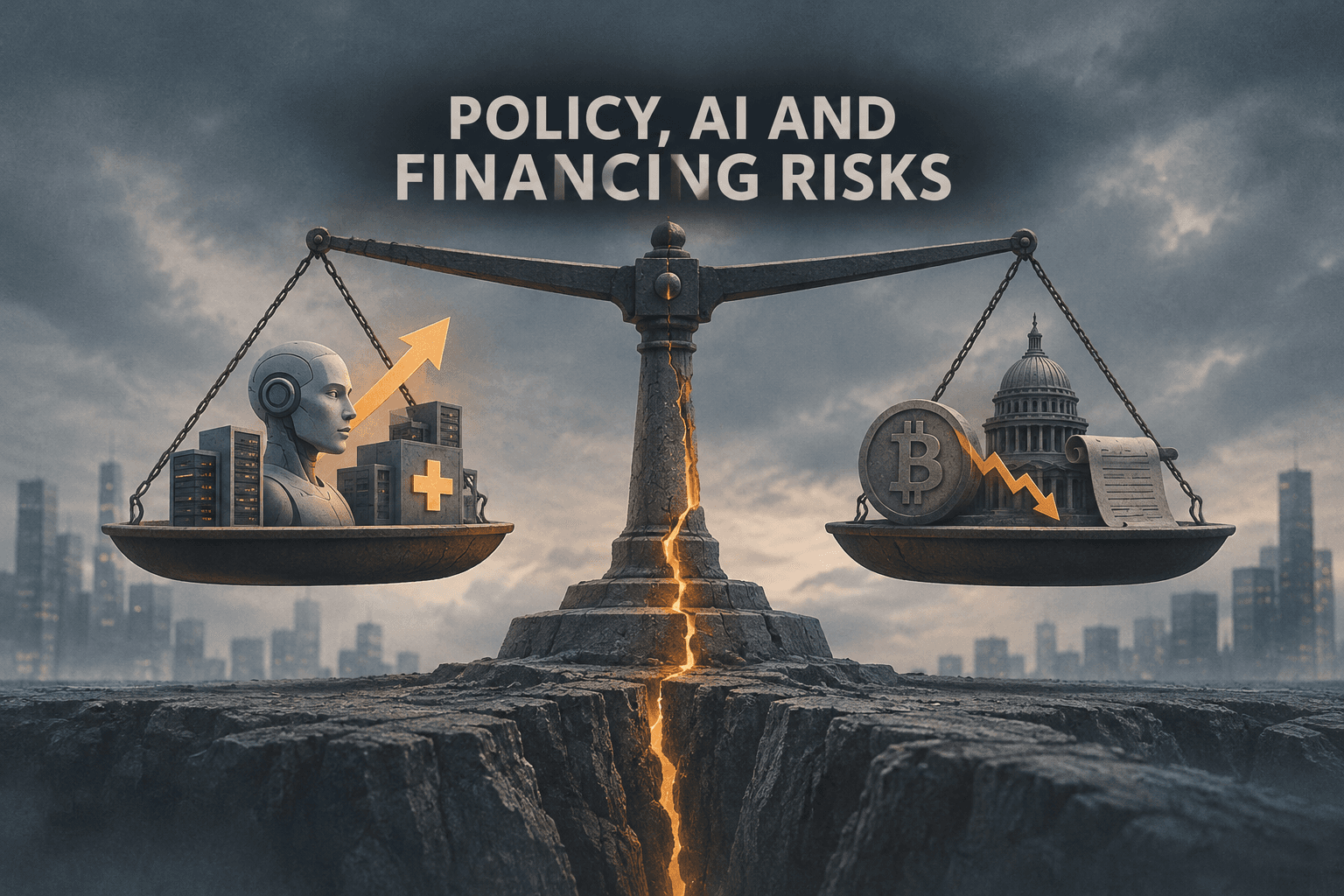
Policy, AI and Financing Risks Divide the Nov. 12 Sector Landscape
Podcast • Loading audio...
Share this article
Spread the word on social media
Key Takeaways
- •The supplied summaries contain no sector-return figures, so actual daily leaders and laggards cannot be ranked.
- •Crypto had the most concentrated negative headlines: Bitcoin touched a 12-week low, with reports of $2 billion in ETF outflows, liquidations and security concerns.
- •AI, healthcare financing, industrial investment and critical-minerals activity supplied constructive catalysts, but execution and commercial returns remain uncertain.
- •Rates, regulation, project financing and operational reliability connected otherwise separate sector stories.
- •Several notable catalysts remain prospective or reported rather than settled, including proposed cannabis reforms and Nvidia leadership claims.
Executive summary
The Nov. 12 sector reports describe a market with no single, uniform narrative. Across industries, investment plans and new products offered reasons for optimism, but those developments were often offset by financing constraints, regulatory uncertainty, operational problems or questions about whether projects can deliver commercial returns. AI featured prominently, as did the practical demands of funding infrastructure, managing supply chains and maintaining reliable services.
The clearest negative news flow came from crypto, where Bitcoin touched a 12-week low and reports cited $2 billion in exchange-traded fund outflows, liquidations, raids and a Chainstack breach. Technology also faced a confidence test: Google advanced its AI-powered Search experience, and Tencent pledged to redeploy half its workforce to AI, but a Microsoft 365 outage and reports of leadership turmoil involving Nvidia introduced operational and governance concerns. The summaries do not establish the effect of these headlines on sector returns.
Elsewhere, healthcare and industrials had notable investment and development stories, including Blackstone’s $1.5 billion commitment to help fund Pfizer’s Phase 3 monthly obesity-treatment program and Mars’s planned $1.4 billion investment in U.S. operations. Materials companies reported exploration and deal activity, while energy and utilities balanced new project support against supply, permitting and grid reliability risks. Consumer, real estate, communications, cannabis and finance each presented mixed signals rather than a clear directional trend.
A key limitation: all 24 supplied summaries list sector performance as “N/A.” This recap therefore cannot identify the actual best- or worst-performing sectors, calculate daily returns, or establish that any reported headline caused a price move. The groupings below describe the relative tone of the reported catalysts—not measured market performance.
Constructive catalysts: investment, deals and product development
Healthcare: large financing meets policy and execution risk
Healthcare had one of the day’s most substantial funding announcements. Blackstone committed $1.5 billion to help finance Pfizer’s Phase 3 program for a monthly obesity treatment. The commitment is a material vote of confidence in the potential commercial importance of obesity medicines, while also underscoring the capital required to test and bring new therapies through late-stage development. Phase 3 is a critical stage of clinical testing, but the announcement is not evidence that the treatment will succeed or receive approval.
The sector’s broader news was not uniformly positive. Physicians’ use of AI continues to grow, pointing to potential changes in clinical workflows, but questions about UnitedHealthcare’s policy audit and uncertainty around FDA leadership kept scrutiny on insurers and regulators. Separate reports on opioid-settlement spending, a prostate-cancer blood test and Nigeria’s malaria-vaccine rollout show the breadth of the sector’s agenda: commercial innovation, public-health priorities and accountability all remain in view. For investors assessing the sector, the contrast is between long-term product and technology development and nearer-term policy, oversight and execution risks.
Industrials: investment plans, automation and portfolio choices
Industrial and manufacturing reports also included sizeable commitments. Mars pledged $1.4 billion for U.S. operations, and BMW struck battery-related deals in the United States and Europe. The reports point to continuing investment in production capacity and supply chains, although they do not specify the timing, full project scope or expected financial returns. System integrators received awards for automation expertise, while new AI tools are being developed for factory workflows. These stories connect the AI theme to physical operations: manufacturers are exploring software and automation to improve production processes, not just selling digital services.
There are counterweights. CNH Industrial plans to sell a $700 million stake in its construction-equipment business, a portfolio move whose strategic implications depend on how proceeds are used and how the remaining business performs. Tariff debate, UPS’s long-range labor planning and supply-chain exposure add uncertainty. ABB-SoftBank talks were also flagged, but the supplied summary gives no details sufficient to assess their status or potential impact. The sector’s constructive tone is therefore tied to investment and automation activity, while execution, trade policy and corporate restructuring remain important variables.
Materials: project pipeline and deal activity, with commercial tests ahead
Critical minerals, exploration and transactions anchored the materials reports. The day’s coverage included U.S. critical-minerals strategy, drilling programs in the United States, Tanzania and Quebec, and an $86 million Altius takeover carrying a reported 60% premium. A separate report cited a $139 million Spanish acquisition. These developments suggest companies and policymakers are working to secure mineral supply and advance projects, while transaction premiums can signal strategic interest in specific assets.
Yet a pipeline of projects is not the same as profitable production. The reports explicitly raise the question of whether new developments can work commercially, particularly if public financing is unavailable. Water availability and rare-earth supply risks add operational and strategic complications. Exploration milestones, permitting, funding terms and eventual customer demand will determine whether announced activity translates into durable cash flows. The news is constructive on activity, but not enough on its own to establish sector-wide performance or project economics.
Pressure points: risk appetite, governance and funding
Crypto: sharpest concentration of negative headlines
Crypto had the most consistently adverse news flow in the supplied summaries. Bitcoin touched a 12-week low as market jitters and liquidations weighed on sentiment. A second report cited $2 billion in ETF outflows, alongside Indian raids and a Chainstack breach. Outflows can indicate reduced demand for listed crypto exposure, while liquidations—forced closures of leveraged positions—can intensify selling when prices fall. The summaries do not provide the timing or measurement period for the outflow figure, so it should not be interpreted as a full-day sector-return statistic.
There were attempts to counter the negative tone. Tokenized-stock plans advanced, new alliances and product launches were reported, and Binance said it had covered a major theft. But the coverage also raised questions about verification and access. In a sector where confidence in custody, security and market infrastructure is central, assurances need to be evaluated alongside independent evidence and the details of incident response. The combination of price weakness, flows, security incidents and regulatory scrutiny points to elevated uncertainty; it does not, by itself, quantify the day’s performance for all crypto assets or related companies.
Technology: AI ambition collides with operational and leadership questions
Technology produced a split narrative. Google advanced its AI-powered Search experience, and Tencent said it would redeploy half its workforce to AI. Those developments illustrate how established technology companies are reorganizing products and labor around artificial intelligence. SMIC reported strong third-quarter results, another sign of activity in the semiconductor supply chain, although the summary provides no figures for assessing the scale or durability of that performance.
At the same time, Microsoft experienced a 365 outage, highlighting the operational dependence of businesses on cloud and productivity services. Reports involving Nvidia CEO Jensen Huang, including claims of a possible removal and a leadership shake-up, raised governance concerns. The supplied reports do not independently resolve those claims, and they should be treated as reported uncertainty rather than confirmed corporate action. Because Nvidia is closely associated with the AI investment cycle, leadership questions can carry broader significance for market confidence even when the underlying business outlook is not detailed. The sector’s central tension is that AI investment and product launches remain active while reliability and governance can quickly become part of the valuation discussion.
Finance: rates and corporate activity pull in different directions
Finance combined a major regional-bank transaction with concerns about interest rates. Hancock Whitney plans to acquire Trustmark in a $3.2 billion deal, a move that could reshape the participating institutions, subject to the transaction’s terms, approvals and integration. Merger activity can reflect strategic efforts to expand scale or capabilities, but a headline deal value alone does not reveal its eventual effect on earnings, customers or capital.
Bond-market concern about further Federal Reserve rate hikes pushed yields higher, according to the summary. Higher yields can support some interest income but may also raise funding costs, affect bond valuations and increase pressure on borrowers. The report also noted the S&P 500’s resilience amid Nvidia-related selling, new technology offerings for community banks, a large quarterly dividend from DHT and a 30% jump in GIB. These isolated company items cannot be generalized into a sector-wide trend without additional context, including measurement periods and the reasons behind the reported share move. The broad takeaway is a financial sector balancing deal activity and technology adoption against rate sensitivity and market volatility.
Mixed and relatively balanced news flow
Energy and utilities: transition investment meets reliability and supply concerns
Energy news ranged from new solar financing and turbine demand to tighter scrutiny of AI use in oil. Europe entered winter with unusually low gas inventories, keeping supply security in focus, while financing constraints weighed on Nigerian oil and gas companies. New U.S. project funding and Dutch support for Ukraine offered counterpoints. Japan’s wind-related feed-in-tariff policy was also described as winding down. Taken together, these items highlight how energy markets are shaped by different time horizons: near-term fuel availability, project financing and policy frameworks sit alongside longer-term shifts in generation.
Utilities faced a related balancing act. The U.S. Energy Information Administration forecast strong growth in battery storage and renewables, but wind-permitting delays and grid reliability needs remain constraints. California distributed-energy-resource rules and Constellation’s hybrid-capacity moves add regulatory and operational detail. Battery storage can help match electricity supply with demand, but deployment depends on grid connections, permitting, project economics and system planning. The summaries identify significant transition activity without providing enough data to say how utilities or energy companies performed on the day.
Consumer and real estate: activity continues, affordability and legal issues linger
Consumer companies are preparing for the holiday season with delivery initiatives, loyalty programs, AI and creator marketing. Grocery Outlet’s comparable sales turned positive, while grocery inflation and policy changes continue to raise questions about household budgets. A comparable-sales measure tracks performance at stores open for a consistent period and can help distinguish underlying demand from growth driven by new locations. The improvement reported at Grocery Outlet is one company signal, not proof that the wider consumer market has strengthened. A McCormick-Unilever matter also encountered an antitrust snag, underscoring how competition review can complicate corporate plans.
Real estate reports described industrial and multifamily transactions, aviation-focused property deals, a record Texas C-PACE loan and South Florida expansion. C-PACE financing is a mechanism for funding eligible property improvements, often tied to energy or resilience upgrades. The activity suggests capital is still being directed toward selected property types, while household-credit data was characterized as steady. AI adoption and mortgage partnerships may change how property and financing businesses operate, but the reports offer no transaction-level returns or broad valuation data. A Compass antitrust case remains a legal risk to monitor. The sector’s tone is active but selective, with financing conditions, legal outcomes and property-level demand still decisive.
Communications and cannabis: policy calendars and business launches
Communications coverage combined entertainment launches and content deals with telecom developments. A new Brooklyn venue, the imminent launch of Grand Theft Auto 6, film deals at IDFA, Netflix casting, private 5G deployments and expanded telecom services all point to continuing activity across media and network businesses. At the same time, telecom regulation and reports of an Nvidia leadership shake-up contributed uncertainty. The range of stories is broad, but without company-level financial details it is difficult to determine their relative significance for sector earnings.
Cannabis also remains highly exposed to policy. Officials in Texas and Wisconsin put reform on the 2027 agenda, and North Carolina Democrats signaled a likely medical-cannabis bill next year. These are potential future catalysts, not enacted changes. California regulatory concerns and uncertainty over hemp-derived THC products temper the outlook. A UCLA study offered new consumer insights, and a Maryland cultivation site unionized, adding research and labor dimensions to the policy story. The timing and substance of legislation—and the final rules—will matter more than preliminary agenda-setting when assessing the potential commercial effect.
Cross-sector themes investors are monitoring
AI is spreading beyond software. Google Search, Tencent’s workforce plans and factory-focused AI tools show that companies are applying AI across consumer products, corporate labor and industrial workflows. Utilities, energy, healthcare and real estate are also dealing with AI’s implications, from grid demand and clinical use to property analysis. The common question is whether adoption produces measurable productivity or revenue, and whether operational reliability and governance keep pace.
Capital availability is a dividing line. Blackstone’s healthcare commitment, major industrial investment plans, property financing and project funding in energy contrast with constraints facing Nigerian energy companies and uncertainty over public financing for mineral projects. Announcements of capital commitments are meaningful, but investors will need to distinguish committed funding from proposed plans and evaluate project costs, timelines and returns.
Policy and regulation influence long-term expectations. Cannabis legislation remains prospective; wind permitting and energy incentives affect project economics; antitrust and healthcare oversight create legal uncertainty; tariffs may alter manufacturing costs. These issues can change the conditions under which businesses operate, but the summaries do not specify final outcomes. Regulatory headlines are therefore catalysts to monitor, not settled forecasts.
Reliability and trust matter as much as innovation. The Microsoft outage, crypto security incidents and questions around company leadership show how operational or governance concerns can offset enthusiasm for new products. Across sectors, reliability of infrastructure, security practices and confidence in management are part of the investment narrative, not separate from it.
What the reports mean for investors
The available information supports a monitoring framework, not a sector-return ranking or a security recommendation. First, separate confirmed developments from proposals and reported claims: a planned acquisition, a legislative agenda item and a reported leadership dispute each carry different levels of certainty. Second, track execution details after major announcements—financing terms, regulatory approvals, project schedules, clinical results and integration plans. Those details determine whether a headline becomes an economic outcome.
Third, pay attention to cross-sector exposures. Higher bond yields may affect banks, property financing and capital-intensive energy or infrastructure projects in different ways. AI can support new products and productivity while increasing the importance of power supply, data security and service continuity. Supply-chain developments in batteries and critical minerals connect industrial investment to energy-transition plans. These linkages can matter even when sector labels suggest separate stories.
Finally, the supplied briefings do not include price changes, trading volumes, valuation data or full company disclosures. The reported $3.2 billion bank deal, $1.5 billion healthcare financing commitment, $1.4 billion Mars investment, $700 million CNH stake sale, $139 million Spanish acquisition and $86 million Altius takeover provide scale for individual events, but they cannot substitute for return data. Any assessment of relative sector performance requires comparable market data for the same period.
Forward outlook
The near-term outlook will turn on whether announced plans progress from headline to execution. Market attention is likely to remain on crypto flows and security, the resolution and verification of technology leadership reports, interest-rate expectations, and the pace of AI investment. In energy and utilities, winter gas availability, permitting and grid reliability will test the balance between transition ambitions and dependable supply. In healthcare, clinical milestones and policy oversight will determine how financing commitments translate into development progress. For industrials and materials, trade conditions, project economics and supply-chain delivery remain central.
On Nov. 12, the broad picture was not a clear sector-wide risk-on or risk-off move, but a collection of uneven catalysts. Innovation and investment plans were visible across several industries, while financing, regulation, reliability and governance tempered the story. Because sector performance figures were not supplied, the most defensible conclusion is qualitative: opportunities and risks were widely distributed, and actual winners and losers cannot be established from these headlines alone.
This article is for informational purposes only. It is not personalized investment advice and does not recommend buying, selling or holding any security.
Sources
+ 14 more sources
Use these insights — enter this week's contest.
Free practice contests — earn Alpha CoinsExplore More Content
Disclaimer: StockAlpha.ai content is for informational and educational purposes only. It is not personalized investment advice. Sentiment ratings and market analysis reflect data-driven observations, not buy, sell, or hold recommendations. Always consult a qualified financial advisor before making investment decisions. Past performance does not guarantee future results.
Spotted something wrong? Report an error.