 Sector Insights
Listen to this Recap
10:54
Mixed Market Momentum: Renewable wins and property strength offset hacks, regulation and sector-specific headwinds — Nov. 3 recap
Podcast • Loading audio...
Share this article
Spread the word on social media
Key Takeaways
- •Utilities, renewables and real estate showed relative strength driven by project activity, financing and leasing momentum.
- •Headline-sensitive sectors — crypto, cannabis and parts of healthcare — experienced elevated volatility from security breaches, policy shifts and liability concerns.
- •Cross-cutting themes: AI-related security/liability risk, energy-transition capex, and automation/logistics investment tied together performance across sectors.
- •Actionable focus areas: cash-flow resilience, security governance for AI-enabled businesses, and monitoring financing windows and permit timelines for capex-driven sectors.
Executive summary
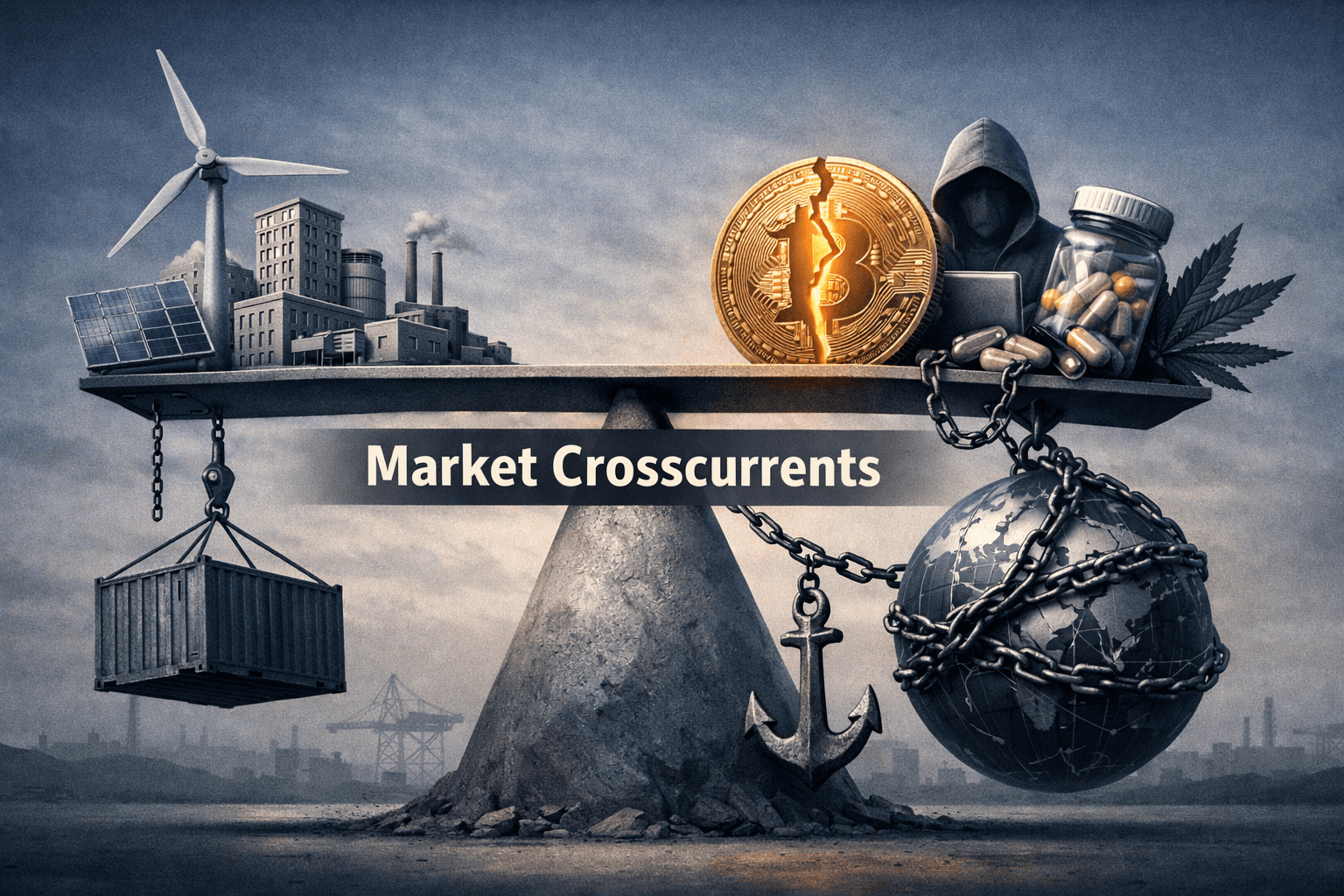
Markets on Nov. 3 presented a classic late-cycle bifurcation: pockets of durable, fundamentals-driven strength in areas tied to income, infrastructure and the energy transition contrasted with episodic, headline-driven weakness in higher-volatility sectors such as crypto, cannabis and parts of healthcare. Utility and renewable project activity, large-scale real-estate leasing and refinancing, and industrial expansion headlines provided defensive and growth-tilted support, while regulatory developments, security breaches and policy uncertainty created rotation and intraday swings.
Key datapoints that shaped the day: Sunrun doubled participation in a Puerto Rico virtual power plant (a 100% increase in that program), a 3.26 MW community solar project came online, a reported $400M bid from Organigram for Aurora stoked cannabis M&A chatter, Tilray (TLRY) announced Canadian production cuts targeting $10M in annual savings, and Tether disclosed a 150,000 BTC holding that drew crypto-market attention. Outside pure dollar figures, large corporate actions — a $6B Symbotic expansion at Walmart (WMT) sites, a $615M Pentagon-backed expansion for Neros, and an Alliant Energy $5.1B loan package — drove sector narrative.
Taken together, the day favored sectors tied to durable cash flows, critical infrastructure and supply reshoring, while headline-sensitive areas saw sharper intra-day swings. Analysts note that the balance between headline risk and fundamental resiliency will determine market leadership into the year-end.
Sector performance groups
Below we group the 24 sectors in today’s summaries based on the dominant tone and likely market response.
Outperformers / Relative Strength
Real estate
- Why: Leasing deals, refinancing activity and improved FFO commentary provided a bullish operational read-through. Vornado’s stronger FFO and large Manhattan office leases were central to the positive tone. Apartment refinancing continued despite higher mortgage-rate backdrops, suggesting selective credit access and stabilization in CRE cash flows.
- Tickers cited in coverage: Vornado (company-level disclosure in summaries), WMT-related logistics expansion that supports industrial real estate.
Utilities (incl. renewables and grid tech)
- Why: Project commissioning (3.26 MW community solar), material increases in virtual power-plant (VPP) participation and large-capacity deals like Hull Street’s ~1,400 MW acquisition signaled accelerating capex and grid modernization. Battery initiatives and major loan packages (Alliant Energy’s $5.1B) pointed to financing capacity for transition investments.
- Data points: Sunrun doubled VPP participation in Puerto Rico (100% increase), Hull Street’s 1,400 MW buy.
Industrial & Manufacturing
- Why: Reshoring momentum, job flows tied to manufacturing expansion and defense-related capex (Neros $615M) continued to support the sector. Agility Robotics clearing a shareholder vote for listing and 3M plant-closure-related productivity moves pointed to both growth and cost-reduction dynamics.
- Data points: Neros’ $615M expansion; Agility Robotics listing vote.
Underperformers / Headline-Driven Weakness
Cryptocurrency
- Why: Security breaches tied to AI-assisted hacks, ongoing major legal cases, and unusual disclosures (Tether’s 150k BTC) increased volatility and raised questions about market structure and custody. Analysts note the practical impact: capital flight to safer assets and heightened trading-volume volatility.
- Data points: Tether disclosed 150,000 BTC; FBI involvement and hack attributions present.
Cannabis
- Why: A mix of M&A drama (Organigram’s $400M bid for Aurora), shifting policy (federal rescheduling fallout), and operational cuts (Tilray’s production reduction and $10M target savings) created headline-driven trading and uncertainty over near-term earnings and regulatory trajectories.
- Data points: Organigram bid $400M for Aurora; Tilray (TLRY) targets $10M annual savings; NY moving to scrap labor peace requirements.
Healthcare
- Why: A string of public-health scares (measles death, bird-flu fatality), liability risk around clinical-AI tools, and regulatory pressures on environmental health standards increased political and litigation risk for parts of the sector. Clinical setbacks and mixed trial news further supported a cautious tone.
- Data points: calls for stricter nitrate limits; clinical-AI liability guidance announced.
Stable / Mixed
Technology
- Why: AI product rollouts, a large private capital raise for a startup, in-space milestones and Apple’s revenue outlook raise contrasted with margin pressure warnings and export-control risk. This set a mixed but resilient tone: growth narrative remains intact, but regulatory and margin callouts create dispersion.
- Tickers: Apple (AAPL) flagged stronger revenue outlook but margin pressure; Google (GOOGL) acted on device malware concerns.
Communications & Media
- Why: Content wins and infrastructure expansion (5G antenna placements) supported selective winners, while the broader industry faces secular streaming pressure and ad-market cyclicality.
Consumer & Retail
- Why: Platform consolidation (DoorDash-Instacart ties), major retailer investment (Walmart’s $6B Symbotic expansion) and strong GMV at The RealReal created a differentiated story: automation and platform plays get credit even as grocery pricing and CPG promo dynamics pressured margins.
Materials and Energy
- Why: Mixed signals. Materials had approvals and plant startups offset by geopolitical supply concerns (critical minerals). Energy headlines mixed strong major results and deal activity with structural transition challenges; oil swings on geopolitics balanced by EV and charging investment announcements.
Finance
- Why: Mixed signals from corporate bond markets and product innovation; earnings and AI disruption themes left room for selectivity rather than broad weakness or strength.
Cross-sector themes and correlations
Several cross-cutting themes linked otherwise disparate sector stories today. Understanding these themes helps explain why some sectors outperformed while others lagged.
Energy-transition capex and grid modernization
- Impacted sectors: Utilities, Energy, Industrial, Materials
- Evidence: Sunrun’s VPP scale-up, a slew of community-solar and battery initiatives, large loan packages for utilities (Alliant Energy $5.1B), and Hull Street’s sizable clean-power acquisition (1,400 MW). These moves suggest a pipeline of long-duration capex that benefits equipment makers, engineering firms and materials suppliers — but also raises questions on permit timelines and supply-chain constraints.
- Correlation notes: Utilities and industrials are positively correlated here, as manufacturing capacity and supply chains feed project delivery.
Security, AI and operational risk
- Impacted sectors: Crypto, Technology, Communications, Healthcare
- Evidence: AI-assisted security breaches in crypto, Google blocking a malware-tainted device maker, and clinical-AI liability guidance for healthcare. As AI diffuses into product and security stacks, the cost of breaches and the regulatory response will be a cross-sector earnings risk.
- Correlation notes: Elevated security incidents can compress risk sentiment across risk-on assets (crypto, high-beta tech) while boosting defensive flows into utilities and real estate.
Policy and litigation as a volatility amplifier
- Impacted sectors: Cannabis, Healthcare, Materials
- Evidence: Federal rescheduling fallout in cannabis, public-health-driven regulatory action in healthcare (water nitrates, bird flu), and geopolitical permit accelerations for mining critical minerals. Policy unpredictability increases dispersion and favors active security selection.
Automation and logistics scale
- Impacted sectors: Consumer/Retail, Industrial, Real Estate
- Evidence: Walmart’s $6B Symbotic expansion and DoorDash-Instacart tie-ups show capital being deployed to automate fulfillment and delivery. That favors industrial automation suppliers, logistics real-estate owners, and software providers tied to warehouse orchestration.
The most significant moves — context and implications
Below we highlight the most consequential individual developments from the day and explain why they matter beyond headline optics.
Organigram’s $400M bid for Aurora; cannabis policy shifts
- What happened: Organigram reportedly made a $400M bid for Aurora, and separately, jurisdictional and federal-level policy activity (including rescheduling fallout and New York’s move on labor-peace requirements) pushed a complex mix of consolidation and regulatory risk across the cannabis patch.
- Why it matters: M&A activity indicates industry consolidation is underway as firms chase scale to overcome low-margin domestic markets and excise/regulatory complexity. Policy changes — which can either lower operating costs or raise compliance burdens — create a two-way volatility profile. Data suggests consolidation helps large producers but may compress valuations for mid-cap operators in the near term.
- Market implication: Expect trading to remain choppy; M&A chatter can act as both a bid for takeover targets and a catalyst for competitive repositioning among producers and retailers.
Sunrun doubles VPP participation in Puerto Rico; community-solar additions
- What happened: Sunrun (RUN) reported a 100% increase in VPP participation in Puerto Rico, and a 3.26 MW community solar project was commissioned.
- Why it matters: Rapid VPP scale shows practical demand for grid-interactive distributed resources and points to revenue diversification for rooftop and residential-scale energy providers. Community solar adds incremental accessible renewable capacity and demonstrates continued deployment despite project-level permitting and interconnection friction.
- Market implication: Utilities and distributed-energy companies that can monetize aggregated customer assets may see more durable revenue pathways. Materials suppliers and battery-makers can anticipate steadier project pipelines.
Tilray (TLRY) production cuts and cost-savings target
- What happened: Tilray publicized Canadian production cuts aiming for $10M in annual savings; New York policy decisions also altered labor-related compliance expectations.
- Why it matters: Operational pruning and cost-savings programs reflect ongoing overcapacity and margin stress in the sector. A $10M run-rate saving for a mid-sized operator affects near-term cash flow but does not solve structural demand questions.
- Market implication: Analysts note that cost-savings are necessary but not sufficient; durable demand-side improvements or price recovery will be required to sustainably re-rate the sector.
Crypto hacks, CFTC moves and Tether disclosure
- What happened: Headlines included AI-assisted security breaches, major legal fights, and a disclosure that Tether holds 150,000 BTC. Separately, the CFTC greenlit equity perpetual futures — a product-structure development.
- Why it matters: Recurrent security incidents increase custody premiums, raise counterparty risk and can prompt tighter regulatory scrutiny. Large, public disclosures of holdings (like Tether’s BTC) can act as market signals about reserve composition and liquidity intent. New product approvals widen institutional access but also add complexity to market structure.
- Market implication: Volatility in crypto can reverberate into risk asset flows, particularly for retail-focused fintech stocks and derivatives providers; custodial solutions and insurance products could see greater demand.
Real-estate leasing, refinancing and stronger FFO at select REITs
- What happened: Vornado reported stronger FFO, Manhattan saw large office leases, and apartment refinancing progressed despite elevated mortgage rates.
- Why it matters: Leasing momentum and refinancing successes indicate selective pockets of commercial real estate are stabilizing. Office leasing wins in premier locations and refinancing of apartment portfolios both reduce near-term capital-stack pressure.
- Market implication: REITs with high-quality assets, diversified tenant bases and conservative leverage profiles may see improved relative performance. Credit-sensitive real-estate companies remain at risk if refinancing windows narrow.
Industrial expansion and defense-backed capex
- What happened: Neros secured Pentagon support for a $615M expansion; Agility Robotics cleared a shareholder vote for an imminent listing.
- Why it matters: Defense-related capex has spillover benefits for suppliers and regional manufacturing hubs. Public-market access for robotics and industrial-automation players underscores investor interest in productivity-enhancing technologies.
- Market implication: Industrial stocks with direct exposure to defense and automation could see stronger order books; watch procurement timelines and supply constraints.
Actionable insights for investors (informational purposes only)
Reassess exposure to headline-sensitive sectors. Crypto, cannabis and parts of healthcare showed heightened headline risk on Nov. 3. Analysts note that headline-driven volatility can persist until policy clarity emerges or material earnings improvements arrive.
Favor cash-flow resilience where available. Utilities with contracted or rate-regulated cash flows and real-estate assets successfully refinancing or leasing in prime markets demonstrated relative resilience. Data suggests that stable cash flows can reduce drawdown risk in periods of headline volatility.
Monitor AI-related security and liability risk across portfolios. The proliferation of AI in product stacks is creating new attack surfaces and liability vectors. Technology and healthcare holdings that rely heavily on AI-enabled products should be evaluated for risk-mitigation measures, insurance coverage and governance practices.
Watch the supply chain and permitting lens for energy-transition exposure. Project announcements (VPPs, community solar, battery projects) are positive, but delivery depends on permitting, grid interconnection and materials availability. Materials and industrial suppliers tied to these projects can benefit if bottlenecks ease; otherwise, margin pressure from higher input prices may persist.
Track financing windows for real estate and utilities. Large loans and refinancing — Alliant’s $5.1B package and other deals — highlight that financing is available for certain credits. Investors should watch spreads, lender appetite and covenant terms as indicators of sector stress or stabilization.
Consider operational durability over narrative growth in select secular areas. Companies that can demonstrate tangible cost reductions (Tilray’s $10M target) or scale delivery (Sunrun’s VPP growth) may warrant closer attention, but momentum should be validated by third-quarter-to-fourth-quarter earnings and cash-flow execution.
Risks and what to watch next
Policy risk: Cannabis rescheduling fallout, water-quality regulation debates and clinical-AI liability guidance may drive near-term legal and compliance costs across multiple sectors.
Security incidents: AI-assisted hacks and malware incidents are an immediate risk to crypto and to broader digital-infrastructure confidence.
Geopolitical and supply constraints: Materials and mining remain exposed to permit timelines and geopolitical moves that can affect critical-mineral flows.
Macro and financing environment: Elevated borrowing costs or a tightening in corporate bond markets could pressure refinancing-dependent sectors such as real estate and capital-intensive utilities, even as some large loans still close.
Conclusion — forward-looking perspective
Nov. 3 underscored a market environment where fundamentals and headlines compete for the price narrative. Utilities, industrials and select real-estate themes showed constructive momentum backed by tangible project activity and financing. By contrast, headline-driven sectors — crypto, cannabis and parts of healthcare — illustrated the fragility that can accompany regulatory and security shocks.
Looking ahead to the rest of the week, investors and analysts will be watching a handful of telltales: whether M&A in cannabis accelerates to provide a structural de-risking; whether AI-related security incidents prompt broader regulatory or insurance responses; and whether project delivery timelines for renewable and grid investments hold up against permitting and supply constraints. Market momentum will likely favor names that can demonstrate visible cash-flow resilience, credible execution on announced capex, and pragmatic responses to emerging regulatory and security risks.
Investment Disclaimer (critical): This article is for informational purposes only. It does not constitute individualized investment advice, nor is it a recommendation to buy, sell, or hold any specific security. Analysts note that the observations above reflect market developments and sector-level analysis; investors should consult their financial advisors and perform their own due diligence before making investment decisions.
Sources
+ 14 more sources
Use these insights — enter this week's contest.
Free practice contests — earn Alpha CoinsExplore More Content
Disclaimer: StockAlpha.ai content is for informational and educational purposes only. It is not personalized investment advice. Sentiment ratings and market analysis reflect data-driven observations, not buy, sell, or hold recommendations. Always consult a qualified financial advisor before making investment decisions. Past performance does not guarantee future results.
Spotted something wrong? Report an error.