 Sector Insights
Listen to this Recap
10:54
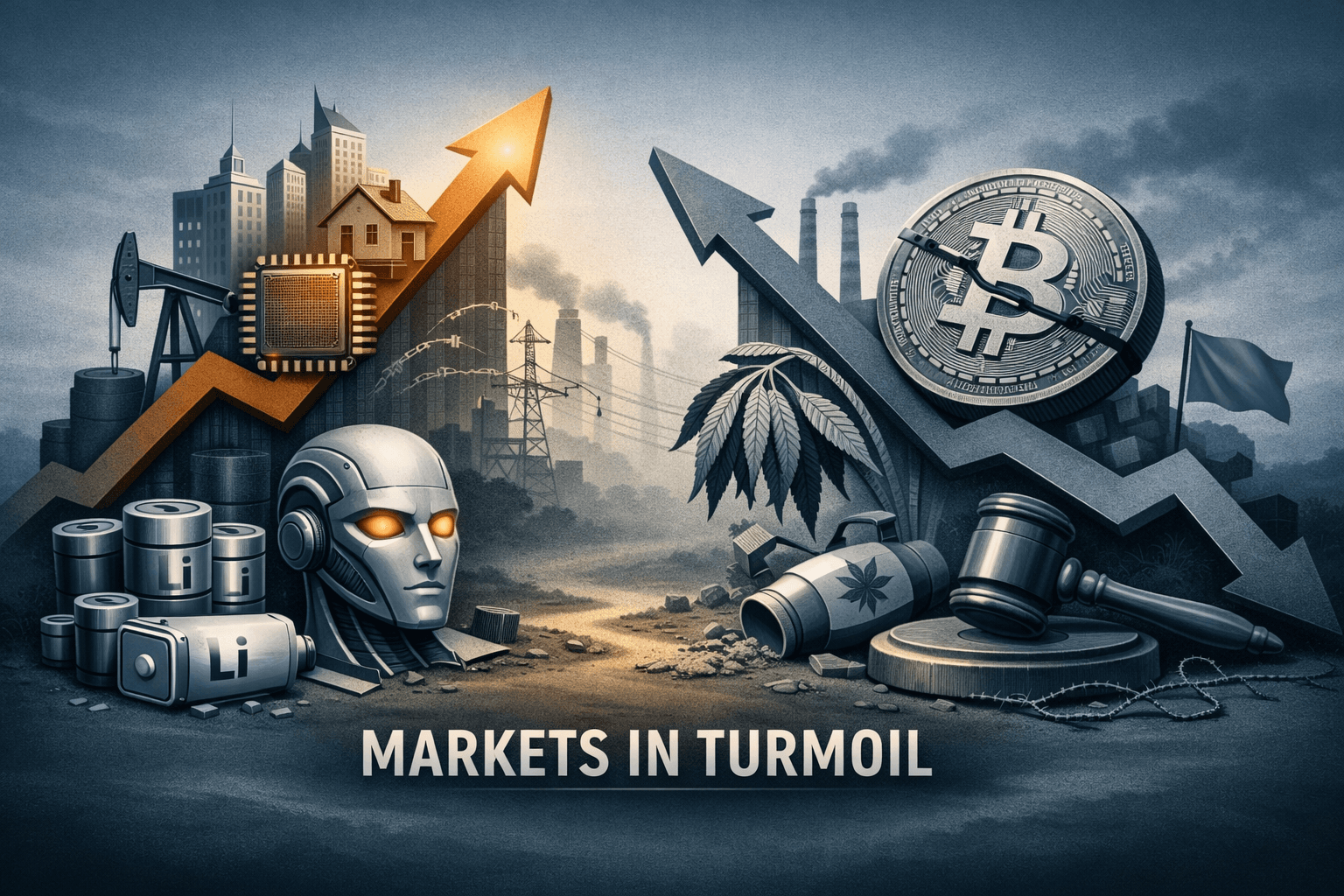
Mixed Market Momentum: Real Estate and Tech Lead, Crypto and Cannabis Lag as Lithium, Policy and AI Drive Cross-Sector Shifts
Podcast • Loading audio...
Share this article
Spread the word on social media
Key Takeaways
- •Market action was mixed: real estate and AI/cloud-linked tech showed pockets of strength while crypto and cannabis faced regulatory-driven weakness.
- •Lithium futures fell about 10%, signaling near-term repricing in battery supply chains even as LNG long-term deals provided counterbalance in energy.
- •Regulatory and policy risk (crypto enforcement, DEA scrutiny of HHC, healthcare pricing debates) is a major driver of short-term volatility across sectors.
- •Investors are differentiating within sectors — favoring hyperscale AI exposure and predictable cash-flow real estate niches while reassessing high-risk, enforcement-sensitive positions.
- •Operational shocks (e.g., Coinbase Base outage) and large settlements (Chemours’ $450M PFAS) highlight the importance of governance and liability analysis.
Executive summary
Markets faced a day of uneven sector performance on June 25 as investors parsed a mix of policy moves, corporate milestones and commodity swings. The clearest winners were pockets of real estate deal flow and select technology themes tied to AI and cloud infrastructure; materials and industrials showed selective strength around supply-chain retooling. By contrast, crypto and cannabis bore the brunt of regulatory and enforcement noise — bitcoin slid into the roughly $58,000 range — while energy moved in both directions as oil flows improved but lithium futures tumbled about 10%.
Across the board, three structural narratives guided behavior: (1) regulatory and policy risk is reasserting itself in highly scrutinized industries (crypto, cannabis, healthcare pricing), (2) an AI-led rotation continues to concentrate capital into software and chip-related names even as idiosyncratic headlines (Alibaba, Coinbase outage) drive episodic volatility, and (3) commodity and supply-chain signals — from LNG long-term deals to falling lithium — are reshaping energy, materials and battery-equipment exposures.
This recap groups sectors by relative performance, teases out cross-sector links and highlights the biggest moves and what they imply for investors. The tone is mixed-neutral: data and headlines present both opportunities and risks, and momentum appears concentrated rather than broad-based.
Grouping by performance
Below we classify sectors into three buckets — outperformers, underperformers and stable — based on the day’s headlines, reported flows and thematic momentum.
Outperformers (relative strength / positive headlines)
- Real estate: Deal activity dominated the tape. Notable items included money flowing into seniors housing, logistics redevelopments and a major 320,000-sq-ft lease backed by roughly $100 million in tenant investment. Those cash flows and leasing wins lent the sector a clear growth narrative for the day.
- Technology (select subthemes): AI infrastructure and hyperscale cloud momentum — for example, Arm’s gains in cloud share and chip-related news from Qualcomm and Meta’s renewed product activity — buoyed software and chip-linked names despite headline risk elsewhere in the group.
- Materials (targeted): Operational milestones, supply-chain reshoring and recycling progress — including increased recycled copper output and strategy moves around rare-earth and magnet supply — gave parts of the materials complex constructive headlines.
Underperformers (headwinds / negative headlines)
- Cryptocurrency: Volatility dominated. Bitcoin slid toward $58k, MicroStrategy ($MSTR) sank on a securities suit, and crypto infrastructure suffered a two-hour outage on Coinbase’s Base. Liquidations near $1 billion were reported in parts of the market. Those developments created a clear risk-off tone for crypto assets today.
- Cannabis: Regulatory pressure re-emerged as a theme. The DEA’s scrutiny of synthetic cannabinoids such as HHC and a packed rescheduling calendar weighed on sentiment even as a bipartisan SAFE Banking bill and state-level licensing activity offered counterpoints. Job metrics were also soft — U.S. cannabis jobs fell about 2.7% and sales slipped roughly 3.3% in 2025 — underlining structural constraints.
- Energy (select exposures): While some oil flows from the Gulf returned and LNG got new long-term deals, there were clear negative swings: Asian crude buying softened and lithium futures plunged around 10%, creating a two-sided picture but net pressure for certain energy and battery-related equities.
Stable / mixed (balanced headlines, sector divergence)
- Finance & Banking: Big banks cleared the Fed’s stress tests, providing a calm baseline, but sector-specific pockets — from space finance names to a surprise FedEx downgrade — kept the overall read mixed.
- Healthcare: A blend of scientific breakthroughs and policy pressure. Discoveries and a $105 million oncology pact with Novartis ($NVS) were offset by concerns over 340B program changes and clinical workload growth that could weigh on margins.
- Consumer & Retail: Omnichannel investments and AI toolkits pointed to long-term productivity gains, but Prime Day spending appeared softer in early reads, producing a cautious tone.
- Communications & Media, Utilities, Industrials: Each of these sectors showed a mix of idiosyncratic drivers — content licensing and ad law changes (communications); grid reliability and solar projects (utilities); automation and a $450 million PFAS settlement for Chemours ($CC) in industrials — resulting in no clear directional bias across the group.
Cross-sector themes and correlations
Several threads connected disparate sector headlines, revealing how policy, capital rotation and commodity moves were transmitting through the market.
Policy and regulatory risk as a cross-cutting market friction
- Cannabis, crypto, healthcare and parts of communications were all affected by regulatory or policy events. The DEA’s HHC focus and rescheduling hearings hit cannabis; securities suits and enforcement risk punished bitcoin-linked equities like MicroStrategy ($MSTR); healthcare faced fresh pressure around drug pricing and 340B; and state ad-volume laws are reshaping media economics in California. The common thread is that regulatory uncertainty is creating sector-specific liquidity events and multiple-day trading ranges.
AI and cloud continue to concentrate capital into technology and up the value of hyperscale infrastructure
- Arm’s gains in hyperscale cloud share, Qualcomm’s China-focused chips, Meta’s AI app relaunch and corporate AI toolkits from Salesforce and retailers all point to a durable reallocation toward software, chips and cloud infrastructure. This rotation is showing up in performance divergence within the broader tech sector: software and AI-adjacent names outperformed idiosyncratic platform stories under pressure from non-AI headlines (e.g., Alibaba’s selloff after an Anthropic allegation).
Commodities and supply-chain rebalancing create winners and losers
- A roughly 10% drop in lithium futures hit battery supply expectations and affected energy/battery names. Conversely, materials firms advancing recycling, domestic aluminium MOUs and magnet strategies gained traction. LNG long-term deals helped offset weaker spot buying for crude, emphasizing that longer-term contractual cash flows can inoculate parts of the energy complex against short-lived demand weakness.
Capital rotation and risk-on/risk-off dynamics
- A reported $1 billion in crypto liquidations, coupled with Micron’s AI-led rally, suggests capital is rotating from highly speculative or commodity-like token exposures into higher-visibility secular winners tied to AI and cloud. Real estate deal activity, which drew tangible capital into leasing and redevelopment, reinforces the narrative that cash is seeking yield and predictable cashflows where policy conditions are clearer.
The day’s most significant moves (what moved markets and why)
Below are the moves with the broadest market implications and the reasoning behind them.
- Bitcoin’s drop into the $58k range, $1B of liquidations; MicroStrategy ($MSTR) hit by securities suit
- Why it mattered: Crypto’s rapid swings reverberate through hedge funds, custody providers and retail flows. The two-hour outage at Coinbase’s Base was an operational shock that, combined with legal pressure on institutional holders like MicroStrategy, amplified selling pressure. Market participants say enforcement fear and short-term deleveraging can trigger multi-day volatility in correlated tech and small-cap names.
- Implication: Crypto’s risk premium widened, reducing short-term demand for risk-on allocations tied to digital assets.
- Lithium futures down roughly 10%
- Why it mattered: Lithium is a bellwether for the battery supply chain and EV production expectations. A 10% futures drop suggests either demand softness (geographic: Asia) or a near-term supply repricing. The day’s energy headlines — weaker Asian crude buying — support the view that demand-side dynamics in Asia are moderating.
- Implication: Battery-centric miners and developers, plus equipment suppliers tied to EV manufacturing, face margin and investment-timing questions.
- Real estate lease wins and $100M tenant investment on a 320k-sf deal
- Why it mattered: Large leasing transactions and tenant capital commitments indicate confidence in specific property types, notably logistics and seniors housing. In an environment where financing costs remain a consideration, such deals suggest pockets of capital are still deploying into real assets for yield and long-term cash flow.
- Implication: Property-level execution and rent-roll stability will be the focus for REITs and private owners claiming outperformance in these niches.
- Materials and recycling headline wins (aluminium MoU, recycled copper, Energy Fuels’ magnet strategy)
- Why it mattered: Supply-chain security and domestic-processing initiatives are drawing attention as governments and corporates seek to reduce import reliance for critical minerals. Moves to bolster magnets and rare earth strategies have downstream implications for EV and defense supply chains.
- Implication: Companies with demonstrable domestic-processing capabilities or recycling scale may capture premium valuation as risk premia for long-haul supply chains rise.
- Tech headlines: Alibaba selloff, Arm’s cloud gains, Microsoft support extension, and chip supply news
- Why it mattered: The tech sector displayed internal divergence. Alibaba’s drop after an Anthropic-related allegation highlighted geopolitical and governance risks in China-exposed tech stocks. Conversely, Arm and chip-related wins underscored the structural AI demand story. Microsoft’s extended Windows 10 support is a pragmatic product move that reduces enterprise migration urgency and could affect software lifecycle economics.
- Implication: Investors favor clear AI-exposure and cloud compute plays while pricing extra risk into China-facing platforms and regulatory-sensitive businesses.
- Industrial liability headline: Chemours $450M PFAS settlement
- Why it mattered: Large environmental settlements create two effects: direct balance-sheet hits for the company and a re-evaluation of industry-wide legal and remediation risk. Markets reprice peers where contaminant liabilities may be under-provisioned.
- Implication: Industrial and chemicals names with potential legacy environmental exposure could face higher funding and remediation costs.
- Healthcare scientific and policy juxtaposition
- Why it mattered: The $105M oncology pact with Novartis ($NVS) and AI-driven vaccine research added growth optimism. But policy frictions — Medicare cost pressure and 340B program scrutiny — moderated enthusiasm, showing the sector’s classic growth-versus-policy dynamic.
- Implication: Valuation dispersion is likely to persist between innovative biotech assets and legacy providers exposed to reimbursement risk.
Actionable insights for investors (informational, not advice)
Reassess regulatory risk exposure across thematic allocations
- Data suggests regulatory headlines are concentrated but potent (crypto, cannabis, healthcare, Chinese tech). Analysts note that positions in these areas may require tighter risk controls or hedges given enforcement and legislative timing uncertainty.
Differentiate within technology: AI cloud and hyperscale names remain the structural winners
- Momentum indicates persistent demand for chips and cloud infrastructure. Investors tracking AI exposure may prefer to focus on firms showing demonstrable hyperscale spend capture, software monetization shifts and chip roadmap clarity rather than broad-platform narratives that are subject to country and regulatory risk.
Treat lithium and battery-related exposures as term-structure plays
- A roughly 10% pullback in lithium futures highlights short-term repricing. Those looking at battery suppliers should separate near-term demand concerns from multi-year structural electrification trends. Hedging near-term commodity swings or layering positions across the supply chain (mining, refining, recycling) can manage timing risk.
Use real estate leasing and capex signals to identify stable cash-flow niches
- Significant leasing transactions and tenant-funded redevelopments point to pockets of resilient demand (logistics, seniors housing). Investors focusing on predictable income should examine leasing backlogs, tenant credit and capex commitments rather than headline NOI or same-store figures alone.
Monitor environmental and legal exposures in industrial portfolios
- Large settlements like Chemours’ $450 million PFAS resolution force re-assessment of long-tail liabilities and potential balance-sheet strains. Fiduciary analyses should incorporate remediation scenarios and insurance recovery assumptions.
For crypto holdings, prioritize operational and regulatory risk controls
- Outages (Coinbase’s Base) and concentrated legal actions (MicroStrategy suits) amplify systemic contagion risk. Market participants recommend reviewing custody arrangements, counterparty concentration and liquidity buffers if crypto allocations remain in a portfolio.
Notable tickers and data points mentioned today
- Bitcoin: ~ $58,000 range
- MicroStrategy: $MSTR (suffered selling pressure after a securities suit)
- Chemours: $CC (reported a $450 million PFAS settlement)
- Novartis: $NVS (entered a $105 million oncology pact)
- Alibaba: $BABA (suffered a steep selloff after allegations tied to Anthropic)
- Microsoft: $MSFT (extended Windows 10 support)
- Arm: ARM (milestone in hyperscale cloud share) — note: ARM listing exposure varies by exchange
- Qualcomm: $QCOM (China-compliant chip developments)
- Meta: $META (AI app relaunch)
- Coinbase: $COIN (Base experienced a two-hour outage)
Note: Ticker references are provided to identify the firms discussed in public reporting and do not imply any endorsement or trading guidance.
Conclusion and forward-looking perspective
June 25’s market tape reinforced that the current environment is one of differentiation rather than broad-based directional moves. AI and cloud infrastructure continue to concentrate investment and performance within tech, while real estate deal activity suggests selective demand for cash-flow-rich property types. At the same time, regulatory and enforcement developments in crypto, cannabis and healthcare can generate outsized volatility and episodic selling pressure. Commodity gyrations — exemplified by a roughly 10% drop in lithium futures — further complicate the mid-cycle picture for energy, autos and battery supply chains.
Looking ahead, the two immediate catalysts to monitor are: (1) the regulatory calendar — hearings, enforcement actions and legislative timelines that affect cannabis, crypto and healthcare — and (2) macro/commodity updates that will determine whether recent swings in lithium and crude are temporary corrections or the start of a larger repricing. Additionally, continued AI spending by hyperscalers and corporates will likely remain a structural tailwind for a subset of technology and materials names tied to compute demand.
For investors, day-to-day navigation will require active risk management, careful sector selection and an eye on policy risk. Data suggests capital is moving toward predictable revenue streams (real assets, contract LNG deals, cloud spend) while away from high-volatility, enforcement-prone exposures. That rotation may persist until regulatory clarity improves and commodity price trends stabilize.
Investment disclaimer: This analysis is for informational purposes only and does not constitute financial, investment or trading advice. The content does not recommend buying, selling or holding any specific security. Analysts note that market conditions can change rapidly; readers should consult a licensed financial professional for personalized guidance.
Sources
+ 14 more sources
Use these insights — enter this week's contest.
Free practice contests — earn Alpha CoinsExplore More Content
Disclaimer: StockAlpha.ai content is for informational and educational purposes only. It is not personalized investment advice. Sentiment ratings and market analysis reflect data-driven observations, not buy, sell, or hold recommendations. Always consult a qualified financial advisor before making investment decisions. Past performance does not guarantee future results.