 Quick Briefs
Listen to this Recap
16:39
AI Infrastructure, a $4.5B Financing Deal and Conflicting Retail Signals Lead a Thin News Day
Podcast • Loading audio...
Share this article
Spread the word on social media
Key Takeaways
- •Banks are reportedly preparing a $4.5 billion loan sale tied to Meta and CoreWeave, but pricing, structure and the exact relationship remain undisclosed.
- •AI-related announcements spanned data-center energy storage, utility cloud software and enterprise services, yet most lacked orders or quantified revenue impact.
- •BMO’s Abercrombie & Fitch rating cut alongside a higher $180 target is a mixed analyst signal; the rationale and revised rating were not provided.
- •SPDN reportedly gained 0.50% to $9.03 on 185.04 million shares, but one session and no volume comparison do not establish a trend.
- •Much of the day’s remaining news was procedural, promotional or research-focused, with limited direct evidence of a public-company earnings catalyst.
The day’s biggest signals
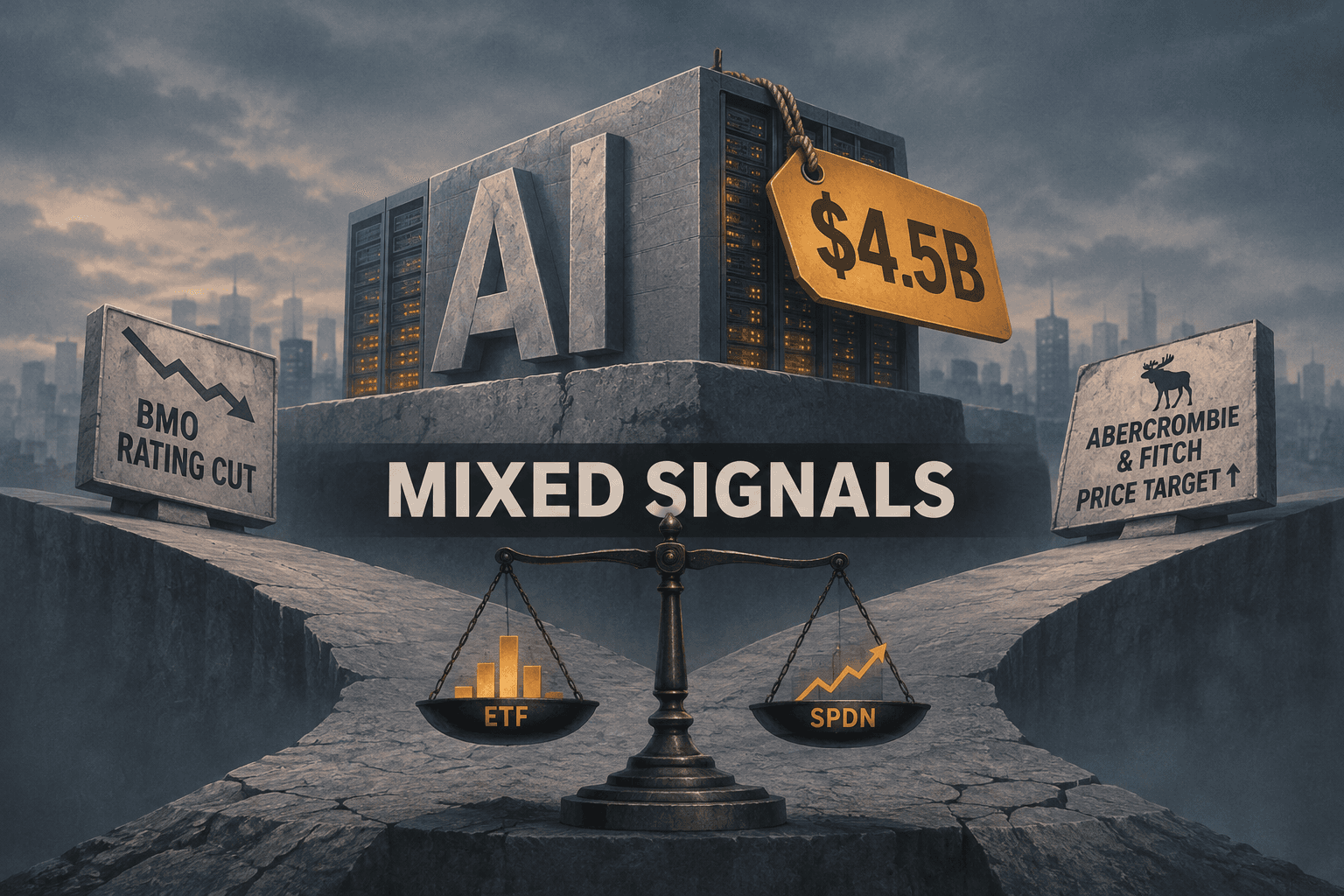
Wednesday’s briefs offered few confirmed earnings or market-moving disclosures, but three items stood out: banks are preparing a reported $4.5 billion loan sale tied to Meta (META) and CoreWeave; BMO Capital cut its rating on Abercrombie & Fitch (ANF) while raising its price target to $180; and SPDN gained 0.50% to $9.03 on reported volume of 185.04 million shares.
Each headline comes with an important qualification. The CoreWeave report does not include the loan’s pricing, structure or exact sale date, and does not explain the nature of Meta’s connection. The analyst note lacks the revised rating, prior target and rationale. And SPDN’s one-session gain, without historical volume or broader performance context, does not establish a trend. Still, these updates carry more market relevance than the many announcements today that provided no listed-company link, financial figures or evidence of commercial impact.
A broader theme runs through the news: companies and markets are building around artificial intelligence and digital infrastructure, but the announcements largely describe financing, product capabilities or credentials—not disclosed orders, revenue or returns. That gap between strategic positioning and measurable results is the key context for reading much of today’s coverage.
AI infrastructure: financing meets product pitches
The reported loan sale is the clearest financing story. Banks are preparing to sell $4.5 billion in loans tied to Meta and CoreWeave next week, according to Bloomberg reporting cited by Investing.com. The scale makes the transaction worth following, especially given the reported Meta link, but the available information does not say whether Meta is a borrower, customer, guarantor or connected in another way. Without terms, it is not possible to assess the cost of financing or its effect on CoreWeave’s financial position.
That financing headline sits alongside two AI-infrastructure product announcements. EVE Energy presented a portfolio of energy-storage solutions for AI data centers at RE+ 2026, spanning source-grid, power-distribution and cabinet-side applications. The breadth suggests the company is targeting power needs across multiple parts of a facility, but the release provided no customer orders, capacity, prices or expected revenue. It is a product showcase, not evidence of commercial adoption.
CGI (GIB) also announced a global expansion of its u@Cloud platform for utilities. The platform already supports electricity, water and gas services for six million consumers, a useful indicator of its existing reach. CGI did not identify new customers or quantify future bookings or revenue, however. Utilities’ procurement, regulatory and deployment cycles can be lengthy, so global availability does not necessarily translate quickly into reported results.
Together, these stories highlight two sides of the data-center buildout: financing needs and the supporting power infrastructure. They do not, on their own, establish the size or timing of future returns. The more informative follow-through would be loan terms, confirmed customer deployments, orders, capacity additions or financial disclosures that connect expansion to revenue and margins.
AI adoption extends into software and services
Infosys (INFY) said it became the first organization to achieve CMMI AI Maturity Level 5, a recognition of its approach to scaling responsible AI in software engineering and service delivery. The milestone may help communicate process maturity to enterprise customers, but the announcement did not report a new contract, customer adoption, cost savings or revenue contribution. The commercial question remains whether a formal AI capability translates into measurable demand or improved operating performance.
Two private-company announcements point to related enterprise-software themes. IntelliGRC launched a Trust Center for managed service and managed security providers to share security and compliance documents with clients through controlled access. CobbleStone Software, meanwhile, highlighted usability as a priority for contract-lifecycle-management buyers in 2027. Both address practical workflows—vendor security reviews and contract management—but neither announcement supplied customer counts, pricing, revenue or quantified efficiency gains. They are industry signals, not confirmed catalysts for a publicly traded security.
Stirlingshire Investments’ appointment of Daniel Gicklhorn as chief technology officer adds another AI-related organizational update. He will lead technology strategy and AI-native engineering for Stirling ONE, but no ticker, operating metrics or financial targets were reported. As with the Infosys recognition, the important distinction is between a stated technology priority and proof of business results.
Taken together, the AI stories suggest that adoption is moving beyond model development into infrastructure, energy storage, enterprise processes and service delivery. The evidence remains uneven: today’s announcements describe capabilities and positioning far more often than paid deployments or quantified benefits.
Market activity, analyst views and fund updates
BMO’s Abercrombie & Fitch call is notable for its mixed direction: the firm cut its rating but raised its price target to $180. Without the revised rating, previous target or explanation, the action cannot be interpreted as a clear change in the company’s outlook. The brief also did not provide the current share price or a verified earnings date and estimates. The rating and target should therefore be treated as separate pieces of an incomplete analyst update, not as a conclusion about the stock’s likely performance.
SPDN’s reported 0.50% rise to $9.03 was the day’s clearest price-and-volume snapshot. The brief reported 185.04 million shares traded, but offered no comparison with recent sessions and no catalyst explaining the move. A single day’s performance is not enough to establish persistent momentum. The ticker identifies an inverse-market ETF, so its movement should also be understood in the context of its fund strategy rather than as a broad-market reading by itself.
Options became available on three Anthropic-linked exchange-traded funds: the 2X Long Anthropic Daily ETF (ANUU), the 2X Short Anthropic Daily ETF (ANDD) and the 1X Short Anthropic ETF (ANSS). The listing expands the set of ways market participants can express views through these products, but the announcement gives no contract details, option volume, liquidity or trading-cost information. The funds have different exposure directions and leverage structures; their availability is not evidence of a change in Anthropic’s business or valuation.
Infrastructure Capital Advisors announced distributions for four income-focused funds: BNDS, ICAP, SCAP and QVOL. The available summary omitted per-share amounts and payment dates, limiting the usefulness of the update for assessing fund cash flows. Those details, rather than unexplained percentages included in the source material, are what would allow a meaningful comparison.
PNC Financial Services Group (PNC) said its CEO and CFO will speak at the Goldman Sachs Financial Services Conference. The announcement offers a potential venue for management commentary, but the brief supplied no speaking time, new guidance or results. It is an event to monitor, not a new financial disclosure.
Consumer and operational updates: mostly unquantified
Several announcements concerned products, promotions and customer-facing programs, but did not include information that would establish a material earnings effect. Duracell and Amazon (AMZN) are partnering on a two-day holiday event in Chicago, with a purchase requirement for access to a performance. No expected attendance, campaign cost or sales impact was disclosed. Azazie, a private retailer, announced a winter bridal pop-up tour in 12 cities; no public listing, sales estimate or UPS (UPS) shipping agreement was identified.
Baffin launched the ICE ENFORCER winter safety boot for industrial workers, including customers in construction and oil and gas. The release did not give pricing, orders or production estimates, and the issuer behind the ticker reference in the brief was not clear. UC Riverside expanded a reusable-container program with Reusables.com as California’s SB 54 takes effect, but did not report participation, costs or savings. These updates may be relevant to their respective industries, yet the available details do not support a company-level financial conclusion.
Other announcements were primarily informational or procedural. A Consumer Product Safety Commission notice pointed readers to new recalls and warnings, identifying Zenara detectors in the supplied excerpt but not providing enough detail to establish affected unit counts, injuries, remedies or the responsible company. The full notices are essential before assigning any business impact. A class-action notice concerning Webull (BULL) says purchasers during April 26, 2025, through October 6, 2026, may seek to lead an action by December 7, 2026. The available summary did not describe allegations or report a court decision; the deadline is procedural, not an outcome.
Healthcare and research: promising signals, limited commercial evidence
Two research updates may draw attention to medical technology, but neither establishes near-term public-company revenue. Brainomix plans to present research at RSNA 2026, scheduled for November 29 to December 3, on stroke-imaging biomarkers calculated from non-contrast CT scans. The summary reports stronger associations with final infarct volume than conventional CT, but provides no performance figures or validation details. A conference presentation is not the same as regulatory clearance, hospital adoption or commercial success.
Flo Health reported an observational study of nearly 2,000 women across 97 countries finding an association between higher BMI and greater perimenopause symptom burden. The study does not establish causation, and its app-user sample may limit how broadly its results apply. Flo Health is private, and the research does not provide direct earnings news for a listed company.
Santa Clara Family Health Plan, a nonprofit, committed $19.2 million over two years to outreach and renewal assistance for Medi-Cal members facing new requirements. Current Clinic Carlsbad received three-year accreditation for CT services. Both announcements concern healthcare access or quality, but neither reported a measurable effect on a publicly traded company’s revenue or patient volumes.
What to watch tomorrow
U.S. markets are scheduled to close Thursday for Thanksgiving, so the next session may bring thinner liquidity and a different pace of price discovery. Across the holiday break, watch for confirmation of the CoreWeave loan sale’s terms and the precise relationship to Meta; any fuller explanation of BMO’s Abercrombie rating change; and contract-level details for the newly listed Anthropic ETF options. The SPDN volume figure also merits context from subsequent sessions rather than interpretation in isolation.
The next scheduled research milestone is Brainomix’s RSNA presentation beginning November 29. For the broader AI theme, the signal to watch is whether product launches and capability claims are followed by disclosed orders, deployments, recurring revenue or margin effects. Today’s news points to active investment in AI-related infrastructure and workflows, but the clearest pattern is that commercial proof remains the missing piece.
Sources
+ 15 more sources
Use these insights — enter this week's contest.
Free practice contests — earn Alpha CoinsExplore More Content
Disclaimer: StockAlpha.ai content is for informational and educational purposes only. It is not personalized investment advice. Sentiment ratings and market analysis reflect data-driven observations, not buy, sell, or hold recommendations. Always consult a qualified financial advisor before making investment decisions. Past performance does not guarantee future results.
Spotted something wrong? Report an error.