 Market Recap
Listen to this Recap
14:54
Nasdaq Leads a Broad Advance as SPY, QQQ and Small Caps Climb
Podcast • Loading audio...
Share this article
Spread the word on social media
Key Takeaways
- •SPY gained 1.62%, QQQ rose 2.69%, and IWM advanced 1.83% on Nov. 27.
- •QQQ led the three benchmarks, while IWM outperformed SPY, indicating that small caps participated in the advance.
- •No sector-return, breadth or volume data were provided, so specific sector leaders and the rally’s internal breadth cannot be confirmed.
- •The supplied event slate highlights AI growth and restructuring, energy and supply risks, consumer issues, crypto and potential credit-policy changes; no individual-stock moves were quantified.
- •No economic releases or Fed repricing details were included, leaving the macroeconomic driver of the rally undetermined.
A decisive advance, led by technology
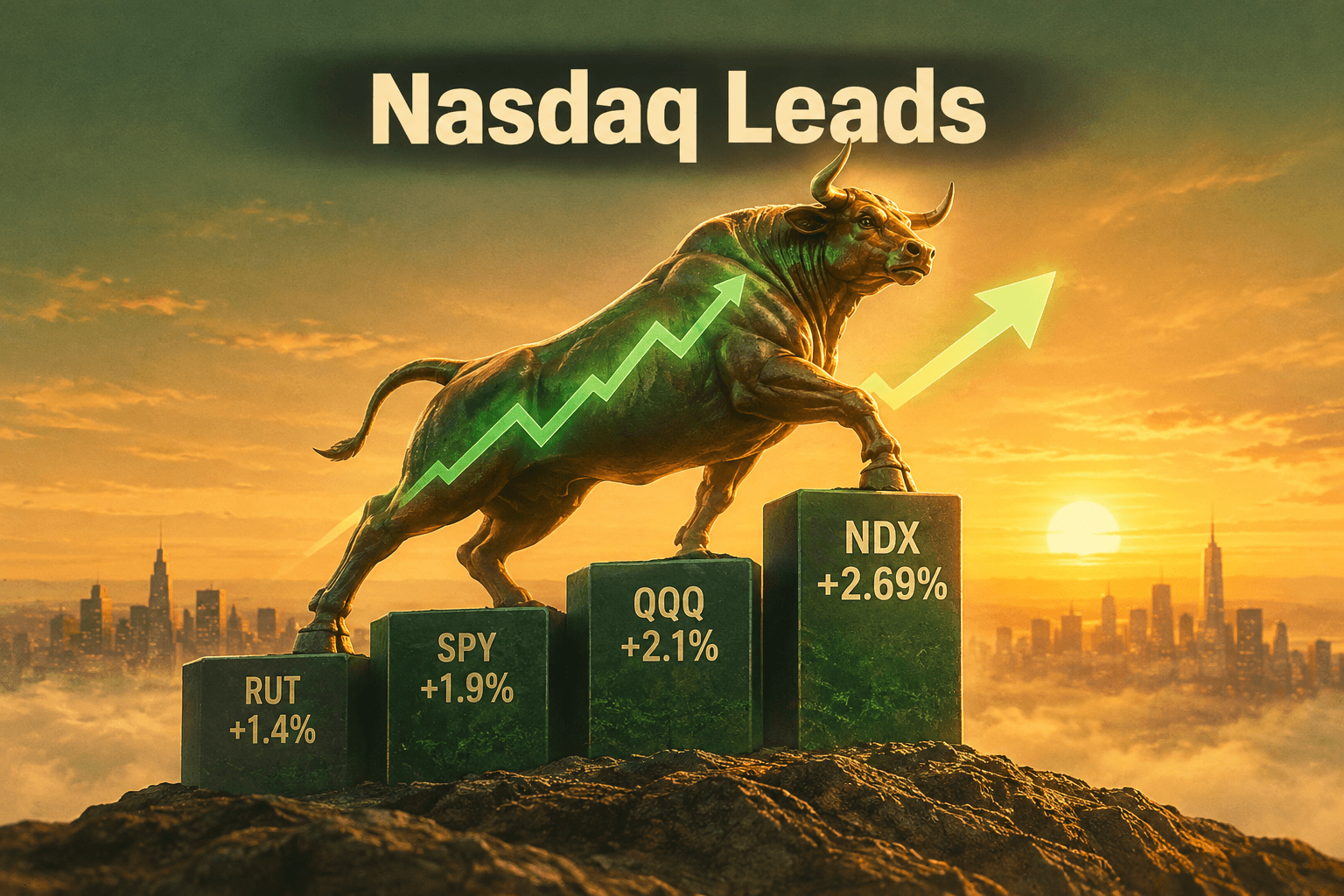
U.S. stocks moved decisively higher on Nov. 27, with the Nasdaq-100 leading a rally that extended beyond large-cap growth shares. The S&P 500 ETF, SPY, gained 1.62%; the Nasdaq-100 ETF, QQQ, rose 2.69%; and the Russell 2000 ETF, IWM, advanced 1.83%. All three benchmarks finished up, while QQQ’s larger move put technology-oriented megacaps at the front of the index performance.
The comparison also points to participation beyond the biggest companies. IWM rose more than SPY, suggesting small caps shared in the day’s advance, though they did not match the stronger QQQ return. That is a constructive cross-index signal, but one session alone cannot establish a durable rotation or show how many individual stocks participated. The supplied data do not include trading volume, sector-index returns or market breadth statistics, so the rally’s internal composition cannot be quantified more precisely.
The day’s decisive story, then, is a broad gain with a clear growth tilt—not a documented move into any one sector. The event slate underscores why the backdrop remains complex: investors are weighing the commercial promise of AI against employment changes, energy and supply risks, consumer and credit questions, and uncertainty in areas including crypto and cannabis policy. Those headlines provide context, but the available information does not establish that any one of them caused the index advance.
What the index split says about risk appetite
QQQ’s outperformance of SPY by 1.07 percentage points is the clearest relative signal in the data. It indicates that the Nasdaq-100 had the strongest session of the three tracked benchmarks. Because the index is concentrated in large growth and technology-related companies, its lead is consistent with greater demand for that part of the market on the day. It does not, by itself, identify which constituents drove the move or confirm a change in longer-term expectations.
IWM’s 1.83% increase is also notable. Small caps gained more than the S&P 500, a result that contrasts with a rally confined solely to the largest companies. Smaller firms can be more sensitive to financing costs and domestic economic conditions, so their performance is often watched as a gauge of risk appetite. Still, no interest-rate, credit-spread or breadth data were supplied to explain the move. The measured conclusion is that small caps participated and outperformed SPY, while lagging QQQ.
These relative returns offer a useful snapshot, not a full market diagnosis. A single session can reflect positioning, news flow or thinner liquidity as well as a shift in fundamentals. The data do not provide a prior-day comparison, recent trend or year-to-date context, so it would be premature to characterize the day as a confirmed breakout or a lasting change in leadership.
Sector rotation: themes in focus, performance not supplied
No sector-level performance figures were provided, so there is not enough evidence to say which sectors led or lagged, or to describe a confirmed rotation. The day’s index results support two limited observations: growth-linked exposure, as represented by QQQ, outperformed the broad S&P 500, and smaller-company exposure, represented by IWM, also advanced. Neither observation substitutes for returns in technology, financials, energy, utilities or other sector groups.
The event list nevertheless identifies themes that market participants may be monitoring. AI demand featured across several items, including AMD’s cited growth catalysts, SAP’s reported consideration of 10,000 job cuts as part of an AI push, and discussion of AI demand in materials and mining. These stories illustrate the dual character of the AI investment cycle: companies may pursue revenue growth and productivity gains, while also changing staffing and capital priorities. The headlines alone do not quantify expected spending, revenue contribution or the market reaction in either company’s shares.
Utilities and grid growth were also in focus, alongside new energy technologies. That theme connects potential power demand with questions about infrastructure, project execution and financing. Materials and mining coverage raised AI-related demand as well as mine risks, a reminder that increased demand for computing infrastructure can have upstream implications without removing operational or supply constraints. No utilities, materials or mining returns were included, however, so these topics should be treated as areas of attention rather than evidence of sector leadership.
Other event themes were less directly tied to the index split but remain relevant to the broader market narrative. Streaming and media developments, changes to holiday advertising and the Macy’s Thanksgiving Day Parade, real-estate rules and referrals, and industrial integration all point to questions about business models and demand. The list supplies no company-level sales figures or sector reactions with which to assess their market impact.
Economic data and the Federal Reserve
The supplied market brief contains no releases on inflation, employment, consumer spending, growth or other economic indicators, and it does not identify a Federal Reserve announcement or a change in market-implied rate expectations. There is therefore no specific data surprise to connect to the day’s rally and no basis for claiming that traders repriced the Fed’s policy path.
That absence matters for interpreting a strong session. Interest-rate expectations can influence valuations, particularly for long-duration growth companies, and can affect borrowing conditions for smaller firms. But the day’s returns alone cannot reveal whether markets were responding to rates, earnings expectations, positioning or another catalyst. A sound assessment of Fed implications would require the relevant economic releases, Treasury yields or futures-market pricing, none of which were supplied.
The appropriate takeaway is conditional: if upcoming data change expectations for inflation or the pace of policy easing, rate-sensitive shares could react, but the Nov. 27 index figures do not establish a particular policy outlook. For now, the positive performance is observable; its macroeconomic explanation remains uncertain.
Stocks and headline risks
The event slate names several individual companies, but it does not provide their daily share-price moves. AMD appeared in coverage of two potential AI growth catalysts and revenue acceleration. That framing makes the company’s ability to convert AI demand into sales and earnings a key question, but no forecast, financial result or price reaction is included here.
SAP was associated with reports that it may cut 10,000 jobs in an AI-focused push. The item appears in several similar formulations, which should be understood as one reported theme rather than three separate developments. Such a plan, if confirmed, would raise questions about restructuring costs, productivity and the balance between workforce reductions and investment. The provided information does not confirm the details or quantify the financial effects.
PepsiCo was the subject of a question about whether it has become a different kind of stock to own, but no supporting results or valuation data were supplied. Huron Consulting (HURN) was tagged for outperformance, and Fervo Energy (FRVO) for a Q3 pullback; neither item includes a quantified return or enough detail to establish the cause. Accordingly, these labels should not be read as verified one-day gain or loss rankings.
The broader headline slate also flagged Bitcoin below $59,000, oil around $96 per barrel alongside supply risks, possible changes to credit-card interest-rate caps, and risks building in finance and banking. Each could matter to particular companies or markets, but the data do not show that these subjects drove the day’s equity moves. In particular, no percentage change for Bitcoin, oil or financial stocks was supplied. Cannabis policy crosscurrents around hemp, and the other consumer, real-estate and industrial stories, likewise warrant context rather than unsupported price attribution.
No top-gainer or top-loser list was available. There is therefore no defensible basis to rank individual stocks by the day’s performance, and the named companies should not be mistaken for the session’s leaders or laggards.
Outlook for the next session
The next session’s setup will depend on whether the broad advance can persist and whether market leadership remains concentrated in QQQ or continues to include smaller companies. The strongest measurable signal from Nov. 27 is the combination of a 2.69% QQQ gain, a 1.62% SPY advance and a 1.83% IWM rise. A follow-through in both IWM and SPY would be consistent with continued participation beyond the largest growth names; renewed QQQ outperformance would reinforce the technology and growth tilt. These are scenarios to monitor, not predictions.
Economic releases, interest-rate expectations and company updates would help clarify the rally’s durability, but none were specified for the next session. Market participants may also continue to assess AI spending and restructuring, energy supply and prices, consumer demand during the holiday period, and proposed credit-policy changes. The impact of those themes will depend on concrete data and confirmed developments, not headlines alone.
Overall, Nov. 27 was a clearly positive session across the three major ETF proxies, with the strongest gains in QQQ and meaningful participation from small caps. The tone is bullish for the day’s price action, while the lack of sector, breadth, volume and macroeconomic detail argues for restraint in extending that conclusion. This recap is for informational purposes only and is not personalized investment advice or a recommendation to buy, sell or hold any security.
Sources
+ 10 more sources
Use these insights — enter this week's contest.
Free practice contests — earn Alpha CoinsExplore More Content
Disclaimer: StockAlpha.ai content is for informational and educational purposes only. It is not personalized investment advice. Sentiment ratings and market analysis reflect data-driven observations, not buy, sell, or hold recommendations. Always consult a qualified financial advisor before making investment decisions. Past performance does not guarantee future results.
Spotted something wrong? Report an error.