 Market Recap
Listen to this Recap
15:05
Stocks Retreat Ahead of Nvidia Results as Small Caps Lead the Decline
Podcast • Loading audio...
Share this article
Spread the word on social media
Key Takeaways
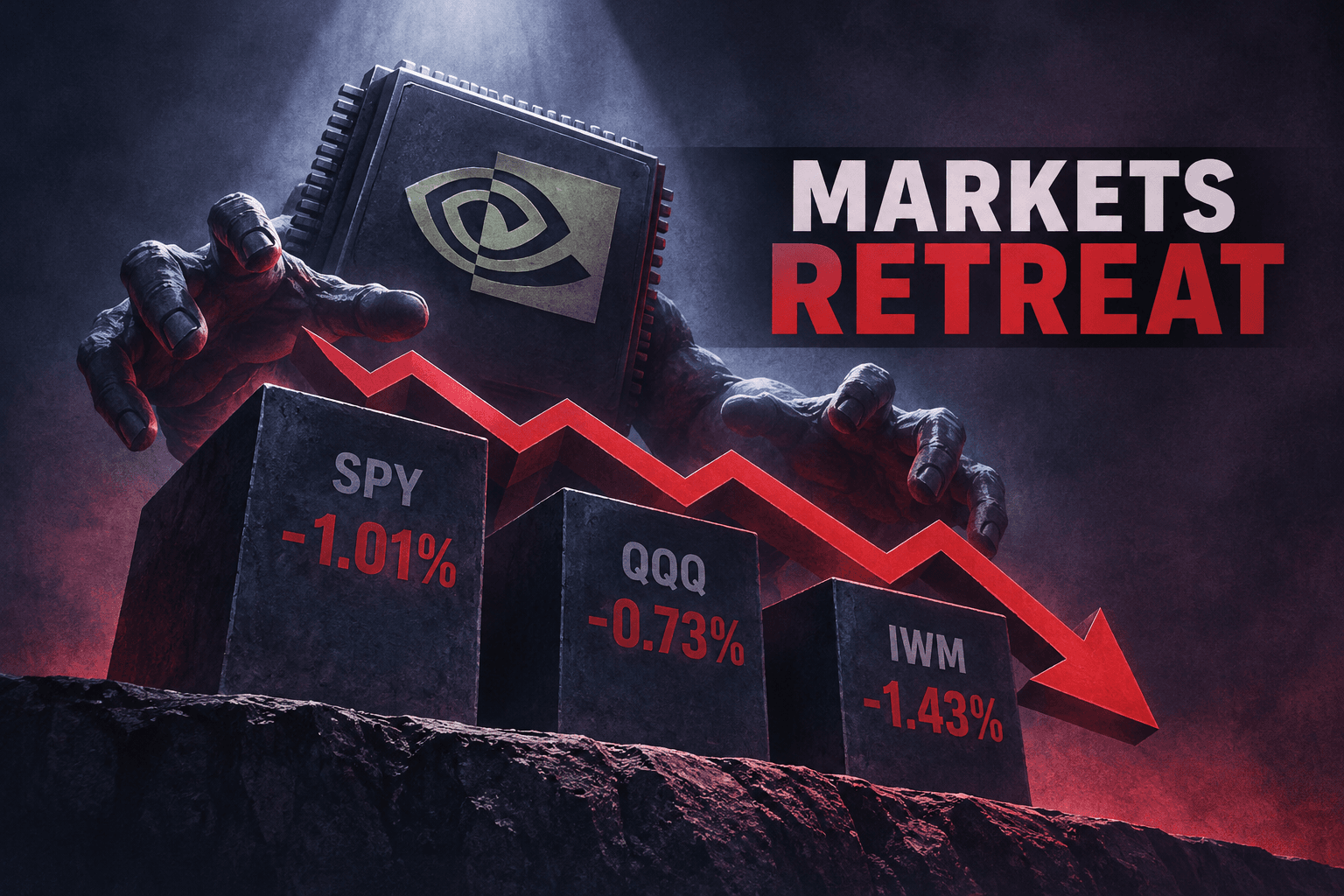
- •SPY fell 1.01%, QQQ declined 0.73%, and IWM dropped 1.43% on November 17.
- •Small caps were the relative laggard, while QQQ held up better than SPY and IWM.
- •Nvidia’s results and market expectations were the key upcoming catalyst; options positioning is not a reliable directional forecast.
- •Disney was reported to have beaten expectations and reaffirmed its EPS outlook; KLA shares pulled back and Deutsche Bank shares sank, with no percentage moves supplied.
- •No economic releases or Fed developments were provided, limiting conclusions about macroeconomic drivers.
A broad pullback sets the tone
U.S. stocks moved lower on November 17 as caution outweighed the prospect of a closely watched corporate catalyst. The S&P 500 ETF (SPY) fell 1.01%, while the Nasdaq-100 ETF (QQQ) declined 0.73%. Small caps underperformed: the Russell 2000 ETF (IWM) dropped 1.43%. The day’s pattern was therefore a broad risk-off session, with the heaviest relative pressure in smaller companies rather than a technology-led rout.
That distinction matters heading into Nvidia’s results. QQQ’s smaller decline compared with SPY and IWM suggests that technology shares, in aggregate, held up somewhat better than the wider market, though the available data does not include sector index returns or a complete list of individual stock moves. Nvidia remained the central event risk: market coverage focused on expectations for the company’s results and options positioning around a $170 call level. Those references describe market attention, not a forecast of the stock’s direction.
The session’s decline also came after reports that stock futures were rising as traders awaited Nvidia’s results. That setup underscores how quickly sentiment can shift around a high-profile earnings event. Futures indicate positioning before the cash session, not a guarantee of the eventual close; on Tuesday, the major ETF benchmarks finished lower.
Small caps lag while sector signals diverge
IWM’s 1.43% decline was the weakest of the three index ETF moves, a sign that the day’s pressure was not confined to large-cap growth names. Small-cap companies can be especially sensitive to changes in financing conditions, confidence in domestic demand, and expectations for future earnings. The supplied market information does not identify which of those forces drove the underperformance, so the move should be read as a market result rather than attributed to a specific cause.
Sector headlines offered a mixed picture rather than a single, clear rotation. In utilities, coverage weighed potential gains from energy storage against demand risks. Materials and mining headlines pointed to projects advancing, while industrial and manufacturing coverage highlighted automation alongside risk. Those themes suggest ongoing investment opportunities and operating challenges, but the source data does not provide sector-level returns with which to determine whether investors rotated into or out of those groups on the day.
Energy coverage similarly balanced risks around oil with growth in solar. Consumer and retail headlines paired growth with risks, while real estate reporting noted builder concerns alongside continued deal activity. Communications and media coverage flagged risks at Cable One. Taken together, these stories describe an economy and corporate landscape with uneven demand and business-specific pressures; they do not establish that any one sector led the market’s decline.
The policy backdrop for cannabis was also characterized as mixed. That uncertainty may affect expectations for companies exposed to the sector, but no specific policy change or related stock performance was supplied. In finance, coverage linked Bitcoin and a bank outage, while a separate headline noted that Bitcoin had slipped. Deutsche Bank shares were reported to have sunk, although the size of the decline and its precise catalyst were not provided.
Earnings and company-specific stories
Nvidia’s pending results were the most prominent near-term catalyst in the event list. The headline referenced a $115.8 billion beat alongside a “$170 call wall,” but the supplied information does not explain the figure’s context or specify whether it refers to a forecast, historical comparison, or another measure. It would be premature to treat the options level as a reliable price target. The broader point is that expectations and positioning around a major earnings release can amplify volatility, particularly when the market is looking for evidence about demand connected to artificial intelligence.
Walt Disney was reported to have beaten expectations and reaffirmed its earnings-per-share outlook. That combination provides a comparatively constructive company-specific signal: the reported result exceeded expectations, and management maintained its stated outlook. However, no figures or share-price reaction were included, so the item cannot be ranked among the day’s top gainers.
Other company headlines were more mixed. American Express was characterized as resilient, while KLA Corporation shares were reported to have pulled back. Quanta Services was discussed in relation to its AI-demand outlook, and Veeva Systems coverage noted a shift in sentiment. These descriptions point to distinct company narratives, but they do not provide enough evidence to compare their returns or identify a definitive winner among them.
Walmart was the subject of an earnings-move guide, rather than a reported earnings result in the supplied headlines. Pershing Square’s third-quarter holdings were also covered, but no portfolio changes or specific positions were included. Without further detail, neither item supports a conclusion about the day’s stock performance.
The available data lists no ranked top gainers or top losers. Accordingly, there is no defensible basis for naming three leading or lagging individual tickers. The reported pullback in KLA and decline in Deutsche Bank are notable headlines, but neither has an associated percentage move in the data provided.
Economic data and the Federal Reserve
No economic releases, inflation figures, labor-market data, Treasury-yield moves, or Federal Reserve communications were supplied for November 17. That limits the extent to which the market’s decline can be linked to a change in the macroeconomic outlook or to revised expectations for interest rates. It would be misleading to attribute the session to a particular data surprise or Fed signal without evidence.
The Fed remains relevant because interest-rate expectations influence borrowing costs, valuations, and the discount rates applied to future corporate earnings. Those channels can matter for both growth-oriented large caps and smaller companies, but the day’s ETF moves alone do not reveal whether rates or Fed expectations were the primary driver. For the next session, any newly released economic information or central-bank commentary could shape that interpretation alongside the Nvidia results.
What the market’s relative performance says
The three index ETFs all closed lower, establishing a negative tone across market capitalizations. QQQ’s relative resilience compared with SPY and IWM suggests that the decline was not simply a broad liquidation of technology exposure. At the same time, the information provided is insufficient to conclude that investors were definitively rotating into large-cap technology: that would require sector returns, breadth statistics, and more complete stock-level data.
IWM’s deeper loss is the clearest relative signal in the index comparison. It indicates that smaller companies faced greater selling pressure on the day. Whether that reflects concerns about economic sensitivity, financing costs, or company-specific positioning cannot be determined from the supplied figures. The distinction is useful for describing the market, but not enough to establish a lasting trend.
Outlook for November 18
The next session’s central focus is Nvidia’s results and the market’s response to them. Traders will be assessing not just headline earnings, but also commentary on demand, forward expectations, and whether results appear to support the elevated attention around AI-related spending. Options positioning may contribute to volatility around the event, but it does not determine the direction of the underlying shares or the broader market.
The reaction across SPY, QQQ, and IWM will help show whether the next move is concentrated in technology or reaches more broadly across the market. A steadier QQQ alongside weaker SPY and IWM would echo Tuesday’s relative pattern; a change in that relationship could indicate a different balance of market leadership. These are scenarios for interpreting price action, not predictions.
Beyond Nvidia, investors will have reason to monitor any newly available economic releases and Fed commentary, since none were specified in Tuesday’s data. Company developments at Disney, Walmart, and the other names in the headlines may also draw attention, but the information provided does not establish their timing or likely market impact for the next session.
Overall, the November 17 close was bearish across the three major ETF benchmarks, with small caps underperforming and technology-heavy QQQ declining less than SPY. The upcoming earnings catalyst creates scope for a sharp reassessment of expectations, but the direction and breadth of any response remain uncertain. This summary is for informational purposes only and does not constitute investment advice.
Sources
+ 10 more sources
Use these insights — enter this week's contest.
Free practice contests — earn Alpha CoinsExplore More Content
Disclaimer: StockAlpha.ai content is for informational and educational purposes only. It is not personalized investment advice. Sentiment ratings and market analysis reflect data-driven observations, not buy, sell, or hold recommendations. Always consult a qualified financial advisor before making investment decisions. Past performance does not guarantee future results.
Spotted something wrong? Report an error.